



 September 27, 2008


Taipei Biennale Revisits Globalization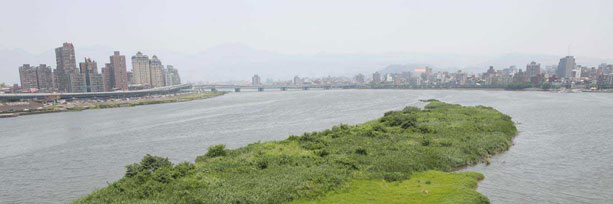
Courtesy Taipei Biennial
Lara Almarcegui, "An Empty Terrain in the Danshui River, Taipei" (2008)
By Susan Kendzulak
Published: September 26, 2008


Courtesy Taipei Biennial
Superflex’s “FREE BEER TAIWAN” (2008)
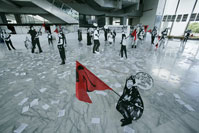
Photo by Susan Kendzulak
Internacional Errorista, “We are all Errorists” (2008)
The 2008 biennial sees several changes from previous editions. The start date was changed from November to September — the biennial opened September 13 and runs to January 4, 2009 — to allow it to coincide with the other Asian biennials that have banded together under the umbrella title Art Compass 2008. Also, for the first time, the biennial includes works installed off the museum’s premises, at the Taipei Art Park, the Taiwan Beer Brewery, on a digital screen at Taipei Arena, in a Mass Rapid Transit station, and in an abandoned lot. In addition, several independently organized events are taking place concurrently, including a conference co-presented with the Dictionary of War; the Urban Nomad Film Fest, which provides free screenings of independent films with a focus on social activism in the region; and “Taipei Drift: International Workshop for Art Academics 2008,” a student/faculty workshop organized by the Taipei National University of the Arts and featuring participants from around the world. What has not changed is the biennial’s theme. As in 2004 and 2006, the organizing principle is the catchall idea of “globalization.” According to the curator’s statement: “The 2008 Biennial deals with a constellation of related issues arising from neo-liberal capitalist globalization as seen in Taipei and internationally, such as urban transformation, the dire circumstances of foreign labor forces, divided nations and micro-nations, permanent conditions of war, ecological collapse, global unrest, as well as opportunities for change. These issues are addressed through do-it-yourself practices, humorous approaches, and idiosyncrasies.” Of the 47 artists and collectives in the show, 32 are from Europe (including Turkey), eight from Asia, two from the U.S., one from Australia, one from South America, and two from the Middle East; 10 are female. Needless to say, the viewpoint is predominately male and European. Upon entering the museum’s lobby, viewers are greeted with cutout figures and paper strewn on the floor from the Argentine art-activist group Internacional Errorista. There is a mural spray-painted by anonymous Taiwanese graffiti artist Bbrother, and the Taiwanese artist Wu Mali, known for her work that empowers local communities, has planted vegetables on the museum’s premises to highlight sustainability and green practices. But most of the works are videos, on view in dark screening areas with sofas. Scottish artist Roderick Buchanan’s two-screen projection pits the pro-Irish Parkhead Republican Flute Band against the loyalist Black Skull Corps of Fife and Drum. Wei Liu, the only Chinese artist in the show, is showing a video of himself going to Tiananmen Square on the anniversary of the 1989 massacre and asking people what day it is; no one wants to answer on camera. Videos from the Yes Men show them pranking CNN and other institutions. Mario Rizzi’s riveting documentary filmed in Taiwan tells the stories of two women — one Vietnamese and one Indonesian — who endured terrible arranged marriages to Taiwanese men. The work is a testament to one of the negative effects of globalization in Asia: Many young women from Southeast Asia join matchmaking services to marry Taiwanese men as a way of escaping poverty; some of the matches turn out well, but others result in exploitation, indentured servitude, or prostitution. The biennial curators also invited Vienna-based artist Oliver Ressler to curate an exhibition within an exhibition. His “A World Where Many Worlds Fit,” which appears on the museum’s second floor, contains works by 12 western artists and collectives documenting grassroots protests against the IMF and WTO in such cities as Genoa and Buenos Aires. Christopher DeLaurenti’s audio recordings compiled during the chaotic 1999 WTO protest in Seattle saturate the room, while videos, maps, light boxes, and agitprop banners, posters, and leaflets used by activists are exhibited as artworks. Dmitry Vilensky’s video Protest Match – Kirov Stadium (2006) shows the heavy-handed tactics used by Russian authorities to quell dissent at the G8 meeting at St. Petersburg in 2006, and Ressler and Zanny Begg provide a 40-foot-long timeline of the modern anti-globalization movement that began in 1999. Among the highlights outside the museum are Malaysian Wong Hoy Cheong’s digital images of Indonesian and Filipino women installed in the Mass Rapid Transit station and Danish group Superflex’s “Free Beer” project (the beer, available for purchase at various Taipei venues, is free in that its recipe comes from a Creative Commons license [a nonrestrictive copyright]). Spanish artist Lara Almarcegui made two interventions in the city: One involved having a concrete wall that surrounded an old-style Japanese house torn down; for the other, she secured an agreement with the city government that it not develop a small river island for 10 years. The work’s idealism is unfortunately undermined by naïveté and a lack of familiarity with the local culture. What she doesn’t know is that in Taiwan, if the government wants to reclaim land, it will, as residents of Taipei’s squatter/artist community Treasure Hill know only too well. |




 Save to Del.icio.us
 Digg this








