 |
| Photo By Stacy Recht Czar |
|
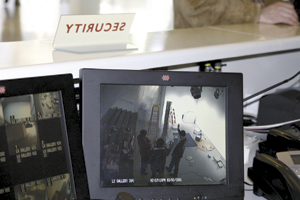
The anonymous members of Institute for Applied
Autonomy assemble their exhibit, which includes a
critique of hyper-surveillance in the U.S.
|
Artists, protesters and grassroots appropriators descend on the
Contemporary Arts Center Saturday, with scathing and humorous critiques
of corporate irresponsibility, a government bent on global domination
and a population unconcerned with constant surveillance. Using
mainstream communication channels and self-legitimizing technology,
these organizations turn activism into an art and exploitation of media
gullibility into a farce, inspiring dialogue on corporate culpability,
invasive security measures, public space used to curate art projects
and the role of art in activism. Thought provoking? Try
action-provoking. The joyously irreverent and insurgent works on view
at the CAC might make you want to throw something. Or overthrow something.
Six artist/activist groups present their DIY projects of civil disobedience for the CAC exhibit Incorporated: a recent (incomplete) history of infiltrations, actions and propositions utilizing contemporary art, curated by Matt Distel, mastermind of the CAC's coolest exhibits.
The Institute for Applied Autonomy uses their technical expertise for
good, employing vast intellectual and ideological impetus, technology,
resources and cunning techniques to distribute subversive messages. By
appropriating tools of government, military and industry to criticize
and parody those structures, IAA links technology, ingenuity and
activism in a running public-art-science project whose artifice is
delightfully obscured by its sophistication.
The members of IAA thrive on their anonymity. The obscurity of their
identities acts in opposition to a growing trend of numerical
identities, identity theft and constant monitoring by corporations and
governments.
"John Henry," one of the anonymously named members of the organization,
says, "(The government) uses fear against the people. By creating a
fear greater than an Orwellian future, you make the Orwellian future
seem to be a happy medium." IAA's spoofs on a security-obsessed nation
employ not only humor and irony, but also complicated mechanics,
engineering and, in their words, "contestational robotics."
The members of this secret society of civil insurgents described the
ideas behind GraffitiWriter, a fast, four-wheeled robot that prints a
dot-matrix paint message on any surface.
"We looked at ways robots were being used to perform tasks that were
dangerous to humans. Meanwhile, we saw a rise in law enforcement --
people would be in jail for decades for graffiti. It seemed that
graffiti became dangerous work, so we created a robotic graffiti writer
to rapidly print paint on a sidewalk," says one of the Henrys.
"It turns out the robot didn't have to be stealthy. People assumed a
high-tech piece of machinery had authorization. Technology carries a
legitimizing effect. We had expected it would be confiscated, not us," Henry says.
How did the John Henrys of the IAA and their contestational robotics come to occupy the gallery space of an art museum?
"We use the power of aesthetics. That's a way in. There's also a sense
of humor that makes the work accessible." They describe the difference
between their collective and other art collectives as "a common belief
rather than a common need for a kiln."
IAA is also famous for the distribution of various protest
technologies, including TXTmob, which linked protesters through
broadcast cell-phone text messages at the campaign conventions over the
summer and last month's inauguration. They also developed a service
called iSee, which offers a Web-based map of security cameras in
Manhattan, allowing you to link your location and destination. An
algorithm then maps the "path of least surveillance," a route designed
to avoid as many security cameras as possible.
Corporate imposters The Yes Men gained notoriety by posing as
corporate spokespersons, such as for the World Trade Organization, and
unapologetically describing the WTO's exploitation of poorer nations.
Posing as a spokesman for Dow Chemical, Yes Man Andy Bichlbaum accepted
full responsibility for the Bhopal chemical leak on behalf of Dow on
the BBC, promising to compensate victims and clean up the disaster. Dow
was not amused -- nor did the company accept responsibility. The Yes
Men are also behind various other activist hoaxes, including Web site
spoofs of President George W. Bush. A documentary and book have been
made about their efforts.
Concerned with the encroachment of advertisement on our
psyches, Temporary Services creates ephemeral art in public spaces. The
use of public spaces for art -- instead of for strategically placed
products and advertisements -- fuels their imaginations and their
activities. Using items such as adhesive hooks or sandwich cookies to
augment or obscure advertisements in public spaces is their way of
beautifying their world, silencing the visual noise of commerce and
offering art to people who likely would not have sought it out on their
own.
Cleveland-based newsense enterprises, founded by a husband-wife artist
duo, Kristin Bly-Rogers and Lyz Bly, presents art aimed at public
commentary. By making art out of public structures and public
structures out of art, newsense uses materials of construction to
infiltrate public spaces with art, forcing a dialogue of acceptable use
of public spaces.
The State of Sabotage is its own nation, borderless, without
any real rules or laws, utopian and anti-hegemonic. SoS places its
temporary embassy in the CAC during the exhibit, and they will be
issuing passports to visitors.
The Atlas Group documents the stories behind 15 years of car-bombings in Lebanon in a multimedia exhibition.
Incorporated opens Saturday and continues through May 8 in the
Contemporary Arts Center's second floor Delta Air Lines Gallery and
U.S. Bank Gallery. And, no, the irony of an anti-corporate exhibit
housed in corporate-named galleries is not lost on us.
INCORPORATED, presented by the Contemporary
Arts Center, has an opening reception for CAC members on Friday, 6-9
p.m. A panel discussion about the show is set for Saturday at 4 p.m.





