|
JEAN-FRANÇOIS LYOTARD famously described
postmodernism as "incredulity toward metanarratives." But lately I have
thought a more apt characterization would be "incredulity toward
MetaFilter," using the popular blog (metafilter.com) as a metaphor for
all Internet information, which arrives in such volume and with so many
hallmarks of legitimacy as to strain the usual measures of veracity.
For example, I was recently alerted by MetaFilter to the existence of a
gated community near São Paulo called AlphaVille. This seemed an
elaborate joke—a cluster of guarded villas named for Jean-Luc Godard's
techno-pulp metropolis, where free expression, art, and even love had
been outlawed? AlphaVille's website depicted a self-contained
heterotopia-in-the-sun straight from J.G. Ballard's novel Super-Cannes
(2001), but I was still skeptical. Websites can be faked (think of
those e-mails with credible subject lines like "re: your last message,"
or entreaties from eBay dressed in rigorously counterfeited graphic
identities). It took several more minutes of research before I could
finally ascertain that, yes, AlphaVille was for real and, indeed, was
an increasingly popular settlement amid the urban violence of Brazil. It
was no doubt a similar dilemma that confronted a BBC producer last year
when he visited the website dowethics.com, hoping to solicit a comment
from the Dow Chemical Company (the corporation that bought Union
Carbide) on the twentieth anniversary of the disastrous gas leak in
Bhopal, India. The website looks genuine, replete with Dow logo and
slogans. A more careful look, however, reveals unexpectedly
counterintuitive public-relations gestures such as: "Dow is responsible
for the birth of the modern environmental movement. Rachel Carson's
1962 book Silent Spring, about the side-effects of a Dow
product, DDT, led to a groundswell of concern and the birth of many of
today's environmental action groups." 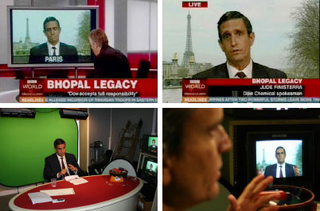 | | Andy Bichlbaum being interviewed on BBC World as "Jude Finisterra, DOW Chemical spokesman," 2004. |
As
any journalist under deadline knows, finding a last-minute quote is
like a mad scramble for the fire exits—any one will do. Navigating
corporate websites is particularly daunting, as one sifts through
endless menus looking for that official oracle that will lead to an
appointed spokesperson. So it was undoubtedly with a measure of relief
that this BBC producer came across contact information for the
company's representative "Jude Finisterra." Soon this individual—whose
Martin Amis–esque name melded the patron saint of impossible causes
with the end of the earth—was speaking from a Paris television studio,
providing a BBC anchor with what seemed to be the journalistic scoop of
the decade: "For the first time, Dow is accepting full responsibility
for the Bhopal catastrophe." Dow, it appeared, was ready to pony up $12
billion for environmental remediation and pain and suffering, above and
beyond the original settlement of $470 million, which many had thought
shockingly low. Within twenty-three minutes of this announcement, Dow's
share prices had tumbled more than four percent, a loss of more than $2
billion. Before long, Finisterra was
discovered to be not an official Dow spokesman but Andy Bichlbaum,
cofounder of the Yes Men, a loose affiliation of media pranksters
created in 1999 that specializes in what it calls "identity
correction"—a play on the idea of "identity theft"—in which members
appropriate the identities of corporations or government bodies in
order to speak truths that, ostensibly, those entities dare not. The
Yes Men first garnered attention when, having mirrored the World Trade
Organization's website with their own, gatt.org, the collective fielded
a number of invitations to appear at international trade conferences.
Armed with thrift-store suits and PowerPoint presentations, Bichlbaum
and fellow cofounder Michael Bonanno posed as representatives of the
WTO under names like Hank Hardy Unruh or Granwyth Hulatberi, making
outlandish calls (to generally nonplussed audiences) for abolishing the
southern European siesta in the name of productivity and cultural
uniformity, or advancing arguments that the US Civil War was
unnecessary because the corrective forces of the market would have
achieved the same results. (The North's intervention only "deprived
slavery of its natural development into remote labor.") The height of
capriciousness came in 2002 in a lecture at SUNY-Plattsburgh, in which
a Mr. Kinnithrung Sprat, né Andy Bichlbaum, joined by a fictitious
representative from McDonald's, postulated a "reBurger"—a hamburger
patty formed from filtered human waste generated from previously eaten
burgers—that could be sold at reduced cost to the Third World. "Who is
to say whether people in the Third World even want a burger?" retorted one exasperated student. The
Yes Men, whose efforts are chronicled in a recent documentary of the
same name, is only the most recent effort of Bichlbaum and Bonanno, who
have previously, under various guises, performed a variety of rather
notorious media pranks. I first met Bonanno years ago, when he was
living under a different name, appropriately enough, in Piru,
California, a small town kept alive by its commercial use as a
historically hyperreal Hollywood film set (complete with
authentic-looking signage and the like). By that time, he was already
renowned for his exploits with the Barbie Liberation Organization,
which switched voice boxes on G.I. Joe and Barbie toys, causing a rash
of gender panic in Toys"R"Us stores throughout the nation. Bichlbaum,
meanwhile, had hacked a videogame he was working on, SimCopter, to
include swimsuit-clad male characters who kissed each other. As
interesting as these efforts were, they were ultimately absurdist
enterprises that confounded the expectations around a single product:
Barbie speaking like G.I. Joe. The move into producing simulacra
confounded in another way: The clones of websites were not what one
expected, but due less to their absurdity than because they said things
that were "too real"—too real for a world of public-relations
palliatives and careful management of messages and impressions. The
Internet also allowed for a whole new order of deception, a massive
expansion in the political economy of pranking. You couldn't
impersonate a company like Dow, with its thousands of employees and
glassy corporate towers; but with a little gumption and some HTML
expertise, you could create a believable website. Type in the wrong
domain name—using "org" instead of "com," or GWBush.com instead of
georgewbush.com—and you enter a parallel universe. The
hoax as a cultural product has an ancient lineage—from medieval
manuscript forgeries to pretenders to the throne—but as the world has
become more connected, the hoaxes spread farther and faster than ever
before. We have all become not only the potential audience for hoaxes
but also the potential generators of hoaxes, the carriers of rogue
memes. It is a bit of a paradox: In a mass society, the individual has
grown in importance. In the John Cheever story "The Enormous Radio," a
couple in Manhattan find they are able, through the eponymous device,
to hear the conversations in other apartments. The World Wide Web is
like an Enormous Radio, and each day we can hear everything that we
choose to in all the other rooms of the world. Our belief can be
transmitted, mirrored, and eventually through sheer mass and repetition
begin to assume the contours of credibility. Not only was the initial
faux Dow "apology" the top story on Google's news server, but so was
the real Dow's official denial—and so, too, was the Yes Men's faux Dow
"retraction": "Dow's sole and unique responsibility is to its
shareholders, and Dow CANNOT do anything that goes against its bottom
line unless forced to by law." The media cycle echoes the Yes Men's
phony reBurger menu, where the designations One, Two, Three, etc.,
refer to the number of times each item has been successively digested,
eliminated, and reconstituted; there is now an overwhelming appetite
for news, thousands of narrowcasters in search of the same memes. To
paraphrase a coffee mug, same shit, different blog. Most successful hoaxes work by the fidelity with which they cleave to the original source. The early 1967 document Report from Iron Mountain on the Possibility and Desirability of Peace,
the alleged product of an ultrasecret think tank, worked so well that
it was not fully debunked until its own authors exposed it (an act that
some maintained was itself part of the subterfuge). Iron Mountain
worked because it was only as satirically outrageous as were those
reports from which it drew inspiration, madcap theses from Herman Kahn
et al. that postulated "winnable nuclear war" and the transfer of
social institutions underground. When "Andreas Bichlbauer" of the Yes
Men went to a trade conference in Salzburg, Austria, and called for
such absurdities as the abolition of all regional differences, he was
speaking in a venue where corruptions of thought and language were not
necessarily out of place, as in this Rumsfeldian nugget from a
corporate mediator: "If you create what I call an indifference curve
about language—if you can find more than one way to acceptably say the
same thing—then if you cannot reach agreement on one set of words, one
phrase, you can reach agreement on another, and effectively say the
same thing and it will mean what the parties needed to mean." The
point is: Concepts like "truth" and "reality" no longer matter much in
any objective sense. Truth and reality can, to paraphrase the prior
quote, mean what the parties need them to mean. The Yes Men are the
perfect realist artists of our time; they interpret the world as they
see it, but they do it through the accepted aesthetic conventions of
the day: websites, PowerPoints, authoritative-sounding language, etc.
When "Hulatberi" debated an antiglobalization activist on CNBC, the
preposterous nature of his rhetoric was rather lost among all the
signifiers of factual information that surrounded him: the scrolling
stock indexs, the CNBC logo, his suit and tie and placement in a Paris
TV studio. But a hoax, no matter how artfully presented, would fail
without an audience that wanted to believe. Bichlbaum recalls
that his own nervousness in appearing as a bogus WTO official was
ameliorated by the audience's faith in his authority; as he puts it,
"they suspend your disbelief." This echoes the early-twentieth-century
hijinks of Paul Jordan Smith and his Disumbrationist School of Art, an
outlandish parody of Cubism and other au courant movements. Expecting
howls of derision, Smith found his works enthusiastically received.
Presented with a tinge of the accepted conventions—a gallery, the
social pressure to keep up with the latest trends—the audience absolved
the work of its illegitimacy. As George Orwell said, there are some
ideas so preposterous that only intellectuals (and perhaps the art
world) will believe them. Label something art, it becomes art; label
something truth, it becomes truth. But did no
one among those audiences who sat politely through the Yes Men's WTO
presentations, even taking notes, get the joke? In an e-mail, the Yes
Men offered an explanation: "We are certain that some people found it
absurd—they must have. But the fact that the social conventions kept
them from speaking out against it is frightening. We learn here that we
can all implicitly support extremely violent and patently absurd ideas,
and in an auditorium of experts we may find no one who will publicly
dissent. All this has been proven time and time again: in history, as
violent regimes are supported by public majorities; and in the
laboratory, by experiments like Milgram's" (a reference to Yale
psychologist Stanley Milgram's experiment in which subjects were
persuaded by a scientific authority to administer what they thought
were painful electric shocks to actors playing test subjects). It
is still an open question, though, as to why, how, and for whom the Yes
Men's stunts can be regarded as successful: Do they expose that
organizations like the WTO really are as venal as the artists would
have them, or do they simply reveal a naïveté on the part of the
antiglobalization movement—i.e., that in thinking that people really
fall for this stuff they are essentially doing the same thing (in other
words, they're so far in on the joke, the joke's on them)? Were the
SUNY students who challenged the Yes Men's comments brave for speaking
out or stupid for rising to the bait? Perhaps both. It is ironic that
the Beeb fell for it, though: This is the network that in 1957 ran a
satirical account of the "spaghetti harvest" in southern Switzerland,
after which thousands called to inquire about getting their own
"spaghetti tree." But the sadder irony is that the BBC was one of the
few news outlets even interested in covering the twentieth anniversary
of Bhopal. In this sense, the Yes Men won. They could have sent earnest
press releases about Bhopal to respected news organizations, but would
Fox and CBS have listened? Instead, they redefined the terms of
engagement and issued a preemptive strike against the managed flow of
news. They made Dow respond to a question it did not want asked, and
the whole world was watching for its answer. New York–based writer Tom Vanderbilt is the author, most recently, of Survival City: Adventures Among the Ruins of Atomic America (Princeton Architectural Press, 2002). |