Bhopal:
It was probably the label that deterred shoppers in London from
grabbing a free bottle of water being distributed one summer afternoon
this year. B’eau Pal’s water was deceptively clear even though it came
from a slum colony hand pump in Atal Ayub Nagar, Bhopal. Its bold red
label told the real story, the fine print that shocked people: “The
unique qualities of our water come from 25 years of slow-leaching
toxins at the site of the world’s largest industrial accident.”
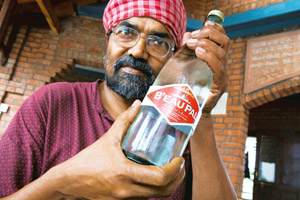
Toxic contents: Sarangi of Sambhavna Trust with a bottle of B’eau Pal. Madhu Kapparath / Mint
Londoners
naturally said no to the product, which listed contaminants such as
dichloromethane, carbon tetrachloride and chloroform as its
“nutritional” contents. But the project marked a step forward in
seeking global attention to a long-drawn agitation in India, which
completes its 25th year next month.
The struggle for justice for the
victims of the Bhopal gas tragedy, which happened at the city’s Union
Carbide factory, is now no longer limited to sit-in protests, black
flags or burning effigies on the streets of New Delhi or Bhopal. It’s
now moving out of Indian shores.
B’eau Pal is the wacky product
of two anti-globalization activists’ imagination. Performance artists
from the UK—Mike Bonanno and Andy Bichlbaum, popularly known as The Yes
Men—launched B’eau Pal to highlight what they said was the continued
refusal of Dow Chemical Co., which bought Union Carbide Corp. in 2001,
to take responsibility for the disaster. At least 25,000 people died as
a result of the leak on the night of 3 December 1984.
Also Read our previous stories in this series
Dow
has always maintained that it has nothing to do with the accident and
that the defunct Union Carbide factory in Bhopal is now the property of
the Indian government.
The company said in an emailed
statement: “Although Dow never owned nor operated the plant, we—along
with the rest of industry—have learned from this tragic event, and we
have tried to do all we can to assure that similar incidents never
happen again.”
The statement also pointed out that “the former
Bhopal plant was owned and operated by Union Carbide India Ltd, an
Indian company with shared ownership by Union Carbide Corp., the Indian
government and private investors. Union Carbide sold its shares in UCIL
in 1994, and UCIL was renamed Eveready Industries India Ltd, which
remains a significant Indian company today.”
Responses such as those haven’t satisfied activists such as Bonanno and Bichlbaum.
Their satire has extended to a movie, The Yes Men Fix the World (TYMFTW), and will soon extend to a comic strip. Released in the US last month, TYMFTW also
had a select screening in Bhopal. The film premiered in the UK on 11
August, soon after the B’eau Pal launch in London, and won an award at
the Berlin Film Festival.