|
You Don't Know What You Think You Know: An Interview with Museum of Hoaxes Curator Alex Boese
[28 June 2006]
"The scams that advertisers, politicians, and the media get away
with frustrate me enormously, and I often wonder why people allow
themselves to be manipulated so easily." Glenn McDonald talks to author
and Hoax Expert, Alex Boese.
|
by Glenn McDonald
The
Museum of Hoaxes was established in 1997, as a place to catalog and
document the phenomenon of hoaxes -- "a variety of humbugs and
hoodwinks -- from ancient deceptions all the way up to modern schemes,
dupes, and dodges that circulate on the Internet." The tricky part is
that the Museum of Hoaxes doesn't actually exist. Well,
it does, but only virtually. Alex Boese has been operating the Museum
as a running website-slash-blog for nearly a decade at www.museumofhoaxes.com.
Boese (pronounced BURR-za) runs the show from a fat broadband
connection in his California home, although there's been enough
confusion about the issue that he regularly gets emails requesting
tickets and driving directions. There are 50 or so different
categories, or "wings" in the Museum of Hoaxes, including "Con
Artists," "Conspiracy Theories," "Mass Delusion," "Military," "Pranks,"
"Religion," and, of course, "Gnomes." Boese updates the site frequently
-- often several times a day -- and corresponds with a huge following
of readers who submit items for display. The Museum averages about a
million page views a month. Boese's
efforts have won him a reputation as a leading "hoaxpert," and he often
advises media types when the inevitable April Fools Day feature stories
rotate onto editorial calendars. Spend some time scrolling through the
digital halls if the MoH, and you'll find evidence of a man obsessed.
The Museum is a remarkably comprehensive chronicle of misinformation,
tirelessly cataloged and researched. What began as research for a
doctoral dissertation in the history of science, has turned into a
full-time occupation for Boese. He's written two books on the subject
-- The Museum of Hoaxes:
A History of Outrageous Pranks and Deceptions and his latest work, Hippo Eats Dwarf: A Field Guide to Hoaxes and Other B.S.
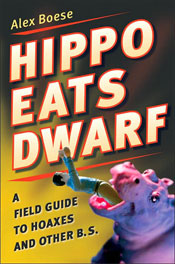 Hippo Eats Dwarf: A Field Guide to Hoaxes and Other B.S. Hippo Eats Dwarf: A Field Guide to Hoaxes and Other B.S.
by Alex Boese
Harvest Books
April 2006, 288 pages, $14.00
[ Amazon ]
|
Hippo Eats Dwarf
keeps the focus on modern-day hoaxes and pranks, and it's a fascinating
read. Boese doesn't just compile wacky stories, he digs in with the
tenacity of a scholar. While much of the material is just weird and
funny, some of the stuff here is, frankly, terrifying. Not so much the
baby-in-a-bottle kind of items (though there's plenty of that, too) but
rather the relentless, seemingly institutional dishonesty in our
society -- governments, corporations, and media. Boese frames the
material with a tone somewhere between healthy skepticism and weary
cynicism. Your
books and ongoing blog reveal a pretty deep fascination with hoaxes.
Where did that come from? What is it about the concept of hoaxes that
you find interesting?
I'm sure there's something in my psychological make-up that causes
hoaxes to appeal to me. I've always been a skeptic, distrustful of
authority, and unwilling to take things at face value. Plus, hoaxes
appeal to my sense of humor. But what I find really interesting is the
question of why we believe what we believe. When we read something in a
newspaper or in a textbook, why do we accept it as true? Basically
we're taking it on trust. Realizing that -- how little of our beliefs
depend on first-hand experience and how much depends on trust -- can
make one a bit paranoid about what really is true. What if that trust
is misplaced? I guess I've allowed my sense of paranoia to develop into
a full-blown obsession with how belief is manipulated and distorted.
Where did the term "hoax" come from?
The word hoax dates back to the 18th century. The most popular
theory is that it was a contraction of 'hocus' from 'hocus pocus,'
which itself was a satirical play on 'hoc est corpus,' the phrase used
by priests when they performed the act of transubstantiation.
Protestant jesters making fun of priests were the first to use the
phrase 'hocus pocus,' and from there the phrase developed into 'hoax.' Your
background is in the history of science. Mass media technology and
especially the Internet have fundamentally changed how information
moves around. From a historical perspective, how have these
technologies affected hoaxing?
The history of hoaxing is the dark underbelly of the history of
communications. As communications evolve, so do opportunities for
hoaxing. What I find interesting is that the advent of new forms of
communication, such as the telegraph, TV, and the Internet, have all
been accompanied by utopian expectations that by facilitating better
communication these technologies would usher in a golden age of peace
and harmony; the idea being that if people can communicate better,
they'll learn to understand and accept each other. But the irony is
that making it easier for information to spread simultaneously makes it
easier for misinformation to spread as well. This is very evident on
the Internet, which has become the greatest breeding ground for hoaxes
ever seen in the history of Mankind. Whereas in the past only a select
few had access to the tools of the mass media, and thus were in a
position to create hoaxes that could reach huge audiences, nowadays,
thanks to the Internet, everyone has access to those tools. In this
sense, the Internet has democratized the phenomenon of hoaxing.
Although thankfully the Internet has also made it easier to debunk
hoaxes, as well as to create them.
What are some of the most notorious Internet hoaxes you've documented?
Easily the most notorious internet hoax I've documented has been Bonsai Kitten,
which is a site that purports to show how to grow mutant kittens by
raising them inside of glass jars so that their bones mold to the shape
of the jar. To this day it continues to generate controversy, years
after being debunked. Another classic is Objective: Christian Ministries
which purports to be the homepage of some fanatically fundamentalist
Christians who rant about how Apple computer is a front for
"evolutionism" and want to stamp the word "GOD" in big letters on the
American flag. It's very hard to tell whether or not the site is a
joke.
Finally, there's the Blair Witch Project,
which documents the history of Maryland's Blair Witch in very
convincing fashion. So convincing that it persuaded millions of people
to believe that the Blair Witch was real and helped to propel the movie
it was promoting into becoming a blockbuster hit. Do have a personal favorite hoax, or type of hoax?
I'm always fond of satire mistaken as news, which is when reporters
are fooled into believing that some ridiculous story is true and print
it up as fact. There's just something gratifying about the media being
made to look stupid. Perhaps because the media often takes itself so
seriously.
Classics
in this genre include the time that newspapers reported that Indiana
congressman John Hostettler was introducing legislation to change the
name of Interstate 69 to the more "moral sounding" Interstate 63. Their
source was a hoax story penned by Josh Whicker of Hoosier Gazaette.
And
one of the all-time classics was Alan Abel's Society For Indecency to
Naked Animals. Back in the early 1960s, Abel fooled the media for years
into believing that there was an organization of this name seriously
devoted to promoting the cause of putting clothes on all the naked
animals in the world. Its slogan was: "A nude horse is a rude horse."
Its members would even issue "SINA citations" to people caught walking
naked dogs.
There's
this relatively new term, "culture-jamming," that suggests deliberately
using media in a subversive way against itself. Would you classify
culture-jamming as distinct from hoaxing in general? What are some
examples of culture-jamming?
'Hoax' is a very broad term that includes a lot of different
activities (pranks, frauds, tall tales), so I wouldn't say that
culture-jamming is distinct from hoaxing in general, but rather that
it's a distinct type of hoaxing: hoaxing with a social conscience.
The
group of activists known as the Yes Men are probably the most
well-known culture jammers. They scored their biggest coup in 2004 when
they fooled the BBC into announcing that Dow Chemical was going to pay
$12 billion to the victims of the 1984 chemical disaster in Bhopal,
thereby causing Dow's stock value to temporarily drop and also
highlighting that, in reality, Dow wasn't doing much for the victims of
that tragedy.
Can hoaxing be considered a form of art?
There are certainly hoaxers who consider themselves artists. For
instance, the hoaxer Joey Skaggs argues that his hoaxes are a form of
performance art, and that the media itself serves as his canvas. Hoaxes
are the paintbrush he uses to manipulate them. Some of his hoaxes
include his "Cathouse for Dogs" in which he posed as a "dog pimp"
running a bordello for dogs. And then there was the time he posed as
Dr. Josef Gregor and announced he had invented Cockroach Pills that
were a cure for just about everything including acne, allergies,
menstrual cramps, and radiation sickness. The media, of course,
completely fell for it.
Then
there are more literary hoaxers who weave elaborate fictions, and
present these fictions to readers as fact. Not many people realize that
quite a few of Edgar Allan Poe's stories were originally printed as
fact, not fiction. Poe loved to manipulate audiences in this way. And
on the web you can find sites such as Boilerplate which is the very convincing (fake) history of a Victorian-era robot. I definitely consider Boilerplate to be a work of art.
You've written that it's useful to separate hoaxes into two categories,
"overt" and "covert." What are the distinctions there?
Overt hoaxes are meant to be exposed. The moment of exposure is the
punch line, when the hoaxer lifts the curtain on his farce and reveals
that all the people who fell for it are gullible fools. These hoaxes
are a form of prank or practical joke. Covert hoaxes, by contrast, are
not intended by the hoaxers themselves to ever be exposed. The hoaxers
are simply trying to get away with something. They're pulling a con.
It's interesting that overt hoaxes reverse the relationship between
liar and victim. Usually we blame liars for telling lies. But in the
case of overt hoaxes we actually blame the victim for believing the
lie, and we celebrate the hoaxer for his cleverness.
There's
a kind of epistemological issue running through your work, which can be
very interesting and slightly creepy: How do we really know what we
think
we know?
Welcome to my world, in which a vague sense of doubt surrounds
everything. Basically I don't think we can be sure that we really know
what we think we know. We have to decide what evidence we're willing to
accept, and proceed from there. As the saying goes, "In a trickster
universe, doubt is the only certainty." That may sound like a paranoid
view of the world, and maybe it is, but I think this kind of self-doubt
-- realizing there's a limit to what we can know -- is a good thing. I
don't trust people who are sure that they're absolutely right and won't
consider any other point of view.
Your
book can also be a little paranoia-inducing in that it reveals just how
much misinformation is floating around, and how many people are
essentially lying for a living, in advertising and politics. Do you
ever despair about it all?
The scams that advertisers, politicians, and the media get away
with frustrate me enormously, and I often wonder why people allow
themselves to be manipulated so easily. I suppose it's because the
scammers successfully prey on people's hopes and fantasies, so that
people willingly go along with the lies.
I
have a 90-year-old great uncle -- a lifelong skeptic who likes to point
out that during World War II he was literally an atheist in a foxhole
-- who firmly believes that the proliferation of lies is due to the
public being incurably stupid. He often claims that several national
polls have shown 50 per cent of American adults to be marginally
literate. I haven't yet reached my great-uncle's level of cynicism, but
a few more elections like the past two may get me there.
For those looking to delve deeper, do you have any favorite books or other resources on hoaxing?
Some of the books that should be in the library of anyone interested in hoaxes are Hoaxes by Curtis MacDougall, Fads and Fallacies in the Name of Science by Martin Gardner, and The Encyclopedia of Hoaxes by Gordon Stein. Unfortunately all these books pre-date the internet, but I still find myself referring to them all the time.
But
I actually find the greatest resource to be the visitors to my site.
Their knowledge never ceases to amaze me. No matter what the question,
one of them will have the answer.
| 





 MORE BOOKS