
Living Library
I absolutely loved your story on the Liv....
—Ineke Hartman
Denise Leembruggen
Denise is a mum of two kids (now 18 & 21....
—Scott Kenney
http://www.abc.net.au/ tv/enoughrope/ podcast.xml
http://www.abc.net.au/ tv/enoughrope/ enoughrope.rss
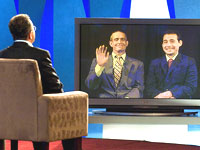
Andrew Denton & The Yes Men - Andy Bichlbaum & Mike Bonanno
Photo by Gary Johnston
The theory goes that ordinary people are powerless, that we can't really have a say in the globalisation process. For years now The Yes Men, a pair of anti-corporate pranksters, have travelled the globe, passing themselves off as spokesmen for major corporations, exploits which have been captured in an upcoming documentary. Putting the act into activism, please welcome, from Paris, The Yes Men, Andy Bichlbaum and Mike Bonanno.
ANDREW DENTON: Welcome,
men. Mike, if I could start with you. In 1993 you put your name on the
map with the Barbie Liberation Organisation. What was that?
MIKE BONANNO: Well,
that was an event where we switched the voice boxes between talking
Barbie dolls and talking GI Joes and put them back on store shelves all
around the United States, resulting in GI Joe's that said things like,
"I love to shop with you," and Barbie's that said, "Let's shoot 'em
up," and, "Dead men tell no lies." So on Christmas Day people brought
these toys home, the kids opened them up and they got a little
something extra, a little extra surprise from what we call the Barbie
Liberation Organisation.
ANDREW DENTON: That is so sweet. Andy, you, in 1996, first made your mark with Simcopter. What did you do?
ANDY BICHLBAUM: Well
I was working in a games company, a computer games company, and I was a
bit fed up with my job, basically, and just as kind of a lark I decided
to make the game more interesting without my bosses knowing. So I put -
you know, I thought what would be interesting would be to see hundreds
or thousands of boys in swim trunks kissing each other in the middle of
the game randomly. Other people thought that was interesting, too, and
they fired me. Then it became this big media story because I told a
reporter and he thought that was interesting, and then everybody
suddenly thought that it was very interesting. So I found, like, a lot
of people shared my sense of what was interesting and that's kind of
how I started thinking of this sort of activism.
ANDREW DENTON: Mike, you guys joined forces and in 1999 you managed to do something that upset George W. Bush. What was that?
MIKE BONANNO: We
had put up a website at a domain called gwbush.com, which was a similar
one to georgewbush.com, his official website. On gwbush.com website we
tried to be a little more honest than he was being himself. So, for
example, we announced a program on his behalf, called Amnesty 2000, in
which he was going to release all of the prisoners in Texas who were
being held on drugs charges. Because he, of course, had admitted to
using drugs as a youth. He said that since that time he had grown up
and so we figured, "Well all these other people have spent all this
time in prison, growing up, so they're entitled to their release." He
wasn't very fond of the website and he announced in a press conference
that there ought to be limits to freedom and he thought we were garbage
men and he urged us to remove the site, which we didn't.
ANDREW DENTON: So,
Andy, after the George Bush website, you decided to set up another
website, www.gatt.org, to tell people, in plain language, what the
World Trade Organisation stood for. But the trick was, you made it look
exactly like the WTO's actual website so people couldn't tell the
difference. What sort of things did you say? How did the WTO react?
ANDY BICHLBAUM: Well
we made it look similar to the real website, but if you read one single
line of the text you'd be really shocked by what was on there. There
was stuff about, you know, how the Holocaust was bad, but today we have
a new Holocaust and it's called distrust of big business, and, you
know, really tasteless things like that and worse. We intended it to
make fun of the WTO, just like a satire, kind of like with gwbush,
where we were making fun of Bush. We set up gatt.org to make fun of the
WTO. But we were shocked because immediately we started getting a
steady stream of email from people wanting to know all kinds of obscure
trade matters, so we had to suddenly become experts on obscure trade
matters and answer these questions as best we could.
ANDREW DENTON: There
was another reaction, too, which is that you started getting requests
to speak at conferences, to appear as representatives of the World
Trade Organisation. Eventually you accepted one, one at International
Trade Law in Salzburg. You set yourselves up as experts, what kind of
expertise did you have?
ANDY BICHLBAUM: We
felt like we understood the basics of free trade philosophy, which is,
basically, you let the rich do whatever they want and it will be great
for everyone. So we took off from there and just went as far off the
deep end as we could. We suggested, basically, letting the rich,
letting corporations buy votes from individual citizens, instead of
financing elections and campaigns indirectly, the way they do today.
Just, you know, offer 10 dollars a vote to anybody who wants to vote
for candidate A or B and pay people to vote, and they loved it, they
thought it was a good idea.
ANDREW DENTON: So, Mike, even though you were going, what you thought, was off the deep end, the response to this was, "This sounds great"?
MIKE BONANNO: Yes,
it was incredibly shocking. We expected to go in there and get kicked
out, we expected to maybe find out something about law enforcement in
Austria, because this was in Salzburg. So it was incredibly shocking to
not have any law enforcement action and to not even have people raising
an eyebrow in the audience, to simply have them nod and say, "Good
idea. Let's open a free market in democracy."
ANDREW DENTON: The
invitations continued to come, including television appearances. Andy,
you went on European television, as part of a debate about
globalisation, as Granwyth Hulatberi, where, amongst other things, you
suggested that the rich are right because they have power. We have an
excerpt of that appearance here.
(EXCERPT SHOWN)
ANDREW DENTON: Andy, again, did anyone bat an eyelid here and say, "Hang on, this guy is not for real."
ANDY BICHLBAUM: Well,
no. The producers of the show didn't notice, none of the business
audience noticed. Nobody noticed. The excerpt you saw was only the tip
of the iceberg, I just really said some disgusting things, like, "We
have the books, we've been studying these things. People have been
writing books about this theory, it must be right."
ANDREW DENTON: What did that tell you?
ANDY BICHLBAUM: Basically
that you can't go far enough, I think. If you're the WTO and you're
speaking to a business audience, you just can't go far enough. They
seem to have infinite trust, or maybe they just weren't listening.
ANDREW DENTON: Mike, you decided to try go and further at a Textiles of the Future Conference in Finland. What was your plan for that?
MIKE BONANNO: We
decided that maybe, since people weren't getting it when we were just
saying it and showing Power Point images, maybe they needed something
visual, a visual reminder. Some kind of metaphor. I won't explain
exactly what it is because I believe you might have a clip that shows a
little bit of it.
ANDREW DENTON: We
do, and there are no words that can adequately describe this. So let's
take a look at The Yes Men in action at the Textiles of the Future
conference in Finland.
(CLIP SHOWN)
ANDREW DENTON: Now, gentlemen, presumably when you unveiled the EVA you were thrown out of the conference, right?
MIKE BONANNO: Wrong
again. In fact, after the event we actually went around and tried to
get people to complain about the phallus. You know, we asked them, "Is
there anything wrong with this?" just implored them to find something
wrong with it. There was only one person, a woman, who said she was
offended by it and we asked her why and she said, "Well, women can be
factory owners, too." So she didn't have a problem with the idea of
giving electric shocks to workers in the Third World, but she had a
problem with just the shape. Andy actually suggested, "Well what if it
was in something a bit more, kind of, like, feminine," and she said,
"Yes, that'd be fine."
ANDREW DENTON: We would never fall for an act like yours in Australia, would we?
ANDY BICHLBAUM: No, no, absolutely not.
ANDREW DENTON: You've never done anything here, have you?
ANDY BICHLBAUM: No, no.
ANDREW DENTON: Yes, you have.
ANDY BICHLBAUM: Okay,
you got us. When we were invited to Australia by the Accounting
Association in Sydney, we decided to dissolve the World Trade
Organisation as representatives of the World Trade Organisation. For 45
minutes I described the reasons why we were shutting down, you know,
rising poverty, rising inequality, all kinds of unrest in the Third
World. The Australian accountants who were there were overjoyed,
because they had thought about this before, they knew that it was an
inappropriate system, that was not - unjust, that it was unjust to the
poor and that it did have to be changed or things would get really bad.
ANDREW DENTON: Mike,
there is a strong argument and plenty of statistics to back it up, that
in fact globalisation works, that at no time in history has there been
so much wealth spread amongst so many nations. What's your problem with
that concept?
MIKE BONANNO: I
think that if you compare that to the statistics, the idea that there
are more poor people in the world than ever before, that the gap
between rich and poor is as wide as it's ever been, that we see the
poorer countries getting poorer over the last 20 years and the richer
countries getting richer and we see increased rates of starvation, it
seems that then the arguments that say that this current trade system
is working don't seem to hold up anymore. In some cases it does work
and in some cases it doesn't. But we need an organisation like the one
we proposed to the accountants in Australia, that says, "We're going to
apply a different set of rules here and our goals are going to be
different." Instead of helping businesses do businesses, which is the
goal of the WTO, you can read it on their website, our goal is going to
be to help businesses help people and to make sure that all of those
business decisions are about helping those people on the ground,
helping the poor and helping the environment.
ANDREW DENTON: Andy,
it's not just the WTO you target. Last December was the 20th
anniversary of the Bhopal disaster, a leak at a Union Carbide plant in
India which killed thousands, left more than 100,000 needing lifetime
care. You were invited on BBC Worldwide, as a representative of Dow
Chemicals, Jude Finistera. What did you say?
ANDY BICHLBAUM: What
I did, on 3 December, was announce, on behalf of Dow, to the world,
that we were doing the right thing. That we were compensating the
victims of Bhopal finally, we were cleaning up the site so that people
wouldn't continue to die of toxicity in the ground water. I went on for
five minutes, explaining all the wonderful things that we were doing
and it became world news for about an hour. Then Dow, of course, was
finally reached and informed the BBC that it wasn't, in fact, doing
anything whatsoever.
ANDREW DENTON: How did you feel about raising the hopes of the people of Bhopal, if only for a brief period of time?
ANDY BICHLBAUM: Well
for a little while we felt pretty bad about that, until we actually met
some of the people from Bhopal, who told us that they were overjoyed
and that the false hopes wasn't a really big deal for them, compared
with the 500 articles in the US press that resulted from the event.
ANDREW DENTON: Mike,
it's an extraordinary thing that you managed to get access to BBC
Worldwide to do something like this. In the end, though, are you just
showing up the big guys for a moment, or is there something more you're
achieving?
MIKE BONANNO: I
like to think that for that particular event, the Dow event, we showed
that another world is possible. For just a moment everybody in the
world who watched BBC News, or who read the story, could imagine the
results of Dow suddenly doing the right thing. Again, it was just a
matter of piercing the illusion that they couldn't, because in fact,
you know, 12 billion dollars for them, I know it's a lot of money, but
they could liquidate Union Carbide and they could compensate those
victims. It would be the right thing to do and it would be easy to do
if simply people could say, "Let's have a different kind of system.
Let's make sure that the victims are cared for, let's make sure that
the site is cleaned up." It's that simple.
ANDREW DENTON: Was part of the joy in this actually forcing Dow to come out and refuse to do the right thing?
MIKE BONANNO: Yes,
that was definitely one of the things we wanted to do, because on the
anniversary Dow was not going to say anything, we knew that, on the
anniversary of the disaster. So we wanted to make sure that they had to
say that they weren't going to help the victims. It was also somewhat
satisfying that their stock plunged three billion dollars on the
Frankfurt Exchange, before it rebounded again when the traders found
out that it was false, that the story was false.
ANDREW DENTON: Andy, is this a full-time thing for you guys? How do you support yourselves?
ANDY BICHLBAUM: These
days it's full-time. Mike has a job, I don't yet but I probably will
soon. We've been lucky to - I mean I have a very frugal lifestyle. You
can't see my pants, but I've been wearing them for about a week and a
half now. We, at least I, just basically spend money on this and that's
all, and, kind of, yes, survive on very little. Also we've gotten a few
art grants. We've been taken for art by arts organisations at times and
gotten grants that have probably funded us for a couple of years of the
time that we've been working.
ANDREW DENTON: Mike,
the World Trade Organisation manipulates the truth for its ends, you
fake things for your ends. Who can we trust and how will we ever know
the truth if we see it?
MIKE BONANNO: Well,
I think one of the lessons of what we do is to trust nobody, but
especially distrust those who have power. I mean, trusting us, in a
sense, doesn't - you don't lose anything from trusting us, whereas by
trusting those who have power and trusting everything they say and
following along blindly, we lose a tremendous amount.
ANDREW DENTON: Andy,
last question. Do invitations still come into your various websites?
Are you still being asked to appear as people you are not?
ANDY BICHLBAUM: Yes.
ANDREW DENTON: We look forward to the next one. Andy Bichlbaum, Mike Bonanno, The Yes Men, thank you very much.
MIKE BONANNO: Thank you.
ANDY BICHLBAUM: Thank you.


 Clive James
 The Yes Men
 Show & Tell - Allan & Kim Turner