No, really. . .

'Yes Men' filmmakers take political parody to its logical conclusion
By James Hebert
STAFF WRITER
October 1, 2004
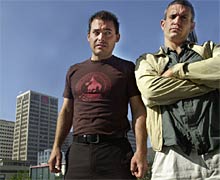
RONI GALGANO / Union-Tribune
The adventures of political pranksters Mike Bonanno (left) and Andy Bichlbaum are documented in the film "The Yes Men."
|
|
|
|
|
They may have their own movie now. But a year or two ago, Andy
Bichlbaum and Mike Bonanno couldn't get arrested. Which actually helps
explain why they have their own movie now.
The two political pranksters featured in "The
Yes Men" (opening today) had set up a satirical Web site mimicking that
of the World Trade Organization. It was their way of protesting the
harm they argued the corporate-friendly WTO was inflicting on poor
nations.
Suddenly, though, the pair found themselves fielding speaking invitations from people who took them for the real thing.
So they went with it – Bichlbaum posing as a
fatuous WTO rep, praising the moral superiority of rich people in
interviews on cable news.
"We thought it was a stunt where we would get
arrested," says Bonanno. "And when we didn't get arrested – when we had
more invitations coming in – we thought, wow, we should really get some
filmmakers along for the ride here."
The resulting documentary follows the two cheeky
pretenders around the globe as they hatch increasingly absurd efforts
to "explain" the WTO's policies. The film's three directors include
Chris Smith, who made the Sundance favorite "American Movie" five years
ago.
As the duo arrives outside a downtown San Diego
coffeehouse for an interview on a recent weekday morning, they pop out
of what seems the perfect prop: a chauffeur-driven black sedan,
preferred ride of proud capitalists on the move.
Only, not their preferred ride. That
would be the "Yes, Bush Can!" tour bus the pair left somewhere back in
Ohio recently, after it broke down on the first leg of their
enthusiastic (if not exactly authorized) campaign to do for the
president what they did for the WTO.
They like to call their technique "identity
correction." It entails assuming the actual, stated positions of a
politician or organization, and then following to wherever weird places
those positions might lead.
"We just make ourselves go a little further than
they usually go," as Bichlbaum explains it. "Just push those ideas to
their logical conclusions. But they're really the right theories, if
you believe (for example) in the WTO.
"The real policies of the WTO are pretty
grotesque. If you learn that you let corporations do whatever they
want, and everything's going to work out well – which is the core idea
of that kind of thinking – then anything else is just a detail within a
detail."
In the film, the Yes Men travel to a business
conference in Finland, where Bichlbaum expounds on the wonders of the
"involuntarily imported workforce model" (a euphemism for slavery) and
demonstrates a freaky, gold-lamé suit fitted with a phallic TV monitor
that lets managers supervise workers from afar.
The most startling part is that until the two
try to pass off a highly unsavory food-recycling scheme on college
students near the film's end, nobody appears to object to their ideas –
or even to suspect the pair aren't who they say they are.
Bichlbaum chalks it up to the power of group-think.
"It doesn't seem to be intelligence-related or
even ethics-related," he says. "There are probably very few people who
are trained to see the WTO as a completely insane thing that you have
to watch out for.
"If you're not prepared to think about it that way, then why would you?"
After all the nonchalance that greeted their
outlandish schemes at business meetings, Bonanno says it was a relief
to get abuse heaped upon them by the college students, some of who
stalked out of the "lecture" in anger.
"It was a much happier thing to walk away from a
group of people who reacted badly to horrific ideas, then to walk away
from people who simply agreed with you."
That local angle
Both Bichlbaum and Bonanno have been through
town before. Bonanno earned a graduate degree at UCSD in the mid-'90s,
studying with such figures as the activist artist Louis Hock.
Bichlbaum, for his part, once landed an aptly
"Yes Men"-esque gig here as a temporary troubleshooter for a computer
system he knew nothing about.
"I said, 'Yes, I'm an expert at this
system,' " he says. "They flew me out and I arrived and asked for
the manuals. I said, 'I just want to refresh my memory.' Then I
retreated to my cubicle and read through them and figured it out."
It was good training for his later
collaborations with Bonanno, although both men had made their marks in
what's often called "culture jamming" before they ever met.
In 1989, Bonanno grabbed attention for launching
the Barbie Liberation Organization, a stealth program to switch the
voice-boxes of talking Barbie and G.I. Joe dolls and put them back on
the shelves.
Startled kids (not to mention parents) found
their Barbies barking martial commands and their toy soldiers purring,
"Want to go shopping?"
Bichlbaum, meanwhile, was gaining notoriety for
tweaking a video game he was hired to work on called SimCopter, so on
cue some of the macho characters began kissing each other.
They met through a filmmaker friend, and soon
were on their first joint project: a 2000 parody of George W. Bush's
Web site that got them called "garbage men" by the then-candidate
himself.
Bonanno knew director Smith and co-director
Sarah Price (the film's third director is Dan Ollman) through another
mutual friend. But despite their friendship, the filmmakers take a
vaguely mocking stance toward their subjects in the film, lending it
the odd feel of a prank-within-a-prank.
"It fully fit in with what we wanted," Bichlbaum
insists. "We wanted to come off as the bumbling people that we are. We
wanted it to be clear that anybody could do this, basically."
Bonanno adds that "if it had been too positive
the whole time, it wouldn't be as funny either. Because part of it is
watching this slow-motion train wreck. Everything that can go wrong,
does. And in the end, it's more funny as a result."
Adding to the quirkiness of the entire
enterprise: Much of the Yes Men's travels were financed by a grant from
an arts foundation headed by Herb Alpert, the jazz-pop icon.
Bonanno says what he and Bichlbaum do fits in
some ways into time-honored traditions of satire dating back to
Jonathan Swift. But unlike modern-day pranksterism of the MTV "Punk'd"
variety, the Yes Men have a message to their madness.
"It's political pranking," he says. "It's not just so you can see somebody squirm."
»Next Story»
|