



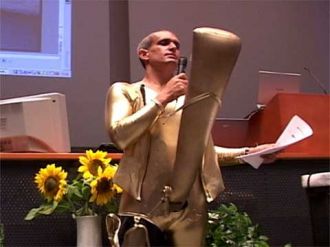
They Yes Men unveil a gold spandex body suit which increases productivity as it allows managers to watch over workers on an attached screen

Related Articles
- CAMPAIGN HERO: Trewin Restorick, CEO of Global Action Plan
- Platform: attempting to drive a wedge between the Tate Modern and BP
- Bruce Parry: the Arctic's climate is 'changing faster than anywhere else'
- Campaign Hero: Caroline Fiennes of Global Cool
- Torbay adopts i-Tree software that 'puts a value on trees'

Exclusive interview They took on Dow and Halliburton... but who are the Yes Men?
Sarah Bentley
1st March, 2011
Their parodies of Dow Chemicals, Halliburton and the US Chamber of Commerce have propelled activist duo Andy Michlbaum and Mike Bonanno into the spotlight. They've gotten under the skin of corporate America - but what's next, asks Sarah Bentley?
American activists Andy Bichlbaum and Mike Bonanno (pictured below), known collectively as The Yes Men, have got balls. Over the last decade the duo have taken on corporate and government foes with a unique strain of gonzo-activism they call identity correction. They set up fake websites that mimic their campaign targets and through them are invited to speak at conferences. Posing as legitimate representatives they give presentations that parody the outfits dastardly ethics and their catastrophic consequences.
To this end they've appeared at Canada's largest oil conference as Exxon Mobil representatives to showcase a new fuel made from climate change victims, have appeared on the BBC as Dow Chemicals to announce the company would compensate the victims of the 1984 Bhopal disaster, and held a press conference as the US Chamber Of Commerce to announce a u-turn on their appalling climate change policy, an act the Chamber are currently attempting to sue them for. Many of these hilarious turns - think Brass Eye meets Borak - are documented in films The Yes Men (2003) and The Yes Men Fix The World (2009).

But besides making thrilling viewing what do these stunts achieve? In an era where the billion dollar industries of spin and PR can make corporate criminals look like humanitarians their antics are a comparatively low-budget method of counter and a slap-in-the-face reality check. And more importantly the brazenness and theatre of their actions provide the press with a news hook to cover important issues. After the BBC hoax Bichlbaum was invited to explain his motives on Channel 4 news and the action was covered in over 600 US press articles.
The Yes Labs
I meet activisms number-one
satirists in a beer and burgers bar-diner in Brooklyn. It feels odd no
one recognises them. Their films have made them stars of the global
activism movement but like most things counter-cultural outside this
world they're virtually unknown. They've just come from their day jobs
as college Professors (Bichlbaum lectures at the Parsons School of Art,
Media and Technology and Bonanno at Rensselaer Polytechnic Institute)
and are en-route to a meeting about a future action.
Over burgers they enthusiastically discuss issues such as Monsanto, the CIA and tar-sands. They're 'excited' about the recent triumph of people power in Egypt and Tunisia and they're impressed by British anti-tax dodging movement UkunCut and are involved in the recently established USunCut. The project that's currently taking up much of their energy are the Yes Labs. These are workshops that aim to help activist groups devise effective actions. 'It's about helping people to do the same things we do,' explains Bichlbaum. 'To have real impact on an issue you need strength in numbers. That's why we're focusing on connecting with other groups and sharing knowledge.'
Like many activists they're reluctant to talk about themselves. When asked about his background Bonanno launches into an amusing monologue of lies. They won't confirm whether their real names are Jacques Servin and Ivon Igor as listed on their wikipedia entry but given their propensity for tall tales it's safe to assume they're not. Given the public nature of their actions why bother with even this shard of secrecy. 'There's actually no reason,' Bichlbaum says. 'It's just habit. And fun.'
Identity corrections
If the narrative of their book The Yes Men: The True Story of the End of the World Trade Organization is to be believed this marriage of fun and activism is what brought them together. In 1993, while still a student, Bonanno made headlines with his Barbie Liberation Organization (BLO) heist. He switched the voice boxes of GI Joe and Barbie dolls then returned them to toy stores. He also added customer complaints number that were actually those of TV news desks and the story was quickly seized by the media. Three years later Bichlbaum, then a games programmer, had his own taste of infamy. Bored with the narrative of action game SimCopter he'd been hired to work on he inserted a ‘feature' where men in swimsuits popped up to plant kisses on each other. Eighty thousand copies of the game were made before it was noticed. Soon after in 1996 mutual friends introduced them and they've worked together since.


Their
first venture into identity correction proper was during the campaign
period prior to the 2000 US Presidential elections. Using the URL
GWBush.com they created a website for the politician to flag up alleged
hypocrisies on his actual site. Where he trumpeted his credentials as
Ecology Governor they highlighted the reality that Texas had become the
most polluted state in the union while under his watch. But this wasn't
to be the last time Bush was their target. Four years later during his
2004 re-election campaign they took their satire out of the digital and
into the physical world. Aboard a bus with the slogan 'I'm telling the
truth!' they joined Bush rallies pretending to be part of his campaign.
The duo got staunch Republicans to agree to have a nuclear waste storage
in their community and to sign their children up to fight in a war in
North Korea. Bonnano commented, 'That's what's amazing about the
discourse in this country. People are so used to complete absurdity that
nothing surprises them anymore.'
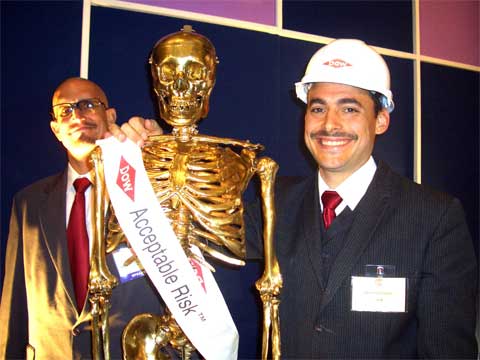 When
they pose as a powerful organisation the level of absurdity people
accept is frightening. When they unveiled to bankers at the 2005
International Payments Conference an ‘Acceptable Risk Calculator' that
saw the death of developing world citizens as an acceptable risk
(pictured right) the audience failed to voice concern. Likewise when
posing as Halliburton employees to present the SurvivaBall, an enormous
inflatable suit that could supposedly act as a self-contained living
system in the event of a disaster caused by global warming (pictured
below), the corporate risk assessors watching missed the joke and
requested business cards. 'You hope the message will sink in later,'
says Bonanno. 'But it probably doesn't.'
When
they pose as a powerful organisation the level of absurdity people
accept is frightening. When they unveiled to bankers at the 2005
International Payments Conference an ‘Acceptable Risk Calculator' that
saw the death of developing world citizens as an acceptable risk
(pictured right) the audience failed to voice concern. Likewise when
posing as Halliburton employees to present the SurvivaBall, an enormous
inflatable suit that could supposedly act as a self-contained living
system in the event of a disaster caused by global warming (pictured
below), the corporate risk assessors watching missed the joke and
requested business cards. 'You hope the message will sink in later,'
says Bonanno. 'But it probably doesn't.'
 Due
to the US's robust freedom of speech laws until 2009 their escapades
hadn't landed them in legal trouble. The duo acknowledge this is a
'double edged sword' that allows them 'to do what we do' but also
justifies the recent Citizens United Ruling that allows corporations to
fund political broadcasts during elections. Although other collectives
have previously threatened legal action (and then backed out presumably
to avoid a stream of negative media attention) the Chamber Of Commerce
are the first to file a lawsuit. The case, which they're being
representing for by digital rights group the Electronic Frontier
Foundation, is currently on hold. 'It's an attempt to squash freedom of
speech,' says Bichlbaum. 'And that's unnerving.'
Due
to the US's robust freedom of speech laws until 2009 their escapades
hadn't landed them in legal trouble. The duo acknowledge this is a
'double edged sword' that allows them 'to do what we do' but also
justifies the recent Citizens United Ruling that allows corporations to
fund political broadcasts during elections. Although other collectives
have previously threatened legal action (and then backed out presumably
to avoid a stream of negative media attention) the Chamber Of Commerce
are the first to file a lawsuit. The case, which they're being
representing for by digital rights group the Electronic Frontier
Foundation, is currently on hold. 'It's an attempt to squash freedom of
speech,' says Bichlbaum. 'And that's unnerving.'
An ideal outcome will be that the Chamber drops the case given the onslaught of negative public attention it's already facing. A serendipitous spate of wikileaks has exposed the possibility the Chamber had been negotiating with ‘cyber security firms' to trash civil opponents such as US Chamber Watch and Change To Win through a campaign of disinformation. The pair have already written editorials about the leaks on the Huffington Post and Guardian websites but claim to not know details of any further actions.
As we wrap up the conversation I point out how what they do requires serious er, nerve. They look nonplussed. 'It's not like we put ourselves in any immediate danger,' shrugs Bichlbaum. 'Compared to what other activists do, it's actually very low risk.'
Further information:
Yes Men's video channel on Babelgum
Sarah Bentley is a freelance journalist

| READ MORE... | |
 |
NEWS Europe's scramble for gas sees controversial hydraulic fracturing cross the Atlantic In the US, gas-extraction in the Marcellus Shale has been linked to pollution and social conflict. Now Halliburton, Chevron and Exxon, among others, want to bring the so-called 'fracking' process to Europe, reports Luke Starr |
 |
HOW TO MAKE A DIFFERENCE Is social marketing our last chance to change people? Worldwatch's influential State of the World 2010 report tells us why we need more stories addressing climate change and fewer shocking facts |
 |
HOW TO MAKE A DIFFERENCE How a new generation of eco-filmmakers are challenging broadcasting convention From the Age of Stupid to the End of the Line, and next year's Just Do It, independent filmmakers are innovating with radical film subjects and creating whole new funding streams, reports Laura Sevier |
 |
NEWS Dow Chemical in the dock as activists confront corporate spies Chemical giant dismisses allegations that it inflitrated Greenpeace in an effort to undermine its direct action campaigns |
 |
INTERVIEW Erik Assadourian: our society needs some serious cultural engineering The editor of the influential Worldwatch 'State of the World' report on the best ways to transform cultures from consumerism to sustainability |
Previous Articles...


Post a Comment
| If you are not logged in, please enter your login with your comments Not registered? | |