 |
|
upcoming & today's programs
Disney Blocks Fahrenheit 911
Walt Disney has refused to distribute Michael Moore’s latest documentary, which is critical of President Bush. Is it good business—or censorship? Monday, on To the Point, we’ll hear about entertainment, news and politics in this era of media concentration.
Will air Monday, May 10, 2004. [GUEST LIST & LINKS]
Secretary of Defense Rumsfeld on the Defensive
 listen listen
Secretary of Defense Donald Rumsfeld apologized at length today for the abuses at Al Ghraid prison in Baghdad, and he promised further investigations. But that didn’t protect him from tough questions from Democrats and Republicans on the Senate Armed Services Committee. Early in the committee hearing, Secretary Rumsfeld was interrupted by 20 protestors calling for his firing. Who knew what and when did they know it? Who was really in charge at the prison? How far up the chain of command did responsibility go? How well did he answer the questions? What are the implications for the war on terror, the war in Iraq and the Presidential campaign? We hear Rumsfeld’s apology and some of the exchanges with committee members.
-
Reporter's Notebook: The Yes Men and 'Identity Correction'
Selling votes to the highest bidder was just one of the ideas proposed in presentations--complete with flow charts and economic jargon—at conferences on world trade. The presenters were satirists trying to make fun of the World Trade Organization. They were astonished to find they were being taken seriously. Mike Bonanno is one of the people who call themselves The Yes Men.
Will air Friday, May 7, 2004. [GUEST LIST & LINKS]
recent programs
The Iraqi Prison-Abuse Scandal and the Presidential Campaign
listen
Before the prisoner-abuse scandal, political insiders accused John Kerry of failing to articulate a “coherent” alternative to the President’s war in Iraq. Despite continuing bad news, polls showed that President Bush was still viewed as a stronger leader, and today, Kerry’s first public remarks on prisoner-abuse failed to make the front pages of most major newspapers. Meantime, White House political advisor Karl Rove has reportedly cautioned another Bush aide against basing the re-election campaign on foreign policy out of concern that it will take a generation for the US to live that down in the Arab world. As the news continues to worsen in Iraq, what are the opportunities and risks for the Kerry? For Bush? Will it open the door for Ralph Nader? Warren Olney speaks with White House reporters, foreign policy experts and journalists following the presidential campaign.
-
Making News: Capitol Hill Responds to Prisoner Abuse Scandal
Defense Secretary Rumsfeld is expected to take a grilling tomorrow in a public hearing before the Senate Armed Services Committee. Today, some Democrats have called for him to resign—or be fired. Republicans, too, are said to be harboring serious doubts. Jonathan Broder, defense and foreign policy editor for Congressional Quarterly, says emotions are running high and calls for action are mounting.
-
Reporter's Notebook: Prison Abuse Echoes Same in US
When she took over Iraq’s Abu Ghraib prison last June, Reserve Brigadier General Janis Karpinski told reporters that living conditions were so good the prisoners “wouldn’t want to leave.” But things were not what they seemed, and since then, Karpinski has been disciplined for what’s now called the prisoner abuse scandal. In a Los Angeles Times' op-ed column, civil rights lawyer Robert Bastian says things are not what they seem in America’s prisons either.
Aired Thursday, May 6, 2004. [GUEST LIST & LINKS]
Torture and Interrogation
listen
President Bush went on Arabic-language television today—not to apologize, but to tell the Muslim World that abuse of prisoners is abhorrent to him and unrepresentative of America. Under the Geneva Convention, what’s allowed and what’s not? Who’s responsible when violations occur? Six Army Reserve military police have been charged with assault, cruelty, indecent acts and maltreatment of detainees in Iraq. The family of one MP has circulated a lengthy memo he wrote about what he saw. We hear what he said, get reaction from the Middle East, and talk with the wife of an accused reservist and to an Army interrogator from the first Gulf War.
-
Making News: Iraq Prison Scandal
Despite Congress' call for heads to role, President Bush told reporters today he has complete confidence in Defense Secretary Rumsfeld and his military commanders. Spurning Al Jazeera, which the White House regards as anti-American, Bush also gave interviews to Arabic-language TV. But, says the Economist's Max Rodenbeck, to Arabs, the President's interviews appeared as little more than a mediocre attempt at damage control.
-
Reporters Notebook: The Mind of a Torturer
What turns ordinary people into torturers? Why do others stand by? These are some of the very disturbing questions raised by what went on at Al Ghraib Prison and other places as well. John Conroy, staff writer for the Chicago Reader and author of Unspeakable Acts, Ordinary People: The Dynamics of Torture, offers an analysis.
Aired Wednesday, May 5, 2004. [GUEST LIST & LINKS]
Iraq and the Propaganda War
listen
Saddam Hussein’s most notorious prison was a laboratory for torture and one of the targets of Iraq’s liberation, but now, there’s pictorial evidence that some of the liberating forces also used Abu Ghraib to torture Iraqi prisoners. Prison pictures have undercut American objectives in Iraq and jeopardized its standing in the Arab world. On Capitol Hill today, there were closed-door hearings and Senators of both parties complained that Congress was not informed of the Army's long-time knowledge about the treatment of detainees at Abu Ghraib. Warren Olney explores how the Iraq war and occupation are being covered by US and foreign media and the impact on America’s credibility in the Arab world.
-
Reporter's Notebook: Presidential Campaign May Cost $1 Billion
John Kerry today launched one of the most expensive ad campaigns in political history, a $25-million TV blitz in 19 “battle ground states” to counter $50 million already spent on TV by the Bush campaign. Anthony Corrado, a campaign finance expert at the Brookings Institution, says that despite attempts to get a handle on money in politics, this year's total spending could top a billion dollars and shatter all expectations.
Aired Tuesday, May 4, 2004. [GUEST LIST & LINKS]
An Expanded European Union
listen
Created in 1951 to coordinate industrial policy among six countries devastated by warfare, the European Union has grown and developed into an Economic Community and a European Parliament. With the 1992 Maastricht Treaty, it set the goals of monetary and political union. Saturday, the EU expanded from 15 to 25 nations, including eight former Communist countries, and it now stretches from Ireland to Poland. The new EU has more people than the United States and a bigger economy. Can prosperous Western European democracies really integrate with the former Communist East? Will America be faced with economic, political and even military competition? Warren Olney looks at the newly expanded EU with a former economist for the International Monetary Fund, an expert on global governance from the Brookings Institution, a Polish entrepreneur and a spokesman for the EU's delegation to the US.
-
Making News: Sharon Defeated by Likud Referendum
In April, President Bush gambled that supporting Ariel Sharon’s plan to withdraw from Gaza would create a breakthrough in the Middle East. Palestinians, other Arabs and Europeans were outraged, Yesterday, 60 percent of Sharon's own Likud Party voted to oppose the plan. Leslie Susser of the weekly Jerusalem Report says the defeat puts the Prime Minister in a real bind.
-
Reporter's Notebook: Abuse of Iraqi Prisoners
Images of American soldiers abusing Iraqi prisoners have been published and broadcast worldwide. Those images raise a lot of disturbing questions. What’s the Pentagon doing to discipline those involved? What’s the State Department saying about the impact worldwide? We hear from John Hendren, Pentagon correspondent for the Los Angeles Times, and Robin Wright, who reports from the State Department for the Washington Post.
Aired Monday, May 3, 2004. [GUEST LIST & LINKS]
Death and Displacement in the Sudan
listen
President Bush has called for an end to “ethnic cleansing” in Sudan, south of Egypt. The State Department says 30,000 people have been systematically killed, while a million more have become refugees. Since independence from Britain in 1956, 30 million Sudanese have been engaged in a civil war that has left two million dead. Now, the Muslim government is arming nomadic Arabs in the western part of the country who are, in turn, systematically destroying villages of black Africans who are also Muslims. The failure of the United Nations to intervene recalls the genocide in Rwanda 10 years ago, and promises that it would never happen again. Warren Olney looks at this developing humanitarian crisis with experts in African affairs, including historians and human rights activists, a UN spokesman and a State Department advisor.
-
Making News: The Latest in Fallujah
The Associated Press says US Marines are withdrawing from positions in Fallujah, handing them over to Iraqi soldiers. Agence France-Presse says flag-waving crowds have greeted former Republican Guard General Jassim Mohammed Saleh. Proclaiming full confidence in Saleh, American General Mark Kimmitt denies the Marines are pulling out. We get an update from Dan Murphy, who's in Baghdad for the Christian Science Monitor, and from Tony Perry of the Los Angeles who's embedded with the Marines.
-
Reporter's Notebook: Why Europeans are Getting Taller—and Americans Aren’t
The Netherlands has become a land of giants, with men seven inches taller than Dutchmen were in the days of Vincent van Gogh. Americans, who were the world’s tallest people up until World War II, aren’t any more. How do we know that? Why should we care? Writing in The New Yorker, Burkard Bilger recounted the research of "anthropometric historian" John Komlos, who’s doing research at the University of Munich.
Aired Friday, April 30, 2004. [GUEST LIST & LINKS]
Brahimi, UN Set the Stage for Transfer of Power in Iraq
listen
The Bush Administration says that regardless of what happens in Fallujah, it remains intent on transferring political power in Iraq on June 30. President Bush says he’ll take the recommendations of Lakdhar Brahimi, the Algerian diplomat who represents the United Nations. But questions remain about who Iraq's new leaders will be and how they can have “full sovereignty” if 135,000 American troops remain under US command? When Paul Bremer’s replaced by John Negroponte, will life change for the Iraqi people? Will the UN give the new Iraqi government legitimacy? Will it make any difference to the Iraqi people? Warren Olney speaks with journalists, foreign policy experts and a spokesman for the Iraqi Governing Council about the prospects for transferring political power on June 30.
-
Reporter's Notebook: Families of Victims of 9-11 Want to Know the Truth
For three hours today, President Bush and Vice President Cheney appeared jointly before the Commission investigating September 11. Later, in the Rose Garden, the President declined to offer details of the meeting but said that they had answered every question. Monica Gabrielle, whose husband was killed in the South Tower of the World Trace Center, and is on the standing committee of the 9-11 Commission, says too many questions remain unanswered.
Aired Thursday, April 29, 2004. [GUEST LIST & LINKS]
The Cheney Energy Case
listen
The Bush White House has gone all the way to the US Supreme Court to keep secret the names of Vice President Cheney’s Energy Task Force. The task force recommended an expansion of nuclear power and oil exploration in the Alaska National Wildlife Refuge, policies which are opposed by the Sierra Club. Both the Sierra Club and the conservative group, Judicial Watch, claim Americans have a right to know the participants' identities. The White House says secrecy’s not just necessary for making policy. It’s protected by the Constitution. Is it all about politics, or is it a real test of principles fundamental to American government? Warren Olney joins experts in environmental policy and national security law, an attorney for the Sierra Club and former Nixon counsel John Dean, for a look at Cheney's Energy Task Force, the Constitutional separation of powers, and politics in an election year. -
Making News Anti-Terror Money Stuck in Bureaucracy, Misdirected
Since September 11, Congress has approved no less than $6.3 billion to help local responders prepare for attacks of terrorism, but 80 percent of it is mired in bureaucracy, and the money that has been spent isn’t going where it’s really needed. That’s according to the House Select Committee on Homeland Security. Josh Meyer, who reports for the Los Angeles Times, has details on the problems, the process and the prognosis.
-
Reporter's Notebook: Rats in New York and LA
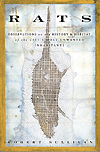 Today’s Los Angeles Times describes a man in Brooks Brothers suit and cuff links, walking the alleys of downtown Beverly Hills. He’s not scouting movie locations or walking off an unsuccessful date, but looking for rats. Robert Sullivan is author of a book subtitled, Observations of the History and Habitat of the City’s Most Unwanted Inhabitants, about an animal that’s always with us, and which can be fascinating.
Aired Wednesday, April 28, 2004. [GUEST LIST & LINKS]
Whatever Happened to Campaign Finance Reform?
listen
Two years ago, the McCain-Feingold Law, named for Senate Republican John McCain and Democrat Russ Feingold, became the first campaign finance reform in a generation. Like all campaign finance reforms, it was designed to prevent individuals or special interest groups from buying access to elected officials. Democrats supported it, despite predictions that it would limit their use of “soft money,” but supporters of John Kerry may be demonstrating otherwise. The Bush-Kerry campaign is the first test of the new law, but even its authors say interest groups have found ways around it. Have Democrats and Republicans changed sides on the issue? Warren Olney takes examines attempts to control the influence of money in politics with journalists, public policy experts, advocates for government accountability, and the former political director of the California Republican Party.
-
Making News: Pentagon Briefing
As the violence continues in Iraq, Secretary of State Donald Rumsfeld and Joint Chiefs Chairman Richard Myers led today's briefing at the Pentagon, answering several questions about the latest attacks in Fallujah and Najaf. Fay Bowers, who covers security matters for the Christian Science Monitor, says Meyers also acknowledged the need to go back to Congress for additional supplemental funding before the November election.
-
Reporter's Notebook: Robert MacNeil on Being an American
 The public broadcasting audience will remember Robert MacNeil as half of the MacNeil –Lehrer anchor team on PBS. Yet, despite his success in this country, MacNeil did not become an American citizen until 1997, two years after leaving the show. His memoir, Looking for My Country, has now been released in paper back. MacNeil shares his thought on how he felt about September 11 and what’s happened since.
Aired Tuesday, April 27, 2004. [GUEST LIST & LINKS]
[more To the Point shows]
|
|


