Yes Men - Colleen Becker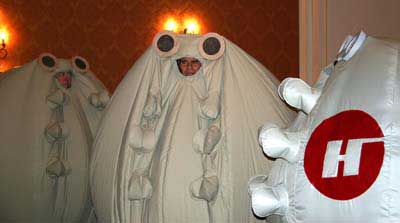 The Yes Men at work.
“Halliburton Solves Global Warming.” While credited to “Halliburton
Emergency Products Development,” a press release with a hook like this
could only be the work of one organization—notorious
prankster-activists The Yes Men. Give the document a quick once-over,
and you’ll find all the attributes of a typical press release: it
starts with a lengthy quotation from purported Halliburton
representative Fred Wolf, which serves up sound-bites from a conference
on Catastrophic Loss held at a Ritz-Carlton in Florida, lauding the
benefits of a new Halliburton product, “The SurvivaBall.” A Dr.
Northrop Goody, identified in the release as the head of Halliburton’s
Emergency Products Development Unit, describes the SurvivaBall as
“essentially a gated community for one,” and his supporting statements
lend credence to Wolf’s claims by demonstrating just how the device
would cater to managers’ climatic, nutritional, medical and
communications needs. Turns out that Halliburton hasn’t actually
“solved” anything, but instead has developed the means for adequately
securing its executives so they can continue to turn profits in the
event of apocalyptic climactic change. The SurvivaBall thus allows the
company to artfully side-step inconveniences produced by its own
contributions to large-scale environmental devastation. Backed up by an
extensive, and thoroughly disingenuous, website at
www.halliburtoncontracts.com/about/, the press release informs the
reader not of actual corporate activities or government contracts, but
of a phony demonstration performed by The Yes Men at the conference in
Florida on May 9, 2006, while ostensibly acting on behalf of
Halliburton Co., New York.
Recent subjects of
an eponymous film (2003), covering their history and documenting pranks
against corporations, politicians and Non-Governmental Organizations,
The Yes Men are one of a small number of media-oriented activists,
sometimes called “culture jammers,” who deploy the weaponry of their
opponents to beat them on their home turf. Like
AdBusters or the Billboard Liberation Front, The Yes Men appropriate
the representational means with which corporate and political entities
promote themselves to critique and subvert these same institutions.
Masters of the game, Yes Men co-founders Mike Bonanno and Andy
Bichlbaum have been playing at it for a number of years: they also
helped establish ®™ark, known for its website featuring DIY protest
projects, internet-based activism tools and calls for public
participation in actions like “Throw Money Off of Tall Buildings” or
“Return the Statue of Liberty to France.”
While
other cultural activist groups are sometimes limited in their
reach—often preaching to the choir of liberal to anarchist leftists who
visit their sites or read their ‘zines—The Yes Men address the subjects
of their critique as well as their supporters by infiltrating their
targets to an often unbelievable degree. Practicing what they call
“identity correction,” as opposed to “identity theft,” The Yes Men
“impersonate big-time criminals in order to publicly humiliate them,”
and this is precisely what they were up to at the Catastrophic Loss
conference, initiated in response to Hurricane Katrina. Looking every
bit the executive, Bichlbaum, posing as Fred Wolf, delivered a speech
entitled “What Noah Knew: Old Models for New Conditions” to attendees
of the “Disaster Preparedness” panel. In his speech, he encourages
members of the insurance and other industries to look on the bright
side of climactic change by considering ways to identify and maximize
investment opportunities in the wake of disaster. He notes, for
example, that Hurricane Katrina rid New Orleans of economically
blighted areas while simultaneously improving real estate valuations,
the Black Plague overturned outdated modes of production and trade and
that Noah found himself with a monopoly on animals after the Flood.
Following this dramatic introduction, Dr. Goody (aka Bonanno)
demonstrates SurvivaBall’s capabilities with a panoply of visual aids
while Wolf explains how the suit would protect vital corporate
managers, enabling them to take advantage of the special conditions
presented by large-scale natural disasters. Incredibly, panel attendees
bite the Noah bait and swallow the whole story hook, line and sinker.
Far from fingering Bonanno and Bichlbaum as imposters, they merely ask
about the feasibility and effectiveness of the SurvivaBall.
Like the
gullible audiences who unquestioningly witness and inadvertently
participate in their performances, The Yes Men’s publicity materials
are uncritically reiterated by outside news outlets, drawing attention
not only to the fraudulence of a corporation like Halliburton, but to
mass media itself. Their press releases, performances and websites are
so convincing, that even while questioning the truthfulness of their
content, reporters still post Yes Men information verbatim, or with
little commentary.
The believability of The Yes
Men’s hoaxes is enhanced by the websites they build to mimic those of
their targets. Imitating the bland, information-rich interface of
Halliburton’s corporate site and appropriating its human
resources-inspired jargon of “community” and “volunteerism,” Yes Men’s
website, like its press release, convinces the guileless visitor
through form if not content. Halliburton’s corporate site is, of
course, www.halliburton.com, but the Yes Men’s site at
www.halliburtoncontracts.com/about/ is close enough to the corporate
URL to elicit an invitation to join the “Disaster Preparedness” panel
from conference organizers. According to the Yes Men, their ability to
infiltrate corporate culture is contingent upon such invitations—issued
in response to The Yes Men’s “identity correction” materials such as
the website—which, of course, minimizes suspicion. They’ve also posed
as representatives of other institutions like the World Trade
Organization, an “identity correction” that prompted invitations to
participate in conferences in Salzburg and Sydney, and in an interview
on CNBC’s Marketwrap Europe.
Thus far,
Halliburton has taken no action against The Yes Men, although
conference security unsuccessfully attempted to seize unauthorized
video filmed on-site by co-conspirators. Such cold shoulder treatment
stands in opposition to the Bush campaign’s reaction to the prank site
constructed by Bonanno and Bichlbaum while still with ®™ark. The
President’s website could be found at www.GeorgeWBush.com, but ®™ark’s
www.GWBush.com site was too close for comfort. Campaign officials
complained to the Federal Elections Commission, and, in the heat of
public debate about the site, Bush issued the much-quoted gaffe “there
ought to be limits to freedom.”
While not artists
per se, Bonanno and Bichlbaum’s projects have long been on the radar of
new media arts organizations Rhizome.org and Eyebeam, their
SurvivaBalls will be exhibited at an upcoming gallery exhibition in
Germany and they are planning a sequel to the first Yes Men movie.
Citing as important predecessors the Situationist International, they
also admire 17th and 18th century writer Daniel Dafoe and San
Francisco’s 1960s street guerillas “the Diggers.” To produce their
work, the Yes Men rely on a whole host of semi-collaborative
participants who make costumes and props, help with 3-D animation,
shoot film and video and house and feed the Yes Men. Similarly, their
non-profit projects are cooperatively funded via e-mail solicitations
and their website, and with the help of awards such as the one recently
received from Herb Alpert’s foundation. The Yes Men challenge
traditional categories of cultural production, but the SurvivaBall is
nonetheless reminiscent of a sculpture. Brainstorming about organisms
that could survive global climatic change, Bonanno and Bichlbaum
thought of amoebas as well as resilient vermin like ticks and roaches.
These informed the SurvivaBall’s physical form, which they consider as
a cross between a human, an amoeba and a blood-sucking insect. In their
eyes, the SurvivaBall is a parasite, an apt metaphor for the
corporation.
|