May 17, 2006

Reclaiming the Land @ the Vera List Center


Panel Discussion
Reclaiming the Land: Conversations on Collaboration

Wednesday, May 24, 2006, 6:30 PM
The New School, Theresa Lang Community and Student Center
55 West 13th Street, New York City

Admission: $10; free for New School students and alumni with ID 

Acknowledging the conditions arising from harmful past land uses and evolving methods to address them, landscape architects, artists, scientists, educators, engineers, lawyers and civic leaders have embarked on efforts to reclaim and reuse polluted lands. This conversation will address such topics as toxic pollution, waste disposal, reclamation design, public lands and urban renewal, looking at the potential for innovative collaborations that engage in contemporary land patterns and processes.
    
Participants
Alan Berger, Associate Professor, Harvard Graduate School of Design; author of "Reclaiming the American West"

Chris Reed, Stoss Landscape Urbanism, Boston

Mierle Laderman Ukeles, Percent for Art-Artist of Fresh Kills, New York City, and Artist-in-Residence, NYC Department of Sanitation

Moderated by Niall Kirkwood, Professor and Chair, Department of Landscape Architecture, Director, Center for Technology and Environment, Harvard Graduate School of Design

This event is part of the Vera List Center's year-long theme "Considering Forgiveness."

TICKETS:  Reservations can be made by email to: boxoffice@newschool.edu.  Tickets can be ordered by phone with a credit card (212) 229-5488; in person at The New School Box Office, 66 West 12th Street, main floor, Monday-Thursday 1-8 p.m., Friday 1-7 p.m.

INFORMATION: 212.229.5353, specialprograms@newschool.edu www.generalstudies.newschool.edu/specialprogram


May 16, 2006

Battle for the North Pole


 via The Week, 5/12/2006:

The Battle for the North Pole
The melting Arctic ice cap may be bad news for polar bears, but it is prompting a frantic scramble for territory and resources. What's at stake?

How fast is the ice cap melting?
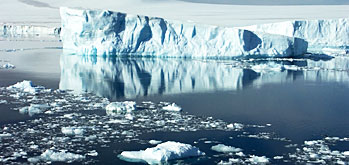
The size of the summer polar ice cap has shrunk 20 percent since 1979, reaching its smallest size last year. With average temperatures in the Arctic rising twice as fast as elsewhere in the world, climate scientists predict the Arctic Ocean could be ice-free by the summer of 2050. In place of the white wilderness that killed explorers and defeated navigators for centuries, the world would have a blue North Pole and a seasonally open sea nearly five times the size of the Mediterranean. Last August, a Russian vessel, the Akademik Fyodorov, became the first ship to reach the North Pole without having to use an icebreaker.

Who stands to lose from all this?
The melting of the ice could shut down the Gulf Stream and wreak havoc with the world’s coasts and climate. It would spell potential disaster for traditional Arctic communities, for ecosystems, and for plant and animal species—polar bears would drown or starve, and the species could become extinct. But fish would prosper. Warming Arctic waters are already creating new fishing grounds as fish migrate and adapt to new conditions. Pink salmon have been seen spawning in rivers far to the north of their traditional territory.

Who stands to gain?
The melting ice cap represents a colossal commercial opportunity. Russian icebreakers are already preparing to take tourists to the Pole for $30,000 each this summer, and the thaw could open up some highly lucrative shipping routes. A northeast sea route, north of Siberia, would allow shipping to sail from Europe to northeast Asia, cutting the journey by a third; and the fabled Northwest Passage through Canada's Arctic archipelago could be open to shipping in a few decades, cutting the journey from Europe to East Asia (now routed through the Panama Canal) by 4,000 miles. The greatest profits, however, are likely to be found under the ice.

What is being discovered there?
Oil and natural gas. A quarter of the world's untapped fossil fuels (including 375 billion barrels of oil) are thought to lie under the Arctic, and will become accessible as the ice melts. Industry experts now talk of a "black gold rush," as companies such as BP Amoco, Statoil of Norway, and the Russian giant Gasprom all race to tap already discovered reservoirs in the region. The Arctic, says Moscow-based energy analyst Christopher Weafer, "is the next energy frontier." [read on...]

Busan Sculpture Project: 'Homage to the Earth'


via e-flux

Busan Sculpture Project in Busan Biennale 2006
(Special Exhibition)

Theme: 'Homage to the Earth'
Period: 05. 27. 06~08. 31.06 (97 days)

*Opening Ceremony: 05/ 27/ 06 16:00, Open Air Stage in Naru Park

Venue: APEC Naru Park
Artistic director: Tae-ho Lee, Professor, Kyung-Hee University
Artworks: 20 works from 12 countries
Host: Busan Metropolitan City, Busan Biennale Organizing Committee

Contact: tel. 82-51-888-6691~9 / FAX: 82-51-888-6693
http://www.busanbiennale.org / bbiennale@paran.com

Humanity’s brutal destruction of the environment has put our planet’s ecosystem in jeopardy not only for human beings but also for all living creatures. As a result, the discussion of environmental issues can no longer be restricted to a select group of environmental specialists, but must become the responsibility of all human beings. Caring for, and protecting our ecosystem is a challenge for each and every one of us.

For this reason, the Busan Sculpture Project - a special exhibition of the Busan Biennale 2006 – has made “Homage to the Earth” its theme. Among other things, the exhibit’s goal is to raise awareness of our natural environment, the broader eco-system and our role within it, as well as to encourage all human beings to take the appropriate measures to appreciate and care for the world around us.

“Homage to the Earth” will showcase 20 artists from 12 countries. Through their art, each artist will focus on the importance of the natural environment, highlighting the message of becoming responsible guardians of the Planet Earth. To facilitate this theme, and stress our relationship with the natural world, the exhibition will be composed of site-specific earth artworks located throughout the APEC Naru Park along the Suyoung River.

Moreover, to maximize viewer interest, the artworks will be dynamically displayed and visual overlapping will be minimized. Some of the exhibits will be set underground, or arranged in a line to represent the interconnectedness of all human beings with the earth. This approach promises to generate a novel experience for viewers – one that will result in lots of fun, while serving as a continuous reminder of our natural connection with the earth around us. 

[read more]

HALLIBURTON SOLVES GLOBAL WARMING


via The Yes Men:

May 9, 2006
FOR IMMEDIATE RELEASE

   Contact: mailto:EPDU@halliburtoncontracts.com
   Photos:  http://www.halliburtoncontracts.com/EPDU/

HALLIBURTON SOLVES GLOBAL WARMING
SurvivaBalls save managers from abrupt climate change


An advanced new technology will keep corporate managers safe even when climate change makes life as we know it impossible.

"The SurvivaBall is designed to protect the corporate manager no matter what Mother Nature throws his or her way," said Fred Wolf, a Halliburton representative who spoke today at the Catastrophic Loss conference held at the Ritz-Carlton hotel in Amelia Island, Florida. "This technology is the only rational response to abrupt climate change," he said to an attentive and appreciative audience.

Most scientists believe global warming is certain to cause an accelerating onslaught of hurricanes, floods, droughts, tornadoes, etc. and that a world-destroying disaster is increasingly possible. For example, Arctic melt has slowed the Gulf Stream by 30% in just the last decade; if the Gulf Stream stops, Europe will suddenly become just as cold as Alaska. Global heat and flooding events are also increasingly possible.

In order to head off such catastrophic scenarios, scientists agree we must reduce our carbon emissions by 70% within the next few years. Doing that would seriously undermine corporate profits, however, and so a more forward-thinking solution is needed.

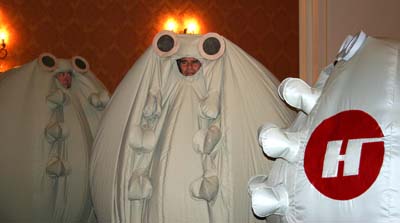
At today's conference, Wolf and a colleague demonstrated three SurvivaBall mockups, and described how the units will sustainably protect managers from natural or cultural disturbances of any intensity or duration. The devices - looking like huge inflatable orbs - will include sophisticated communications systems, nutrient gathering capacities, onboard medical facilities, and a daunting defense infrastructure to ensure that the corporate mission will not go unfulfilled even when most human life is rendered impossible by catastrophes or the consequent epidemics and armed conflicts.

"It's essentially a gated community for one," said Wolf.

Dr. Northrop Goody, the head of Halliburton's Emergency Products Development Unit, showed diagrams and videos describing the SurvivaBall's many features. "Much as amoebas link up into slime molds when threatened, SurvivaBalls also fulfill a community function. After all, people need people," noted Goody as he showed an artist's rendition of numerous SurvivaBalls linking up to form a managerial aggregate with functional differentiation, metaphorically dancing through the streets of Houston, Texas.

The conference attendees peppered the duo with questions. One asked how the device would fare against terrorism, another whether the array of embedded technologies might make the unit too cumbersome; a third brought up the issue of the unit's cost feasibility. Wolf and Goody assured the audience that these problems and others were being addressed.

"The SurvivaBall builds on Halliburton's reputation as a disaster and conflict industry innovator," said Wolf. "Just as the Black Plague led to the Renaissance and the Great Deluge gave Noah a monopoly of the animals, so tomorrow's catastrophes could well lead to good - and industry must be ready to seize that good."

Goody also noted that Jean-Michel Cousteau's Ocean Futures Society was set to employ the SurvivaBall as part of its Corporate Sustenance (R) program. Another of Cousteau's CSR programs involves accepting a generous sponsorship from the Dow Chemical Corporation, whose general shareholder meeting is May 11.

Please visit http://www.halliburtoncontracts.com/EPDU/ for photos, video, and text of today's presentation.

A Series of Practical Performances In The Wilderness


"A Series of Practical Performances In The Wilderness Summer 2005 "
Cary Peppermint & Christine Nadir
Performance on DVD
Summer 2005

via Ecology | Art | Technology:

A Series of Practical Performances In The Wilderness, Summer 2005 is a video performance work made in the woods and on rural back-lots. Performative chapters on the DVD include, Move This Rock, Waiting On Bob, DoAble, Home Economics, Sticks Like Snakes, Digging for Chicory, and Springwater Finale. This video is the first in a series of forthcoming performance-art videos by Peppermint & Nadir which engage issues, ideas, and mythologies of the American concepts of wilderness, space, the frontier, and humans’ relation to animals, forestlands, and nature.

This project is part of Cary Peppermint and Christine Nadir’s series of performance-art videos begun in 2002. Peppermint is an artist who works with new media technologies to create networked environments incorporating the internet, physical installations, experimental music and sound, and live performance. Until recently, Cary directed the Digital Art and Design program of Hartwick College, and in Fall 2006 he will assume the digital media position at Colgate University's Department of Art and Art History. Christine Nadir teaches literature at State University of New York College at Oneonta and is a doctoral candidate at Columbia University where she is completing her dissertation. Its working title is “The Future of the World: Sacrifice, Economy, and Ethics in Environmental Literature and Ecocriticism.”

Christine feels that these videos capture some of the energy, activities, and thoughts that she and Cary have experienced as New Yorkers living in the wilderness for four months every year: trying to establish a functional home without running water, electricity, or maintained roads; developing relationships with locals; un-learning the romanticization of nature while re-learning humanity’s dependence on the environment for survival; and researching the details of the history of the land and the surrounding area (its previous deforestation, its logging, its near use for an auto salvage yard, its use as farmland and grazing ground one hundred years ago, its inhabitation by Native Americans for millennia before that).

Cary says: The North American concepts of wilderness are informed by nationalist ideologies and concepts of freedom as a wild, un-checked frontier of possibility. I don’t believe there is any such thing as wilderness as we Americans are inclined to see it. How could one know or understand that which is truly wild much less employ it toward nation-building? Also, I find a certain intellectual humor in the offering of performances that purport to be both practical and wild.

Look for our quicktime videos on DVBlog.org
If you have seen these quicktime videos on DVBlog.org or through any other venue, we would welcome hearing your response.

May 13, 2006

Thousands Flee From Active Volcano in Indonesia


via NYTimes: 

Thousands Flee From Active Volcano in Indonesia
By THE ASSOCIATED PRESS
Published: May 13, 2006
Filed at 7:43 a.m. ET

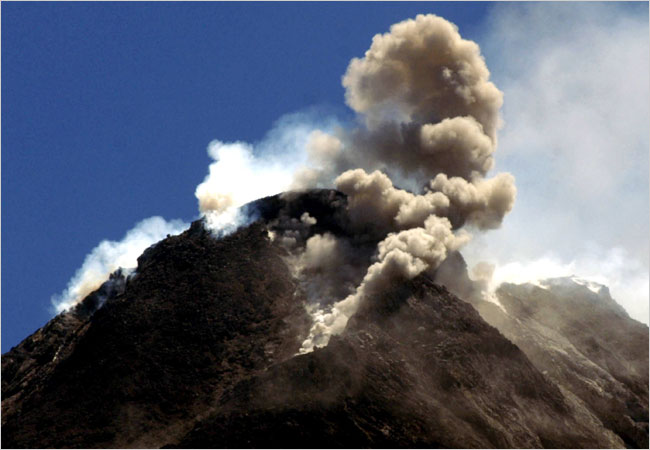
JAKARTA, Indonesia (AP) -- Indonesia on Saturday ordered the immediate evacuation of thousands of people who for weeks have refused to heed the ominous rumblings of Mount Merapi and the burning lava oozing from its mouth.

Hundreds of people began fleeing the 9,700-foot peak after authorities put the region on highest alert, having observed two days of steady lava flow. Bambang Dwiyanto, head of the region's volcanology center, said an eruption may be imminent.

''Because there has been constant lava flows that cause hot gases, we have raised the status to the highest level,'' Dwiyanto said.

The crater had been relatively quiet for years until it began rumbling and spewing clouds of black ash a few weeks ago. On Saturday, experts recorded 27 volcanic tremors, said Ratdomo Purbo, who heads an observation post on Merapi.

He said the mountain belched hot ash at least 14 times over the course of the day and that lava flows reached nearly a mile down the slopes.

Officials were using buses and trucks to relocate women, children and elderly to shelter in schools and government buildings elsewhere in the densely populated province of Central Java. Merapi, about 250 miles southeast of the capital Jakarta, is about 20 miles from Yogyakarta, a city of 1 million.

Many people had been evacuated from homes closest to the crater prior to Saturday, but thousands who live further down the fertile slopes refused to leave. Officials have said as many as 7,000 people still needed to go.

Even after the latest warning, some farmers insisted on staying, reluctant to leave previous livestock and crops. ''We will not leave soon,'' vowed one cattle farmer who declined to give his name.

Merapi is one of at least 129 active volcanoes in Indonesia, part of the Pacific ''Ring of Fire'' -- a series of fault lines stretching from the Western Hemisphere through Japan and Southeast Asia.

Many people who live in the mountain's shadow believe that spirits watch over the peak and will warn them of an eruption.

Although most Indonesians are Muslim, many also follow animist beliefs and worship ancient spirits. Often at full moons, people trek to crater rims and throw in rice, jewelry and live animals to appease the volcanoes.

Merapi last erupted in 1994, sending out a searing cloud of gas that burned 60 people to death. About 1,300 people were killed when it erupted in 1930.


May 07, 2006

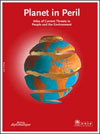
Planet in Peril: Atlas of Current Threats to People and the Environment

 reBlogged via >> mind the __ GAP* ?

mapping the planet in peril

Posted: Wednesday 12 April 2006

Le Monde Diplomatic just published the introduction for the new atlas Planet in Peril: Atlas of Current Threats to People and the Environment

Written by an international team of specialists, these pages from the Atlas illustrate through text and maps, graphics and diagrams the interplay between population and the world’s ecosystems and natural resources both in the short and long terms. It brings together a wealth of information from the most up-to-date sources on such key issues as climate change, access to water, exploitation of ocean resources, nuclear energy and waste, renewable
energy, weapons of mass destruction, causes of industrial accidents, waste, export, hunger, genetically modified organisms, urban development, access to health care and ecological change in China.

That is a good opportunity to point also to its listing of political maps and for those who have access to the article of P.Rekacewicz Confessions of a map-maker:

Earlier this year, Le Monde diplomatique published the second edition of its atlas, and the United Nations Environmental Programme, in partnership with the paper, published a translation of the part of it that focuses on environmental issues. It’s a difficult business being a mapmaker. Maps, as mere visual representations of the idea of the world, are just as subject to diplomacy, border disputes and international struggles as real geopolitical territory.
… (continue on Le Monde Diplomatic - sorrily a password is needed)

May 02, 2006

Climate Change Casino?

Martucket2

 reBlogged via NEWSgrist:
via The Boston Globe
:
Artist, deadpan, floats a proposal
Cape turbines' critic offers a Vegas spin

By Jenna Russell, Globe Staff  |  May 2, 2006

Senator Edward M. Kennedy has flexed his considerable political muscle to try to block a wind farm in Nantucket Sound. Governor Mitt Romney strongly opposes the project.

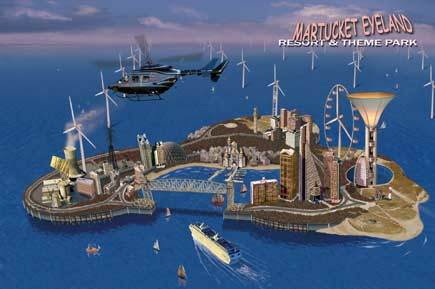
But how would they handle this? A floating theme park, described by its designer, Provincetown artist Jay Critchley, as ''a Las Vegas version of the Cape and islands," to be built on an enormous triangular platform in the midst of the wind turbines.

Some dismiss it as an extravagant -- and expensive -- joke. But Critchley isn't laughing, at least not in public. He says that by proposing the theme park he is trying to bring attention to what he believes is the lack of oversight that the proposed wind farm has received and that he is challenging regulators to give his project similar treatment.

Dreamed up by Critchley, the plans for the Martucket Eyeland Resort & Casino read like classic political satire. Attractions would include the Climate Change Casino & Sweat Lodge, the Captain Ahab Fitness Center, and an amusement park ride called Jaws, Jaws, Jaws, which Critchley describes as ''a simulated eating by a shark -- for the kids."

To be taken even remotely seriously, the 59-year-old Cape Cod artist and provocateur has to insist he has every intention of actually building the theme park. And he does insist. He even filed an application in March with the US Army Corps of Engineers, seeking a permit to move forward with construction.

According to the application, the platform would be anchored between three of the 130 turbines in Nantucket Sound that would comprise Cape Wind.

But in this game of showmanship, federal officials, who admit they were initially amused by Critchley's submission, now caution that the artist is risking serious consequences by forging ahead with his permit request. Applicants found to have knowingly made ''false, fictitious, or fraudulent statements or representations" may be fined $10,000 or imprisoned for up to five years, said Tim Dugan, a spokesman for the Corps' New England district.

''We're working at taxpayers' expense, and we don't want to waste their money," Dugan said with all deliberate earnestness.

Critchley said he is not worried about being prosecuted, though some of his friends are concerned. ''I have other things to worry about, like raising a billion and a half dollars to build the park," he said with equal earnestness.

Corps officials have conducted an initial review of Critchley's application and have asked him for more information. If he does not reply, a spokesman said, his file will be closed. If he moves the process forward, the Department of Justice could be called in to decide if he applied in good faith.

The fate of the Cape Wind farm, while farther along in the planning stage, is still uncertain.

Kennedy supported an effort by Senator Ted Stevens, Republican of Alaska, to block the development by inserting a provision in a sure-to-pass bill funding the Coast Guard that would give the governor of Massachusetts the ability to veto the project. But the provision -- inserted without public debate, after being considered by only the handful of House members and senators negotiating the Coast Guard bill -- has rankled members of both parties.

A group of House members persuaded House leaders to delay a vote on the bill. In the Senate, the chairman and the ranking Democrat on the Energy Committee say they will try to block the Cape Wind provision when the bill comes to the floor.

April 22, 2006

Laurie David on Global Warming

via NYTimes:

Laurie David Raises Awareness of Global Warming

By FELICIA R. LEE
Published: April 22, 2006

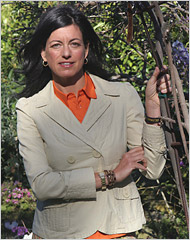
"I am terrified," Laurie David said between bites of her Cobb salad, avocados on the side. "I'm terrified. I'm terrified. And fear is a great motivator."

Ms. David was talking about her fears of global warming. Not exactly an aid to digestion, but talk of global warming is what she does, as the reigning media queen of the issue. She has chatted about weird weather on "The Oprah Winfrey Show," recently shepherded two TV projects on the issue onto Fox News and TBS, and is the executive producer of the global warming primer "Too Hot Not to Handle," to be broadcast on HBO today, Earth Day.

Tall, elegant and intense, Ms. David was also the guest editor of the May issue — "The Green Issue" — of Elle magazine. ("Clean up your act with eco-chic fashion, travel food.") And she is a producer of "An Inconvenient Truth," a documentary film based on former Vice President Al Gore's decades of research on global warming. The film had its premiere at the Sundance Film Festival in January and will be in theaters in New York and Los Angeles on May 26. You might have caught Ms. David (who seems not at all like the TV wife of her husband, Larry David) on "The Bold and the Beautiful," a soap opera. In an episode in January she played herself, trying to talk a shipping magnate into making some changes in his business to cut back on global-warming pollution.

"Yes, that was the low point of my life," Ms. David said. "Not because of the soap opera, but because of my hideous acting. But guess what? I got to talk about global warming on the No. 1 soap opera in the country."

For the near future, at least, Ms. David has resolved to stay behind the camera, and her latest endeavor, "Too Hot Not to Handle," is a sober documentary, full of leading scientists and statistics explaining how global warming is already upon us. If it's scary, she said, then good.

Early in "Too Hot," Michael Oppenheimer, a professor of Geosciences and International Affairs at Princeton, intones, "We're headed toward a completely different world than the one we're used to."

The film provides "a non-wonky" explanation of what, exactly, global warming is, Ms. David said. When you add junk into the atmosphere, blocking some of the energy exchange between the Earth and space, it traps heat near the Earth's surface, a Stanford scientist explains.

Besides watching scenes of hurricanes, heat waves and parched fields, viewers learn that heat waves lasting four days or more have almost tripled in the last 50 years; that moderate rains have decreased while heavy rains have increased. According to the film a quarter of the plant and animal species could face extinction by the end of the century, because of global warming.

If that doesn't grab you, yet another "Too Hot" authority talks about the commonplace ways global warming will be felt: leaves will change color at odd times of the year, ski resorts won't get snow, spring geese will no longer come in the spring.

"And by the way, you know, global warming is good for one thing: bugs and pollen," Ms. David said, tucking into her salad.

"I do not want to be talking to the converted," she said of the film. "We want to talk to people who say: 'O.K., wait a second. What the heck is this and why should I care? And you know, hey, when my kids come home, we're going to all watch it tonight.' "

Her own family is, of course, environmentally correct. Mr. David drives a Toyota Prius, a so-called hybrid car (which runs on both a gas engine and an electric motor) on "Curb Your Enthusiasm," the HBO show in which he plays a curmudgeonly comedian with a tolerant wife. The real-life Davids both drive a Prius, too, and live in Los Angeles with their 10- and 12-year-old daughters. She's a model-thin, sparkly 48-year-old, and Mr. David is 10 years older.

The Davids are well aware that in some quarters Ms. David is caricatured as a celebrity do-gooder. She was infamously labeled a "Gulfstream liberal" in a 2004 article in The Atlantic magazine that noted that she chartered private planes even as she pressed for improved fuel-economy standards. An article in The Hollywood Reporter this week said that Ms. David has become "a symbol to some of showbiz grandstanding at its most self-righteous."

Ms. David said she only occasionally uses a private plane and the majority of her air travel is commercial. "This comes from people trying to marginalize celebrity, trying to marginalize Hollywood," she said of the criticism. "It comes from people not wanting you to be effective. Celebrities who lend their names to causes to raise lot of money for important issues should be admired and not marginalized and made fun of."

She grew passionate about global warming, she explained, when her first daughter was a baby. She felt lost and isolated after leaving a hot career of managing comedians, and when she met some big brains with the Natural Resources Defense Council, she recognized her calling. She now sits on the board of the council, which is dedicated to protecting the public health and the environment.

Frances Beinecke, the council president, gives Ms. David credit for changing the public perception of environmentalists as somewhat overwrought tree huggers and for playing an enormous role in moving the global warming conversation "off of the science page and squarely into the middle of American popular culture."

For instance, Elle magazine, which reaches a huge audience of avid consumers of the fashionable and the trendy, is "green" for May. Roberta Myers, Elle's editor in chief, approached her about being a guest editor, Ms. David said. Vanity Fair also has a "green issue" for May, Ms. David noted.

"This is her great passion, she knows a lot about the environment, she's the fulcrum for a lot of activity," Ms. Myers said of Ms. David. "It was just important to us that we get her voice."

Ms. David started her professional life as a talent coordinator for the David Letterman show (which is how she met Larry David) and now juggles her roles as wife, mother and activist from a home office. She travels extensively but generally limits her time away to three days. At 6 p.m., without fail, the whole family eats dinner together.

"I have taken advantage of my husband, to the extent that I even got HBO to do a documentary with me," she said. "He won't even promote his own show, and I'm like, 'Honey, "Nightline's" coming tomorrow, and you have to talk to them for a couple of minutes.' He went on Oprah with me, which I begged him to do. He's shy."

But you don't have to be famous to help, Ms. David said. Her easy to-do list of suggestions includes buying recycled paper products, unplugging appliances not in use and joining a virtual march on Washington against global warming at www.stopglobalwarming.org.

"I'm completely and totally optimistic," Ms. David said of the green movement, betting that she will win new converts when "Too Hot" is broadcast.

Ms. David called global warming a disaster that must be halted before the crash is too intense. "It's better to be in a car accident at 5 miles per hour," she said, "than one at 60 miles per hour."
Public Programs for The Drop, @ Exit Art

Drop

via NEWSgrist, 4/21/06


Announcing Public Programs for The Drop, @ Exit Art:

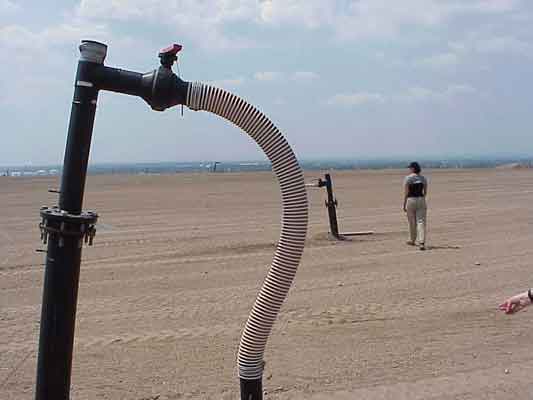
Water Challenges Facing New York City: Finding Visionary Solutions

Saturday, April 29, 2006

THE DROP public programs will include two panel discussions and an artist-led walking tour of New York's waterways & water resources, organized by Amy Lipton of ecoartspace, a curator who has been engaged with art and the environment for ten years. In the spirit of promoting discussion and analysis, Exit Art has organized a flexible presentation of panels and speakers.

The full-day panel and walking tour will focus on visionary approaches to resolving problems with and disputes over New York waterways, and will include artists, activists, water scientists, and representatives from the Department of Environmental Conservation who will speak about the importance of New York waterways. Panelists will present their visionary solutions to the water challenges facing New York City. The afternoon session will be a forum moderated by Amy Lipton, where the panelists will discuss solutions to our local water issues.

11am Morning Session
Each of the participating artists, environmentalists, scientists and landscape architects on the panel will give a five-minute presentation on their work and how it relates to water issues in New York City.

1:00 - 2pm break for lunch

2pm Afternoon Session
The morning panelists will begin a dialogue about real solutions to the water problems facing New York, and then open this discussion with the audience.
Panelists for morning and afternoon sessions include:

Artists: Brandon Ballengee, Bob Braine and Jackie Brookner
Eric Goldstein, Co-Director, Urban Programs, National Resources Defense Council
Chris Wilde, Watershed Director, Riverkeeper
Franco Montaldo, hydrologist / environmental engineer, Earth Institute, Columbia University
Margie Ruddick
, Landscape Architect


Sunday, April 30, 12 noon
Artist led walking tour of New York City waterways, exploring existing and former water sources and their importance.

Organized by Amy Lipton, Curator ecoartspace, NY and Abington Art Center, Philadelphia

Please contact Exit Art for more information 212-966-7745 or info@exitart.org

More about THE DROP:
Introduction - Artists - Curatorial Text - Public Programs - Funders

Technorati Profile

» Blogs that link here
» View my profile

Powered by Technorati

1