Send As SMS

Saturday, May 13, 2006

Devil's Advocate


There has been a lot of digital rhetoric about net neutrality lately as Congress prepares to vote on pending legislation.

Ironically, those opposed to network neutrality (and in favor of "tiered service" or "preferential service" models) have also formulated appeals designed to capitalize on the same anti-corporate and libertarian sentiments that net neutrality advocates trumpet. For example, the webtoon at DontRegulate.org uses a sound-alike spokesman with the same narrating cadence as a popular pro-neutrality video from Public Knowledge. They even use a similar primer style that is punctuated with corporate logos.

By using gimmicks like a singing mountie, the DontRegulate webtoon shows that it can also deploy humor, as the opposition does at shows like Ask a Ninja or This Spartan Life.

Because this pitch appears in banner ads on politically progressive sites for the visually literate like BagNews Notes, it can be difficult to figure out who really is behind it. The webpage of the webtoon's sponsor Hands Off the Internet looks authentically grassroots with its bad graphics, but a few mouseclicks spells out an ABC of corporate sponsors like Alcatel, Bell South, and Cingular.

Friday, May 12, 2006

Son et Lumiere

Today I attended E3, thanks to Jon Goldman of Foundation 9 Entertainment. I've blogged about F9's Getting Up, a videogame about spraypainting, tagging, stenciling, and street art, as a representation of how virtual urban environments invite certain activities that subvert the rules of conventional civic spaces.

Foundation 9 also produces the Age of Empires series, which makes claims for being a tool for teaching history and modeling the impact of particular military, economic, and social policies in virtual nation-states.

It will be interesting to see if F9's upcoming videogame, The Da Vinci Code, generates controversy and reaction from the faithful or if the videogame audience -- unlike the film audience -- is assumed to be largely secular.

E3 was a surreal experience for a bookish academic like myself, although I have always secretly enjoyed attending large conventions and trade schows, since those gatherings are an excellent place to study public rhetoric. For example, I have attended both the National Tattoo Convention and the National Rifle Association Convention in the past.

It reminded me most of attending the International Association of Amusement Parks and Attractions convention years ago, because there were so many elements from "themed environments" in evidence. I shuffled down the stairs of a gangster's mansion, was herded behind security doors for a top-secret military briefing, strolled down a bombed-out French street complete with "GLACES" sign, wandered between pirate cages, and stood gawking in front of a huge skateboarding half-pipe as skateboarders whizzed by.

The gender imbalance at E3 was much worse than I had anticipated. I had seen the Video Games Live! concert at the Hollywood Bowl, which attracted citizens from many LA subcultures, so I was surprised to see such a single-gender group. In some crowds of over fifty people I was the only female spectator . . . although it meant that I never had to experience a restroom line. There were some women dressed as nurses or prostitutes or lab technicians or dominatrixes, but that didn't improve the testosterone factor any. In contrast, the World of Warcraft area was remarkably diverse: lots of women, a multiracial assortment of players, and even several people in wheelchairs. I looked over their shoulders to check that they were actual gamers rather than plants.

Guitar Hero was definitely the game with the greatest crowd appeal, although there were other manufacturers who were clearly trying to push the agenda of gaming as a spectactor sport.

Thursday, May 11, 2006

Head, Shoulders, Knees, and Toes

On Tuesday, I attended the Games for Health Day that was organized in connection with E3. The concept of "Games for Health" might sound odd to those who associate videogames with sedentary lifestyles and detachment from the organic experience of the public sphere, but it is a growing area in treatment, training, and health education in the "serious games" community.

Some of the speakers I have blogged about before, such as Harvey Magee and Skip Rizzo who talks about virtual reality treatments for attention deficit disorder, post-traumatic stress disorder, and physical rehabilitation.

You can watch the Games for Health video trailer for more information about the organization.

Wednesday, May 10, 2006

I Suppose It Takes Balls


"Halliburton Solves Global Warming" announces an authentic looking website that appears to be from the corporate contractor known for no-bids deals. At a speech purportedly at a catastrophic loss conference, the visitor can learn the details of this ambitious plan. Certainly it appears that Halliburton hasn't underestimated the challenges caused by planetary climate change, according to their wry executive PowerPoint:

Unfortunately, things aren't as simple for us as they were for Noah. God isn't telling us what kind of an ark we should build, nor how to deploy it - but luckily Science can fill in the blanks, and Science tells us that what we're doing in the world today will lead to much more flooding, drought, hurricanes, tornadoes, or even worse, with consequences including epidemics, human migration, civic unrest and even war.

But as Warren Buffet, the oracle of Omaha, so astutely said: you must follow “the Noah rule: predicting rain doesn't count, building arks does."

I can personally guarantee you that we as a society are more than ready to build arks against these conditions - in some cases, we've already done so.


Keeping the ark of our interests afloat in a world of increasing disquiet is the job of our defense industries, and they do it quite well - here's the Green Zone in Baghdad.

Likewise, secure neighborhoods protect us against the unknown in our own societies - this security checkpoint built after the Rodney King riots protects a community on the edge of Los Angeles.

As for the Dutch, they're building literal arks - houses that float! Many people live in these houses - young families, the elderly, even CEOs! The Dutch have thus found one good way of making a systemic new problem routine, and even turning it into a net contributor to their economy.

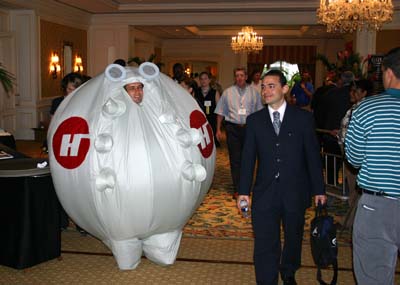
The solution? The patented Survivaball! According to this widely e-mailed website, the ever-industrious Halliburton has now created a disaster-proofcocoonn in the form of an spherical life-support suit that makes the wearer look like a combination of the Death Star and the Michelin man. The speech transcript ends with all the executives onstage enthusiastically clambering into these devices to model their new apparel to themarvelingg crowd.

It's a good hoax in color, choice of fonts, use of corporate logos, and placement of photos of earnest workers and grateful global customers. It also parodies several digital genres at once, including the PowerPoint presentation and the company website. Best of all, the privacy page of the imposter is almost indistinguishable from the one on the real Halliburton site, so you can have your confidentially compromised by political subversives as well as institutional insiders.

I looked around for humorous material on the genuine site and didn't find much to laugh at, although they do offer products like a "Swellpacker" and services like "Chi Modeling." There is the space-agey MyHaliburton that promises you online news along with your networked work environment, a fake parchment historical timeline, and my personal favorite page information graphic, which you can see below. In addition to their core energy resources and postwar reconstruction businesses, perhaps they are also subcontracting for the NSA.



It may be useful to think about how the logic of global warming relates to another digital genre, that of the videogame. The game Civilization has been praised by many videogame critics -- including Kurt Squire, Noah Falstein, and Ian Bogost -- for the way that it teaches players to be conscious of the procedural consequences of particular choices that accrete over time. However, if you have destroyed your planet in Civilization, because of poor planning and impulse decisions, you can play again, hopefully more cognizant of the constraints of rule-based systems.
Now that there are serious discussions about covering polar ice caps with tarps or sending deflecting mirrors into space with magnetic propulsion, the scientific heroism of a one-shot, technology-driven solution like the SurvivaBall doesn't look so ridiculous.

Thanks to Vivian Folkenflik and Julia Lupton for passing on this link!

Tuesday, May 09, 2006

More Network Neus

Still more imaginative digital rhetoric has appeared to explain the network neutrality principle in the simplest possible language to consumers and legislators.

This week's offerings on BoingBoing includes a machinima video from This Spartan Life and a podcast of David Eisenberg reading a Dr. Seuss-style poem against potential ISP robber barons.

To me, the interesting question may be why everyone is assuming that network neutrality is such a complex issue that it requires primers on procedural literacy. See last week on this blog for more about the didactic project of net neutrality advocates.

Update: My personal favorite YouTube celebrity, Ask a Ninja, has come up with an episode on Net Neutrality as well! You can also see a dramatization at the Net Neutrality and Internet Freedom Report, which uses the D.I.Y. presentation techniques that are popular on YouTube.

Artificial Intelligence


This story from a few days ago about House Intelligence Committee hearings on the dissemination of alleged terrorist videogames via the Internet just keeps getting curiouser and curiouser. One of the games shown to congressmen as evidence of this nefarious trend seems to be Sonic Jihad, which features headscarf-wearing baddies with rocket launchers and lots of roadside tank explosions. The details of an AP News Report, which was reprinted in the New York Times, about the hearings appear to confirm that indeed this is the case. Unfortunately, if you take the time to download Sonic Jihad for yourself, you'll quickly discover that it isn't the work of diabolical insurgent organization. In fact, it was created by a pranksterish gamer from the Planet Battlefield forum.

The difference between actual jihadist Internet materials, like those archived by the SITE Insititute, and edited footage of garden-variety Battlefield 2 mass-market game play should have been obvious to the expert team that supposedly included "25 linguists." What is particularly flabbergasting about the gullibility of legislators is that the video opens with parody material taken from the Team America soundtrack!

At first the story was so unbelievable that those in the blogosphere attributed it to bad reporting by Reuters. But now Watercooler Games has revealed that it's media illiteracy from an entire congressional committee that is to blame.

Apparently, there is more than just a subversive videogame or two to be found on the Internet. The AP coverage of testimony by public diplomacy pitchman includes this incriminating catalogue of rhetorical appeals deployed by the enemy:

According to the briefing, al-Qaida has advertised online to fill jobs for Internet specialists, and its media group has distributed computer games and recruitment videos that use everything from poetry to humor to false information to gather support. The media group has assembled montages of American politicians taking aim at the Arab world.

Certainly, patriotic American citizens are writing poetry, humor, and false information to protest the war. They are even assembling images and sound files from American politicians! Will there be house hearings in favor of investigating their activities as well?

At a time when hegemonic political players are seeking justification for expanded surveillance, faulty evidence regarding Internet intelligence is particularly disturbing. For the past week, I have been requesting the transcripts or further information from Washington D.C. to verify that Congress could have actually done something so profoundly stupid. Wish me luck getting the evidence to see for myself!

Monday, May 08, 2006

Body Conscious


The e-card is a digital genre that can also be used by constituents to get the attention of their political representatives. The American Cancer Society has set up a website for their Save Mammograms Campaign, in response to proposed legislation that would no longer mandate that insurers cover certain screening procedures. The airbrushed hot pink brassiere on one of the e-cards, which I have reproduced above, seems to be an ambiguous signifier that could be read as either an artifact of consensual foreplay or of post-assault evidence from a crime scene.

In considering this genre I discovered that there are other more peer-t0-peer forms of the breast cancer e-card that are specifically designed for consciousness-raising in potential victims, many of which regrettably come with music, such as this schlocky hand-holding number or this "humorous" mammogram reminder with a cartoon of an obese man.

Sunday, May 07, 2006

For Rant

Craigslist, the ubiquitous Internet want ad service that covers sellers and buyers from coast to coast (and a number of exotic foreign destinations as well) was discussed at some length in today's New York Times ("The Nitpicking Nation"). The article focuses mostly on bemused commentary on a choice-obsessed culture in which every feature of a potential roommate, lover, or employee can be specified. In a darker vein, it also explains how digital genres blend in current Internet want ads, so that hybrid housing/personal ads give posters the potentially abusive opportunity to request particular sexual favors or fetish accompaniments from their lodgers.

Most concerning, perhaps, for the citizens of what Jane Fountain calls the Virtual State, is the fact that the identity-based strategies of association expressed in these want ads can become mechanisms for exclusion as well. A suit by the Chicago Lawyers' Committee alleges that craigslist allows illegal discriminatory advertising for housing, because it does not adequately screen the ads it posts. Those who are knowledgeable about the profusion of code words and euphemisms for racial and religious bias, including terms like "all-American," are well-aware that such screening must be done by a live person, since -- like pornography -- discriminatory language can get by automated filters. The CLC argues that the added expense of monitoring content can be easily accomodated, because craigslist is a for-profit entity.

Yet the current "terms of use" statement that all posters click already specifies that discriminatory language is prohibited. Furthermore, supporters might counter that additional policing violates free speech and the prime directive of the Internet that "information wants to be free."

Others might say that this slippery category of "community" has always been primary for founder Craig Newmark, who still organizes his flagship San Francisco website with the "community" heading in first position. In fact, web development in the Bay Area has a history of community-building practices around home and hearth, such as the Thursday Night Dinners in the mid-nineties. The ideologies of these communities may actually be ones of inclusion not exclusion.

As a practicing landlady, I also take issue when the Times lumps completely legal requests for "no pets" tenants (for reasons of maintaining the physical condition of the property and limiting liability caused by the actions of non-human actors) in with racist, sexist, theocratic, and otherwise totally unacceptable forms of discrimination.

This doesn't mean that I don't think the article has a point. These are troubling violations. Unfortunately, in my own experience as a user of craigslist, I think that the housing ads are actually not the worst offenders. I've seen far worse entries in the job listings category and more of them, in which age, gender, attractiveness, and lifestyle are frequently offensively spelled out.