



A certain powerful North American country has been brazenly meddling in Europe's affairs, bullying and twisting arms to advance a corporate agenda on the most pressing environmental issue of our time. A phalanx of its lobbyists has descended on European capitals to covertly scheme with oil companies and menace EU parliamentarians who would dare address climate change.
It's not who you might think … but Canada. If any illusions remained about this country's behaviour abroad, they should be put to rest. Newly released government memos have exposed a secret war that Canada is waging in Europe to kill clean energy policies and ensure no market closes to the dirtiest crude in the world – the tar sands of Alberta.
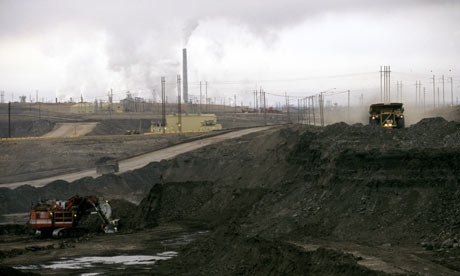
The decline of easily accessible oil has set in motion not a shift to renewable energy but a frantic race for the filthiest, hardest-to-extract and most geographically remote fossil fuels. The prize resource are the tar sands: a sludgy bitumen found in northern Alberta whose conversion to oil requires a uniquely destructive, energy-intensive and costly process. To extract the vast deposit – trailing only Saudi Arabia's in reserves – the industry is stripmining a pristine Boreal forest the size of England, guzzling one of the planet's largest watersheds, poisoning downstream native communities, and emitting three times more carbon than conventional oil production. The planetary scars from the largest industrial project in history can already be seen from outer space.
The dream of the tar barons scouring new frontiers should be familiar to the British: that the sun never sets on their pipeline empire. Canada's laboratory has provided an environmentally disastrous but extremely profitable model – which they now want to export everywhere: Congo's rainforests, Russia's remote basins, the US desert, Jordan, Venezuela, Madagascar and even Trinidad and Tobago.
But the road to these spoils leads through Europe. While the continent doesn't import any Canadian crude, the oil giants and their government backers realise a European fuel quality directive that would slap a dirty label on tar sands to promote cleaner transport fuels could set the global standard – and effectively shut the door on Alberta's exports. "Our fear is that if something happens in the EU and it is spread in other countries … we could have roughly one third of the world's population subscribing to regulation or legislation that mitigates against our oilsands," a provincial minister in Alberta said last year. It is also sure to raise the heat on European oil companies to withdraw their enormous and growing investment in tar sands industries.
Hence the public relations blitzkrieg, conducted since 2009 through missions in key cities: London, Paris, Brussels, Oslo, Berlin and the Hague. Headquartered in England, an "oil sands team" run by Canada's foreign ministry has mounted the offensive. They've monitored green groups; furiously lobbied against the fuel quality directive; coordinated junkets to Alberta for EU parliamentarians; and targeted international journalists in an attempt to improve media coverage. The British government appears to have succumbed to the campaign and is working to block the EU from singling out the larger carbon footprint of the tar sands.
Canada's foreign team has also been getting cozy with big oil corporations they call "like-minded allies". They've held numerous secret meetings with BP, Shell, Total and Norwegian Statoil to share "intelligence" and discuss joint initiatives. The plans run to the very top: Canada's prime minister, Stephen Harper himself, met covertly with Total's CEO in Paris in June 2010, after a visit with French President Sarkozy. Total has since announced plans to pump $20bn into their Alberta projects by 2020.
Harper's Conservative party now has majority control of a government that is the most rightwing in modern Canadian history. He will eagerly execute a philosophy befitting the son of an oil executive. This means the construction of pipeline corridors – to the south through midwest US states, to the eastern seaboard, and to the west carrying crude for shipment to China and beyond – with the goal of converting Canada into a "global energy powerhouse". Output will increase five-fold to 5m barrels of dirty oil a day by 2040. The cost to the global climate is incalculable.
The good news, however, is that the Canadian government is losing the wider battle over hearts and minds. "Oil sands are posing a growing reputational problem [in Europe], with the oil sands defining the Canadian brand," states one government memo anxiously assessing the "resurgence of highly critical public campaigns" on the continent. The Keystone XL pipeline that would run through the US heartland has faced stiff resistance, and is currently under review by Secretary of State Hilary Clinton. And on the home front, the world's top political risk consultancy Eurasia has acknowledged that the opposition of scores of First Nations (indigenous peoples) to the westward "Gateway" pipeline may be insurmountable: "Native land claims scare the hell out of investors," they note.
Even Hollywood seems be pitching in: director Peter Jackson is seen apparently describing shooting the Hobbit in Alberta, with the tar sands as the set of the dark land of Mordor. The video of Jackson has been outed as a Yes Men-style hoax, but a fellowship of international and domestic protest may indeed be the best bet to topple the reign of tar sands oil-induced evil in Canada. Little else will prevent this real-life Sauron from catapulting us towards an environmental catastrophe and ever-deeper climate crisis.










Comments in chronological order (Total 11 comments)
31 May 2011 8:48PM
But being a capitalist dream of never ending earth resource will continue unabated.
31 May 2011 8:51PM
I'd rather hand my money over to Canada than our "friends" in the Gulf.
31 May 2011 8:53PM
This comment was removed by a moderator because it didn't abide by our community standards. Replies may also be deleted. For more detail see our FAQs.
31 May 2011 9:13PM
Pigmobile driving Americans are well prepared to guzzle every drop Canada can produce.
31 May 2011 9:15PM
The Canadian government had seen through the greenslimes' crap.
Pity the UK government hasn't.
31 May 2011 9:25PM
Only when the last tree has died and the last river been poisoned and the last fish been caught will we realise we cannot eat money. ~Cree Indian Proverb
Only when they have, killed off the last consumer and laid waste to the entire planet will the capitalists stop trying to make another fast buck.........
31 May 2011 9:28PM
The five biggest oil importers to the U.S., apart from Canada, are...
Mexico: Falling oil production due to an incompetent national oil company. Much of the population hostile to oil exploration and production due to corruption.
Saudi-Arabia: An oppressive monarchy with political unrest.
Nigeria: Violent, corrupt, and hugely polluting.
Venezuela: Falling production. Hostile to America. Exports to the U.S. are being curtailed due to a snit with PDVSA., the national oil company.
Russia: Said to be contemplating starting up a 2nd cold war.
31 May 2011 9:29PM
Save us O Lord, from the righteous fury of our British friends. But weren't they getting their eco-friendly oil from Libya, not a fortnight ago? Ah, never mind. Must save the planet from the most right-wing government in "modern Canadian history". You heard that right. The most dangerous government to come out of Canada (pause), in the last ten years. Indeed the images from space reveal, not only the damage wrought upon the pristine Boreal forest, but pretty much every square meter of everything on earth. My fellow Canadians, IS NOTHING SACRED?!
31 May 2011 9:37PM
Canada=USA
31 May 2011 9:40PM
Required reading for anyone posting on this thread:
How certain vested interest manage to hijack internet forums
31 May 2011 9:49PM
Area in square kilometers...
Oil sands reserves: 140,000 sq km
Where mining is feasible: 30,000 sq km
Currently being mined: 4,800 sq km
England: 130,410 sq km
Most of the oil will have to be extracted in situ, meaning it won't be mined. What's more, all mined areas must undergo reclamation.
Lukacs is very loose with his facts. Anything to sell a story, I guess.