

Offset The Juggernaut: A Remedial Guide for Good Liberals
The Yes Men
An earlier version of this article appeared in Good Magazine and can be viewed online here.
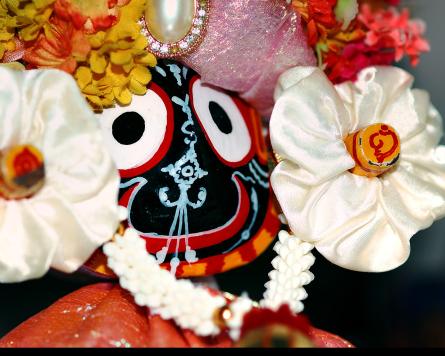
Jagannath ("master of the world" in Sanskrit) is an absurd but kind little god. Normally about six inches high and completely improbable in appearance, once every year he mounts an even more improbable wheeled contraption about five stories high. Row upon row of devotees perch on the different levels of Jagannath's throne as, clearly unsafe at any speed, he lurches through the streets of Puri. In reality, fatalities are usually due to passengers falling off the device, but an early European priest told of it mowing down the devout as they flung themselves in its path, and that's the story that stuck.
Today, we have our own much odder and much less kind Jagannath – "Juggernaut," as the priest wrote it – and while the occasional fatality is due to a devotee falling from the upper reaches of its improvised latticework (didn't one of the Enron managers commit suicide?), death more often hews to the priest's version... except that those that it crushes aren't normally devotees. The 20,000 victims of Bhopal, or the 650,000 (so far) in Iraq, just happened to be in the path of pan-national greed, sometimes fulfilling its dictates, but not really on purpose or with any special enthusiasm.
Now, our very own Juggernaut is preparing some much bigger death, in the form of impending climate calamity. Here too, most of us don't really want that.
A number of decent people do note that J. has produced some wondrous things. Sure, they say, India's transformations in the global free market do produce millions of unemployed farmers, of whom thousands commit suicide every year—but it's also producing a flourishing middle class, thanks to the Bangalore phone banks and tech joints. And though our world-master now threatens the death of civilization, it's also brought us unprecedented luxury and mobility. Even Nero couldn't eat kumquats in winter!
Yes, these folks say, this thing we call the free market may well be a hurtling, death-dealing thing, but it doesn't really mean ill—you just have to get to know it, like a big clumsy pet, and it will respond with love instead of with death. If all of us simply buy the right things, become better citizen-shoppers, leverage the powers of consumer-affection, everything will turn out just fine. Buy a Prius. Invest ethically. Show Coke how to live. [1]
The problem is, our Juggernaut is a force against which a few of us becoming vegetarians, planting trees in the Amazon, or riding bicycles to our jobs on Wall Street are no match at all. And despite the almost psychotically sunny predictions of corporate seers like Stewart Brand and Kevin Kelly, the global free market doesn't want much besides profits and growth; its own survival comes in a distant third, if even that.
That's why many of us think the culture of death needs to be jammed. The best way to jam it would be by withdrawing corporate charters after a company's very first mass murder (no second chances!), making the cost of products reflect their true cost to the world, maybe even stopping the production of gas-powered cars, as we did during WWII. The serious crises we face merit serious responses, and an acknowledgement that our society is sick at its core. Only then will we have the faintest hope of stopping our mean little god from crushing us all.
The trouble is, these kinds of actions require an answerable, transparent government to enact them. And here in the US we have chosen a government as uninterested in our survival as is the free market.
Until we can establish democratic government once again - i.e. one more interested in our needs than the wants of the rich - what are our options?
We can protest. This may be our best option.
Or we can do mischief. We can throw a laundry bag of dollar bills onto the New York Stock Exchange floor, revealing the "profit motive" for the rooting of pigs that it is (Abbie Hoffman, 1967). We can make billboards tell the true story about corporate caring (Billboard Liberation Front, et al.). We can simulate billionaires (Billionaires for Bush, 2004) or fake our way onto television as spokespeople for Dow Chemical (the Yes Men, 2004) in a pantomime of what's wrong.
We can graphically demonstrate that we already have all the technology we need to solve all our problems, as do the people behind WorldChanging – though it's unfortunate that they fail to mention in all those hundreds of pages that the only thing that's essential and missing is government that's up to the task, i.e. democracy. Without that, all those marvelous green solutions are just so much window-dressing.
Protest, mischief, and the sort of thought experiments that comprise WorldChanging
are small measures, desperate ones, no better than saying "ride a
bike." They go no deeper than the "solutions" Al Gore suggests in the
credits at the end of his film.
But symbolic acts can, at least,
make people more aware of a problem than they had been before, and more
eager to address it through substantive means.
And there's hope.
Like Jagannath, our own lumbering monster is at its core a very small
thing – not a six-inch-high god, but a flimsy and absurd little notion,
summed up in one short phrase: let the rich do what they want, and
things will work out wonderfully for everyone. It isn't very hard to
help others see this as the nonsense that it is, which is one reason
that soon, the outraged may be numerous enough to bring the chariot to
a halt, just as they did with segregation, the Vietnam War, and other
stupid, suicidal constructs that were once thought inevitable.
--------
Footnote:
[1] Perhaps all the wishful thinking is just due to laziness. It's so
simple to imagine that the market system can be managed without too
much fuss, that we can turn the system around with no more effort than
purchasing different goods. Or maybe it's also an esthetic problem.
After all, free market theory is quite beautiful.... Without such faith
in the market's inherent democracy, the task we face is both harder and
messier.
- The Yes Men's blog
- Login or register to post comments


 Singer/Songwriter Nicolai Ordahl infuses pop music with the healing songs of Ayahuasqueros.