Advertisement
Environment

I Went to See the She'll Gas Station for Myself

Shell’s pro-women gas station is all too real.

by Harry Cheadle
Mar 9 2020, 11:21am

Photos by harry cheadle

When the oil and gas company Shell announced late last week that it would be rebranding as "She'll"—as in "she will"—this weekend, to mark International Women’s Day, people thought it was a joke. Even in the history of corporate genuflections toward social justice causes (who can forget when a McDonald's flipped its M upside-down in a "celebration of women everywhere"?), this stunt stood out for its cynicism and laziness. It was so on the nose that the infamous prankster group the Yes Men claimed it was a project of theirs.

There was only one way to figure out if this thing was actually real: to drive out to the only gas station that was doing the rebrand IRL, in San Dimas, California. So that's what I did.

San Dimas is in the San Gabriel Valley in eastern Los Angeles County. It's one of those strikingly beautiful places in Southern California, cradled by green hills and almost perpetually sunny, that human beings have decided to fill with chain restaurants, big box stores, and gas stations.

The Shell—I'm sorry, the She'll—is very similar to the other gas stations nearby. It does not stand out from the road, since the main sign is unchanged and doesn't indicate whether it's a Shell or a She'll. The rebrand is only noticeable at the pumps, which are adorned with the extra ' and feature the slogan "#MakeTheFuture gender balanced" along with portraits of women who appear to be from this ad campaign:

This is all meant to highlight She'll's efforts to improve the representation of women throughout its workforce and on its board. But critics online were pretty skeptical of what seemed like a laughable attempt at reputation-washing. Was the public supposed to applaud a company that covered up links between its own activity and climate change after learning of the connection in the 80s, and which has been accused by Amnesty International of abetting human rights abuses in Nigeria for decades? Especially since all we're talking about is a single apostrophe?
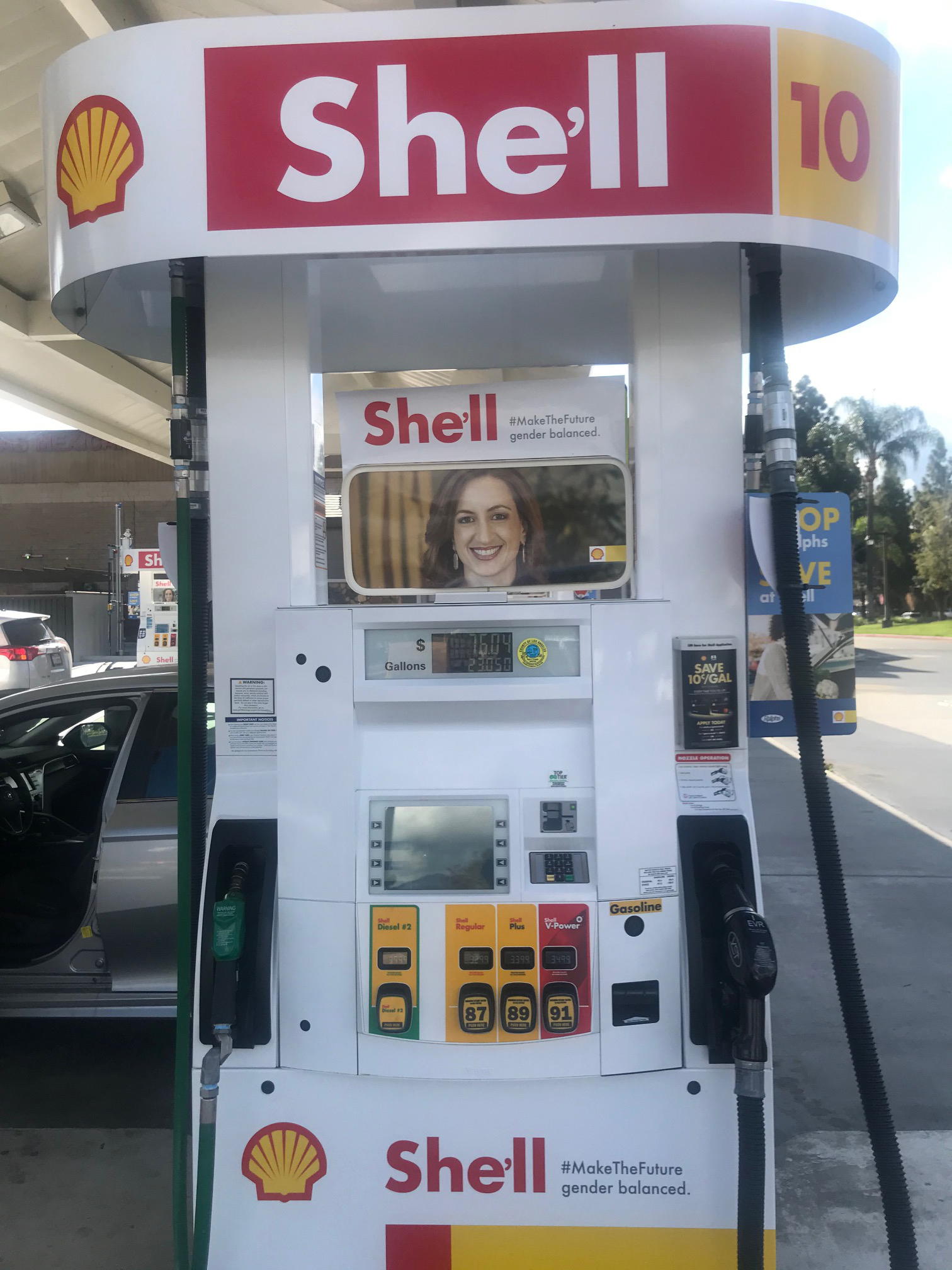
A gas pump rebranded as
This is what the pumps look like.

No She'll corporate leadership was on hand Sunday morning in San Dimas, but I asked Shannon—who has been working at the She'll for five years and was behind the counter—what she thought of the rebrand. Her reaction was positive. "We're the future now, with the women being the top CEOs and all that stuff," she said. "We gotta be equal, we want to be noticeable to other companies."

It was a relief to confirm that the She'll was real and not some collective hallucination of Twitter users. It was also nice to know that at least one She'll employee seemed to be happy with it, since it's unlikely anyone else will really figure out what's going on.

Outside the door I spoke with a man named Larry who says he comes to the She'll every day to use the ATM. "They're doing some promotional stuff here I know," he said, pointing to a sign advertising that drivers got 30 cents per gallon off gas with the purchase of a car wash. "They're really pushing that." I told him that actually I was talking about the apostrophe and the transformation from Shell to She'll that had the internet buzzing.

"I really didn't notice that," he said. "It's Shell from what I can see."

Sign up for our newsletter to get the best of VICE delivered to your inbox daily.

Follow Harry Cheadle on Twitter.

Tagged:
Travel
Oil
California
Los Angeles
international women's day
shell
More like this
Environment

BP Thinks You Selfish Pricks Aren’t Doing Enough to Fight Climate Change

The fossil fuel giant wants social media users to "pledge" to emit less carbon. Really?

by Harry Cheadle
Oct 23 2019, 4:53pm

"Flaring" natural gas is just one process BP has been criticized for. Photo by William Campbell/Corbis via Getty

Back in 2010, software engineer Raffi Krikorian estimated that every tweet consumes 0.02 grams of CO2. Sure, that isn't very much, but it's hard to imagine a worse use of that speck of carbon than this missive from the official BP account:

If you followed that link, in doing so consuming ever so slightly more carbon and therefore infinitesimally hastening the heating of our planet, you'd find yourself on a website decorated with drawings of planes and bikes and whatever. You are prompted to answer some questions about your consumption habits—how often you fly, how much meat you eat—and at the end it spits out a number representing the estimated amount of carbon you're responsible for emitting in a year. I love taking online quizzes, so I did this and got 19 metric tons, which is well above the global average of about 5. I was then given the opportunity to promise to change my behavior.

The idea that we all need to do our part to fight climate change is everywhere. NBC News recently launched a project asking for people's "Climate Confessions," which framed everyday activities as lurid sins: "Where do you fall short in preventing climate change? Do you blast the A/C? Throw out half your lunch? Grill a steak every week?" The New York Times has written articles about how guilty you should feel about flying and the most carbon-efficient way to boil water. The assumption you can get from reading those sorts of stories is that if everyone works together and takes the bus and makes sure to turn off the lights when leaving the house, we'll have licked this climate change problem.

The fact that the company formerly known as British Petroleum is echoing this line should be a big, flaming signpost that this way of thinking is missing the forest for the trees. I should definitely stop flying as much and stop eating meat in order to reduce my personal carbon footprint, but my sins don't even remotely compare to the sins of BP's business practices.

An accounting of the environmental damage done by BP would start with 2010's Deepwater Horizon spill, one of the most devastating such events in history. But even as BP has tried to clean up its reputation—for instance by leaving the conservative climate-denying group ALEC in 2015—it has remained a major culprit when it comes to carbon emissions. As much as it has tried to position itself as pivoting to alternative energy sources, it continues to expand its oil and gas operations and maintains wasteful practices like "flaring" natural gas during drilling, burning the fuel away because it can't transport it quickly enough.

And not only does BP contribute to the climate crisis through its everyday extraction and transportation operation, it supports political efforts to kneecap reform. According to a report on fossil fuel companies from the watchdog group InfluenceMap released earlier this year, BP has joined other giant firms in fighting government regulations and donated nearly $13 million to the successful effort to block a referendum on what would have been a landmark carbon tax in Washington State. (That's despite BP claiming that it supports a "well-designed" carbon pricing system.)

There's no field in that BP-pushed website where you can enter how much money you've donated to politicians or causes, or describe your efforts to influence the kind of climate policy we urgently need. But a lot of activists say that the most important thing you can do has nothing to do with consumption habits—instead, they say, you should join the effort to pressure politicians to enact carbon taxes and go further by passing far-reaching legislation on the scale of the Green New Deal.

That type of activism likely makes BP nervous. Calls to move away from natural gas, for instance, are a direct threat to the parts of BP that sell natural gas. It evidently doesn't want to do that. It's easier to tell me that I should stop driving my Prius so much.

I'd be happy to sell my car, and stop flying altogether, go vegan, and go AC-less, even if it meant sweating through the summers—if, in return, BP would stop funding efforts to block climate legislation and begin dismantling its oil and natural gas operations. We can stop, or at least mitigate, climate change if we all work together. Some of us, though, have more consequential decisions to make than others.

Sign up for our newsletter to get the best of VICE delivered to your inbox daily.

Follow Harry Cheadle on Twitter.

Environment

It's Clear Who's to Blame for Australia's Fires, and It's Not Arsonists

Make the oil companies pay, says an expert who studies the world's worst polluters.

by Geoff Dembicki
Jan 13 2020, 8:58am

A shot of the Dunn Road fire in Australia. Photo by Sam Mooy/Getty

The Australian bushfires that have so far killed at least 28 people and potentially more than a billion animals are due to the actions of a relatively small number of people. No, not the several dozen arsonists that Rupert Murdoch's right-wing media outlets have attempted to blame for the crisis. That's a false claim that's been given a huge platform in the U.S. by Donald Trump Jr. and Sean Hannity.

The true arsonists responsible for one of the worst fire seasons in Australian history are the people who lead 90 of the world's most polluting companies, including oil and gas producers like Chevron, Exxon, Shell, BP, Gazprom, and Saudi Aramco, as well as major coal producers like Coal India and Peabody Energy. Together, these "carbon majors" are responsible for nearly two-thirds of the industrial greenhouse gases released into the atmosphere since the mid-1750s.

Global heating caused by these emissions contributed to the warmest and driest year ever recorded in Australia, which, when combined with later-than-usual monsoon rains and strong winds, led to fires that have burned close to 18 million acres across the country, more than nine times what was burned during California's horrific wildfire season in 2018.

Australia's government nevertheless argues that there is no direct link between the bushfires and climate change, and that any action to reduce emissions is unwelcome because it will hurt the country's exports of coal and natural gas. But in a recent interview with VICE, Richard Heede, the Colorado-based researcher who named the carbon majors in a 2013 paper and continues to quantify their massive climate footprint with the Climate Accountability Institute, said we need to see this disaster for what it truly is: the collateral damage of a business model that benefits only a tiny few while endangering the rest of us. Below is our conversation, edited and condensed for clarity:

VICE: Is it fair to say that the carbon majors bear some responsibility for the bushfires in Australia?
Richard Heede: Absolutely. Quantitatively, the case is pretty straightforward. They have manufactured, produced, and sold fossil fuel products for decades with the knowledge that those products would warm the climate. They have a substantial responsibility for the damages that their products have caused. But also on a political level, they have argued to Congress and other legislators around the world for subsidies to their industry that lower the cost of their products in the marketplace. This has effectively distorted the market and delayed the implementation of alternatives like renewable electricity. So they're responsible for the climate damages that result from having not only produced a lot of the fossil fuels themselves, but delayed political action to deal with climate change.

Chevron recently gave $1 million to the Australia fire efforts, which sounds like a large amount. But is that sufficient?
Well, any help to aid the efforts of Australian firefighters is worthwhile. But of course it's a minuscule drop in the bucket compared to Chevron's investments in additional oil and gas resources. The company's capital expenditures for 2020 are $20 billion, for example.

Should the carbon majors be on the hook for some of the costs associated with climate disasters like the bushfires?
The courts will have to decide whether their climate denial campaigns, their lobbying efforts and their misrepresentation of climate science to the public, as well as to consumers, rises to the level where they're held financially liable for damages. But in my view, they all are responsible for a substantial proportion of climate change. And we now know that increased carbon dioxide concentrations in the atmosphere leads to sea level rise, to increased storms, to floods. As we see in Australia and in the western United States, it also leads to devastating fires.

You mentioned legal challenges. Is that ultimately what it's going to take to cause the carbon majors to pay their fair share for destruction linked to their business models?
It would be reasonable to expect carbon majors to help pay for the damages they have caused, whether they be from sea level rise or floods or fires. But I'm equally interested in making sure that they shift capital investment away from additional fossil fuel resources that they will want to produce and sell and shift their investments into alternative energy and carbon capture and sequestration so that we can avoid the worst of future climate damages.

And what role do Australia's political leaders play in all this?
The Australian government continues to not only subsidize fossil fuel developments, but substantially deny that their coal exports and liquified natural gas exports are linked to climate change. They export in excess of 200 million tons of coal every year, and they should bear some responsibility for that and adjust their own domestic policies.

Sign up for our newsletter to get the best of VICE delivered to your inbox daily.

Geoff Dembicki is the author of Are We Screwed? How a New Generation Is Fighting to Survive Climate Change. Follow him on Twitter.