Printable
version|Email
this article
Identity correction - Yes Men style. Interview with Andy Bichlbaum.
 It’s
disconcerting to have a conversation with Andy Bichlbaum of the Yes
Men, through no fault of Bichlbaum’s. Well, then again, it is his
fault. After having seen The Yes Men movie, and Bichlbaum’s
various poker faced media stunts, there’s always the suspicion in the
back of your mind that he’s somehow, to put it politely, pulling your
leg. This is the man after all who spoke to a conference on
International Trade in Salzburg, claiming to be Andreas Bichlbaeur from
the World Trade Organisation, and suggested that “violence is
acceptable in banana trade so long as prices stay low and trade is
free; that the siesta in Spain and the long lunch in Italy
should be outlawed in the name of standardized business hours; and that
a 'free market' in democracy should be encouraged by allowing the sale
of votes directly to the highest bidder through Voteauction.com”,
without any of the experts present realising that it was all a gag. It’s
disconcerting to have a conversation with Andy Bichlbaum of the Yes
Men, through no fault of Bichlbaum’s. Well, then again, it is his
fault. After having seen The Yes Men movie, and Bichlbaum’s
various poker faced media stunts, there’s always the suspicion in the
back of your mind that he’s somehow, to put it politely, pulling your
leg. This is the man after all who spoke to a conference on
International Trade in Salzburg, claiming to be Andreas Bichlbaeur from
the World Trade Organisation, and suggested that “violence is
acceptable in banana trade so long as prices stay low and trade is
free; that the siesta in Spain and the long lunch in Italy
should be outlawed in the name of standardized business hours; and that
a 'free market' in democracy should be encouraged by allowing the sale
of votes directly to the highest bidder through Voteauction.com”,
without any of the experts present realising that it was all a gag.
In reality though, Bichlbaum’s comedy is one of
context, and he’s deadly serious when talking to the media about the
specific issues raised by the Yes Men’s pranks, such as the absence of
corporate responsibility and the unthinking acceptance of ‘free trade’
ideology (well, maybe not ‘deadly’ serious. His conversational tone is
good natured and cheerful).
“It’s good for popularising things, –says Bichlbaum, talking about the satire on display in The Yes Men,
- and getting people interested in a subject. It’s a good entry point
for people into topics that are very heavy and serious, and that
require serious investigation. We do hope that people, by going to see
our film, get interested and start to realise that there’s something
grotesquely wrong with the world right now, and the way it’s being run.
Hopefully they’ll be stimulated to look into it in other ways”.
The Yes Men started when Bichlbaum met with
fellow media activist Mike Bonanno and, as detailed in the film, they
started setting up websites for what they term ‘Identity Correction’,
where “honest people impersonate big-time criminals in order to
publicly humiliate them. Targets are leaders and big corporations who
put profits ahead of everything else”. An example was www.gwbush.com,
which they setup in conjunction with Zack Exley who owned the domain
name. The site looked to all extents like Bush’s official site, but
with some important differences, explaining the reasons why Bush wanted
to become President: to help the rich at the expense of the poor and
the environment, etc.
From there the idea of www.gatt.org
was born. A website that outlined what the World Trade Organisation is
really all about. As a shocking proof that style does indeed triumph
over substance, researchers around the world arrived at the site, and
because it looked like what a WTO site should look like, they missed
the parody (Sample headline on the site: “Much has been made lately of
IBM's participation in the Holocaust. Indeed, IBM proactively and
creatively helped the Nazis identify all of Germany's Jews, which in
turn made possible the biggest slaughter of all time. Today, however,
another Holocaust is taking place: it goes by the name of 'distrust of
big business,' and it is every bit as terrible as the last”). Invites
poured in from conferences seeking representatives from the WTO. And
from there, it was only a hop, skip and a jump to WTO representative
Hank Hardy Unruh (a magnificently convincing Bichlbaum) standing in
front of a conference in Finland, talking about how the issue of
slavery in the United States (“the involuntarily imported labour
model”) should have been left to market forces to sort out, while
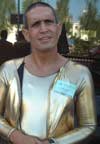
proudly displaying the WTO’s management leisure suit – a gold glitter
suit with a ridiculous inflatable phallus shaped monitoring unit.
The Yes Men is a hilarious and disturbing
film, perhaps as all good satire should be. At various conferences
throughout the world, the pranksters deliver increasingly absurd and
offensive ideas, but face no dissent. The question, though, may arise:
are they satirising the WTO, or the audiences who fail to get the joke?
This writer certainly laughed in disbelief at the Finnish
audience who failed to be offended. This though is not the intent
behind the pieces, according to Bichlbaum: ”We’re not satirising just
the WTO We’re satirising the whole way people don’t seem to question
the foundations of current corporate globalisation, and the way it
works. People seem to just accept it, without thinking. They figure
that someone’s in control, and figuring it all out. One of the points
of the film is to suggest that there might not actually be anyone
seriously thinking about the consequences of all this, or at least not
as many as we assume. We assume that because the economy is being run
this way, there must be a good reason for it. It must have been
figuring it out. If we can propound these extreme versions of this
stuff, and all its absurdities, and nobody notices, then maybe people
aren’t paying enough attention to what’s going on in the world. It’s
not that we’re satirising the audiences in the film, but pointing out a
major failing”.
It could be suggested, watching the film, that
the audiences involved were merely being polite. That silence doesn’t
necessarily mean acceptance. “It could be politeness, – Bichlbaum
responds doubtfully. – You do see in the film that nobody has any
questions, at the end of the talk. What you don’t see in the film was
that we spent the whole day with the people at the conference, from the
time of the lecture through to the evening. We went to lunch with them,
and then dinner with them, and several times we asked people if there
was anything in the lecture that disturbed them or bothered them, and
nobody really found any problems with the content of the lecture.
People were amused by the gimmick, thinking it odd that the WTO would
use such a thing, inflating a giant yellow phallus in front of hundreds
of people, but when we questioned them about the slave labour
questions, as to whether they minded any of that, nobody really
objected. The only real negative reaction was from one woman who was
appalled that we seemed to be saying that only men could be factory
owners, because of the shape of the leisure suit. The footage of all
that exists but we didn’t use it because it wasn’t good quality, the
cameras couldn’t be too obtrusive”.
|
|