


The Yes Men Storm the Big Screen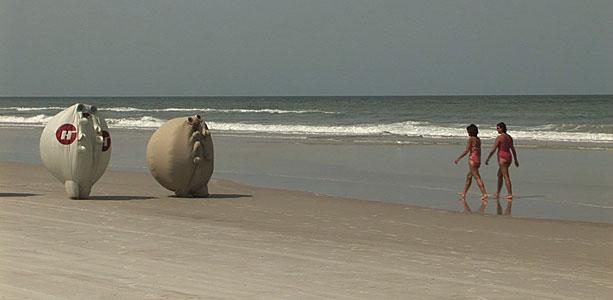
Courtesy the Yes Men
The Yes Men demonstrate SurvivaBalls in their new film, "The Yes Men Fix the World."
By Jillian Steinhauer
Published: October 7, 2009


Courtesy the Yes Men
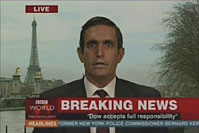
In
2004, Andy Bichlbaum of the Yes Men impersonated a representative of
Dow Chemical and apologized on BBC World News for a chemical leak by
one of the company's subsidiaries that killed 3,000 in India.
In 2001, Dow Chemicals acquired Union Carbide for $9.3 billion, and three years later, on the 20th anniversary of the Bhopal catastrophe, a spokesman for Dow went on BBC World News to announce that the corporation would finally take full responsibility for the disaster. He added that Union Carbide would be liquidated and its money used to help survivors and residents of Bhopal. The value of Dow’s common shares promptly sunk by $2 billion. This story would be a frustrating yet promising capitalist tale that suggests there could be accountability in the corporate world, but for one small problem: The last bit isn’t true. Someone did apologize on behalf of Dow and say the company would help cover medical costs in Bhopal, but it wasn’t a Dow spokesperson. It was a man calling himself Jude Finisterra, who these days more often calls himself Andy Bichlbaum. But that’s not his real name either. It may be easier just to identify him as one half of the activist, culture-jamming duo the Yes Men. The other half goes by the pseudonym of Mike Bonanno, and together the two have made a habit of fibbing their way into fairly important situations: a spot on BBC World News; a 2006 post-Katrina New Orleans housing summit with Mayor Ray Nagin and Louisiana Gov. Kathleen Blanco; GO-EXPO, Canada’s largest oil conference; and various business conventions and meetings. Once there, decked in thrift store suits, they impersonate spokesmen for various big-name companies or government officials and either present outrageous “corporate” solutions to problems like climate change (one example: the SurvivaBall, a ridiculous, massive, ball-shaped suit designed to protect its wearer from all types of climate catastrophes — “truly, a gated community for one,” according to faux promotional literature) or make official announcements, as in the Dow/Bhopal disaster, that they feel corporations or government agencies should be making themselves. They also create fake Web sites for real companies, which tend to confuse people into thinking they’re the real thing and gets them the invitations to the conferences they crash. Having been at it for roughly a decade, the Yes Men have a fairly established routine by now —role playing, if you will, with a strong comedic bent — and yet “we are changing what we do all the time,” Bichlbaum told ARTINFO over the phone last week. “There are all different kinds of things to do. We’re not wedded to continuing to crash conferences.” Indeed, in the past year they have ventured from fake Web to fake print, putting out a quite convincing-looking dream edition of the New York Times last November (top headline: “Iraq War Ends,” plus others like “Nationalized Oil to Fund Climate Change Efforts” and “All Public Universities to Be Free”) and, just two weeks ago, an environmentally focused edition of the conservative New York Post that covered real, previously unreported stories about the threats of climate change (top headline: “We’re Screwed”). In fact, the New York-based Yes Men seem to be popping up just about everywhere in their hometown these days. Bichlbaum, Bonanno, and a cadre of volunteers distributed the faux Post around town on Sept. 21, the day before the U.N. Summit on Climate Change. The next morning they took to the East River at 21st Street to promote the SurvivaBall and launch “Balls Across America,” their civil disobedience campaign in which they plan to get arrested all over the country (and call on others to do the same) to raise awareness about environmental issues. Bichlbaum unwittingly kick-started the campaign that morning: The NYPD arrested him on an outstanding bicycle ticket (received for riding through Washington Square Park, which is illegal), while officers handed out tickets and summonses to other participants because the group didn’t have a parade permit. “It was a major cultural experience,” he says of spending a night in jail. And he was quite pleased with the incident for the unlikely spotlight it cast on the group. “One of the principals of civil disobedience is that it makes your life uncomfortable but gets a lot of press,” Bichlbaum says, sounding a bit like a professor, his other occupation — he’s a faculty member at Parsons under his real name, Jacques Servin. (Bonanno is also a professor, teaching at Rensselaer Polytechnic Institute as Igor Vamos.) Meanwhile, it’s unlikely that the New York buzz around the Yes Men will fade anytime soon. The Yes Men Fix the World, a documentary created by the duo in collaboration with Bowling for Columbine and Fahrenheit 9/11 editor Kurt Engfehr, has its U.S. premiere tonight at Manhattan’s Film Forum and runs there for two weeks. The movie chronicles and contextualizes the highlights of their activism, from the 2004 Dow/BBC stunt through last year’s fake New York Times, in what has become a fairly typical satirical voice-over style for exposé documentaries (think Michael Moore but less annoying), with a humorous and lighthearted approach. Premieres in New Orleans and Bhopal follow on Oct. 10, and Bichlbaum and Bonanno are scheduled to attend a handful of the New York screenings, presenting Survivaballs and hosting activist friends like Reverend Billy. The New York art world, which has long bestowed the Yes Men with a fuzzy “artist/activist” title, is also getting in the game. Public art organization Creative Time announced last week that it will award the duo its inaugural Leonore Annenberg Prize for Art and Social Change, for being “a legendary group of culture jammers [who are], through their longstanding practice of invading and subverting modes of corporate communication, at the forefront of a movement to produce substantive change in our world.” They will receive the $25,000 prize and present an interactive lecture at the Creative Time Summit on Oct. 23, at the main branch of the New York Public Library. But the prize, intended to honor “an artist who has committed her/his life’s work to social change in powerful and productive ways,” raises an interesting question: Are the Yes Men artists? It’s a tricky query, unanswerable for lack of strict definitions. They don’t court or inhabit the art world, but then again, artistry can’t be strictly defined by the art world. It’s not a big stretch to see them as performance artists of a sort, who use CNN and government conferences as their stage rather than galleries and performance spaces. Do they see themselves as artists? “No,” says Bichlbaum, who amusingly adds, “But we don’t mind if others see it that way, because it means they might give us money. It also might inspire talented young people who are in art school and considering a gallery career to look at doing something different with their talents.” It’s a short step from there to wondering what distinguishes art from activism, if anything. Can all activism be considered art? “There doesn’t have to be a line,” Bichlbaum says. “People make art because they want to change things, and we’ve been really explicit about wanting to change things. We don’t really care what art means.” |
advertisements
|





 Save to Del.icio.us
 Digg this