by Emily Gertz
categories:
Activism, Art, Imagining the Future, Jobs & Economy, Media, Popcult
Published
October 04, 2009 @ 08:11PM PT
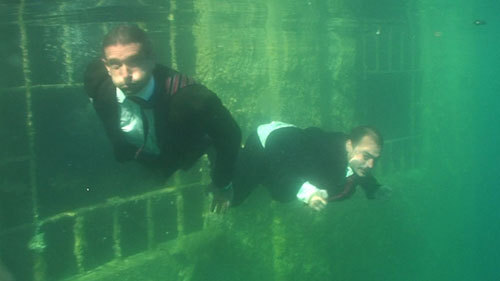
The Yes Men travel a fine line where art, social change, and
sophisticated media hacking intertwine. In their entertaining new film,
"The Yes Men Fix the World,"
duo Andy Bichlbaum and Mike Bonanno also do water ballet -- in between
documenting their shrewd, blackly humorous pranks, which expose how
ready corporations are to capitalize on human suffering.
In this, their second film, the Yes Men turn the humor on themselves
as well. Between recounting their hoaxes, the two men splash around in
a wide expanse of water, dressed in full suit-and-tie corporate drag,
asking themselves (and the audience): Why engage in either art or
activism, when so little seems to change as a result? Are we just a
couple of insignificant drops in a sea of inhumanity?
In their most famous media hack to date, the duo set up a slick faux-corporate website called dowethics.com.
A couple years later, in 2004, an invitation to appear on the BBC News
arrived in email. Bichlbaum, posing as a Dow Chemical spokesman named
"Jude Finisterra," told a global audience of 300 million (as well as a
wholly taken-in BBC crew) that Dow would pay $12 million in reparations
for the 1984 pesticide leak at a Union Carbide factory in Bhopal,
India, that killed and sickened tens of thousands. (Dow bought Union
Carbide in 2001 but has not made any move to either compensate victims
or clean up the factory site.)
Dow's market value plunged by $2 billion in less than a half hour
after the broadcast -- a handy demonstration of how much the current
incarnation of capitalism values profits over ethics.
 Lately
the Yes Men have turned their attention to corporate culpability and
profiteering in the face of climate change. The film follows them to a
major petroleum industry convention. As representatives of Exxon, they
present a new biofuel called Vivoleum, made from the victims of climate
change. They hand out candles made of the fuel to a largely
unquestioning audience and light them, before being ushered out of the
hotel as trespassers.
Lately
the Yes Men have turned their attention to corporate culpability and
profiteering in the face of climate change. The film follows them to a
major petroleum industry convention. As representatives of Exxon, they
present a new biofuel called Vivoleum, made from the victims of climate
change. They hand out candles made of the fuel to a largely
unquestioning audience and light them, before being ushered out of the
hotel as trespassers.
And at a "Catastrophic Loss" conference, the pair introduce the SurvivaBall,
"an advanced new technology will keep corporate managers safe even when
climate change makes life as we know it impossible." It's an orb-shaped
inflatable suit that will allow those who can afford it it to survive
the severe floods, searing heat, water shortages and other nuisances
climate change is likely to cause.
Far from finding the idea outrageous, conventioneers eagerly hand
over their business cards and chat about the SurvivaBall's
profit-making potential.
At this point in the film, Bichlbaum and Bonanno conclude that it's
"going to take more than two guys with cheap suits and fake web sites
to fix the world." They enlist friends to help create and distribute a
fake edition of The New York Times. Headlined "Iraq War Ends" the
faux-Times features upbeat stories like, "Nation Sets Its Sights on
Building Sane Economy," and "Nationalized Oil To Fund Climate Change
Efforts."
Seeing that "the New York Times parody really inspired people," the
pair realize that along with using their talents to highlight corporate
malfeasance, they can also create realistic visions of what a more just
world could look like.
This is the answer -- or at least one answer -- to the question of
why to make art and work for social change, and particularly why to mix
them together. The Yes Men afflict the powerful by exposing the
inhumanity at the core of unfettered capitalism so skillfully and
hilariously that they -- and we -- come away inspired to fight another
day.
 Animal Rights
 Genocide
 Human Trafficking
 Social Entrepreneurship
 Criminal Justice
 Global Health
 Humanitarian Relief
 Sustainable Food
 Education
 Global Warming
 Immigration
 Universal Health Care
 Gay Rights
 Homelessness
 Poverty in America
 Women's Rights

 Facebook
 Twitter
 Digg
Digg StumbleUpon
 Delicious
 Email
Email


