
Home > Movies > News

DAY 5
Spirituality and Art
Two films at Sundance, Arlen Faber and Art & Copy, force the viewer to contemplate dual influences in our lives—God and advertising.
By Bob Davidson | Posted 01/23/09
PARK CITY, Utah—One of the more overtly "spiritual" films at Sundance this year is Arlen Faber. This romantic comedy follows the life of best-selling author Arlen Faber (Jeff Daniels) and his "Purpose-Driven-Like" book, Me and God—a
conversation between Arlen and God. Arlen asked the questions. God
(might have) provided the answers. Arlen writes. Arlen achieves
enormous success. God seemingly disappears. Arlen avoids society.

A scene from 'Arlen Faber'
|
Director John Hindman invites the audience into an
opportunity that most anyone would dream of—an encounter with the
divine. What questions would we ask? How would we respond?
One of the most unique aspects of Sundance (and most
film festivals) is the ability to hear from its directors and writers.
When asked why he wanted to cover spiritual subject matter, Hindman
suggested that he wanted to address the "something" under the surface
that we all seem to be scratching at. At the same time, it becomes a
commentary on those who claim to fully understand this mysterious
reality.
Hindman admits that he wanted to bring the person with these presumptions (i.e. Arlen) to his knees—an idea that he literally follows through with.
What does this say about the way our culture
perceives evangelicals? What does this say about the church's posture?
What would happen if we let go of the need to provide answers, but
instead practiced the art of listening to the questions?
All questions that I continue to consider.

A scene from 'Art & Copy'
|
I've been taking notes throughout each film I see here, and by the end of Art & Copy,
I had six pages. In my favorite documentary here to date, director Doug
Pray provides a wide and deep look into the advertising industry and
its impact on our culture. However, while most would assume a
documentary with such a subject matter would bash the practice and its
negative impact on society, Pray chooses to bless it. The story is not
about companies. It's not about product. And it's ultimately not even
about culture's response. It's about artists and their little (or big)
window to the world.
Pray humanizes the industry by capturing the angst
behind the artists that have created some of the greatest and
influential ad campaigns we've ever seen. Campaigns such as "Just Do
It" and "Got Milk?" are ultimately the creative expressions of a few
individuals. They are not trying to become rich, or merely to peddle a
product. They are people who see things which have become obscured and
bring them to the surface. These artists have the unique ability to see
something that is true, however benign or substantive, and begin their
art with that truth.
As crazy as it might seem, I left appreciative of
the spaces that have infiltrated our televisions and occupied our
billboards. Sure, many abuse such spaces. Sure, the abundance has its
negative effects. But what would happen if we shifted our perspective?
What would happen if instead of copy, we saw expression? Instead of
product, we saw art?
I am sure we will all have plenty of opportunities to ponder today. According to Art & Copy, about 5,000 opportunities. Every day.
* * * * * * * * * *
DAY 4
Getting My Self out of the Way
Through thought-provoking movies like Cold Souls
and others at Sundance, and with assists from my prof and C. S. Lewis,
I'm learning to "surrender" when it comes to art appreciation.
By Bob Davidson | Posted 01/22/09
PARK CITY, Utah—Wednesday was the most time
intensive day I will experience at Sundance. We had class all morning
(more on that in a moment) and then I was able to catch three wonderful
films in the afternoon and evening: Cold Souls, Paper Heart, and Sin Nombre.

A scene from 'Cold Souls'
|
Cold Souls
has kept us talking. With a blend of absurdity and realism, director
Sophie Barthes has developed a story surrounding actor Paul Giamatti
and his burdened soul. Giamatti, who (sort of) plays himself, becomes
intrigued by an emerging technology that can extract one's soul from
body. Subsequently, soul storage facilities have popped up in order to
hold the weight of someone's world in a small glass container.
The absurdity of such an idea hits home when the
audience is confronted with whether they would entertain an option to
remove their own burdens. As Charlie Kaufman explored in Eternal Sunshine of the Spotless Mind,
Barthes asks whether or not "numbness" is a worthy choice. What are we
losing? Does that which we have labeled "the soul" contain the essence
of what it means to be human?
Between the conversations of Cold Souls and Sin Nombre, there's a prominent question I wrestle with on a personal level. What really is the difference
between experiencing a film at Sundance versus my local theater and/or
living room? Is there a difference? Is it the atmosphere? Does waiting
in line for over four hours immediately make a film better? (Yes, I
waited this long for Brief Interviews with Hideous Men.)

A scene from 'Sin Nombre'
|
Then it hit me.
This is my last class as a theology student. Through partnerships between Fuller's Brehm Center and its Colorado Regional Site (which has championed this class
at Sundance), I have had the opportunity to take multiple classes
surrounding theology, film, and the arts. Under the leadership of Craig Detweiler and Rob Johnston, co-directors of the Brehm Center's Reel Spirituality Institute, I have been trained in what might best be called "public theology" and/or "interpretive leadership."
The difference (for me) is not Sundance.
Sure, the interaction with filmmakers and long wait lines affects the
overall experience, but these are mere peripherals. The difference is
not even the films themselves. Personally, what has shifted is how I
now walk into a film—my mindset as I enter the theater.
Here at Sundance, Detweiler acts as our tour
guide. Before we dove into our marathon of films, he invited us to
reflect on C.S. Lewis' words out of An Experiment in Criticism:
"The first demand any work of any art makes upon us
is surrender. Look. Listen. Receive. Get yourself out of the way.
(There is no good asking first whether the work before you deserves
such a surrender, for until you have surrendered you cannot possibly
find out..)"
What would happen if we attempted to remove
ourselves from the art we experience? From the people we encounter?
Sure, such a task is unavoidable on many levels, but should this negate
any attempt? If I have learned anything in my theological journeys, it
is that God is the one revealing. Not me.
* * * * * * * * * *
DAY 3
To Be Loved? Or to Love?
That is the question of the day, posed by two Sundance films about "hideous men" and a person with Asperger's syndrome.
By Bob Davidson | Posted 01/21/09
PARK CITY, Utah—It is Day 3 on this Sundance journey
and many have inquired exactly how the festival works. Here's a general
landscape:
This year, more than 9,000 films were submitted to
Sundance. Only 118 films were selected (not including shorts); however,
only 64 are up for "competition," which falls into four general
categories: U.S. Documentary, U.S. Dramatic, World Cinema Documentary,
and World Cinema. Because every film at Sundance must be a "premiere,"
most show up without distribution, only hoping that someone picks it up.
In the U.S. Dramatic Competition, two favorites come to the fore: Adam and Brief Interviews with Hideous Men. Interestingly, both share similar themes and questions.

A scene from 'Brief Interviews'
|
Brief Interviews with Hideous Men
is the much anticipated adaptation of David Foster Wallace's novel of
the same title. First time director John Krasinski, better known as Jim
Halpert from The Office, pursues the question "What do women want?" through the imperfect nature of men. Through interviews with men, the answers to that question seem to transcend gender—that being loved
is paramount amidst the harsh realities of life. Consequently,
Krasinski does not wrap this film in your typical Hollywood bow and
allows the joys and cost of authenticity to stand as is.
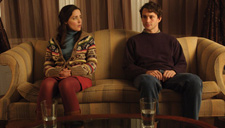
Adam
is a brilliant and captivating story about two twenty-somethings (Adam
and Beth) who find themselves living in the same New York building.
Just when you think this is going to be another predictable love story,
we discover that Adam (Hugh Dancy) has Asperger's syndrome—a
high functioning form of autism that can diminish a person's ability to
process emotions and/or non-verbal communication. Adam is an innocent
yet brutally honest individual who is nothing more than refreshing when
juxtaposed to a room of seemingly "normal" people. Director Max Mayer
pushes this subjective notion by exploring how one "sees the world."
What might we learn from observing how a person with Asperger's
interacts with reality? Here lies the beauty of this film. Adam is
gifted with the ability to see thing "as they are"—escaping the
societal tendencies to hide and conceal. Consequently, Beth is left to
ponder how to love someone that might be more "normal" than we think.
A scene from 'Adam'
|
The question is thrown back to us: How do we see the
world? As Christians, do we avoid dealing with reality? I am reminded
of Christ's interaction with his disciples in Matthew 13,
and his warning about having eyes that don't see and ears that don't
hear. Are we missing God's ultimate reality because of our cultural
tendencies to see what we want to see? Hear what we want to hear?
In the end, both Brief Interviews and Adam
deal with the topics of truth and love; however, come at both via
different directions. The former tackles truth through how to speak it,
the latter how to see it. While Brief Interviews explores what it means to be truly loved, Adam challenges the notion that being loved is our greatest task, instead inviting the audience to explore what it means to simply be loving.
So, have these films been "picked up"? Will you get a chance to see them? I can only confirm that Adam was picked up yesterday by Fox Searchlight and can only assume that the deals for Brief Interviews with Hideous Men are in the works.
* * * * * * * * * *
DAY 2
Obama and the Spirit of the Dance
Fittingly, on the eve of an historic
inauguration, two films about racial relations stir the discussion even
more—and a bunch of theology students join the conversation.
By Bob Davidson | Posted 01/20/09
PARK CITY, Utah—It is inauguration day and there is
a definite "Obama anticipation" in the streets at Sundance. Signs are
tacked on store fronts inviting event goers to step in to watch history
unfold. Filmmakers who received the Tuesday morning slot were sweating.
And bus conversations interweave the new administration with the films
of the day.
A scene from 'Prom Night'
|
While today's historic event certainly marks a shift
in our nation's posture toward racial inequality, independent
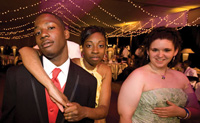
filmmakers don't want to assume our racial struggles are over. Prom Night in Mississippi has created quite a buzz for documenting the first-ever racially integrated prom at Charleston (MS) High School—in 2008.
Academy Award winner Morgan Freeman, a Mississippi resident, offered to
fund the prom in 1997 under one condition: It had to be fully
integrated. He was ignored. Freeman made the offer again last year, and
this time the school took him up on the offer.
Toe to Toe
tells the tale of an on-again-off-again friendship between two lacrosse
teammates at a prep school—a wealthy white girl and a Princeton-bound
African-American girl, who happens to live on the "other side" of town,
one of Washington D.C.'s poorest areas. The story not only reveals the
prominent racial divides that continue to exist in our cities, but in
our schools as well. Why do lunch rooms still look segregated? Why is
an American high school just now having its first racially-mixed prom?

A scene from 'Toe to Toe'
|
One of the most intriguing aspects of Toe to Toe
is the statistic that inspired it—that 87% of interracial friendships
for American teenagers end at the age of 14. The film prompted memories
of my own childhood and some of the closest friendships that eventually
ceased. Is this really a commentary on children or the adults that lay
the constructs? Is the filmmaker the prophet? Do these realities speak
to the Church as well?
Preceding the screening, Toe to Toe director Emily Abt said, "I hope you like it. But if you don't, I at least hope you talk about it."
And this is the beauty of Sundance, where every
director and writer begs for dialogue to surround their film. But I am
less convinced we are trained as film viewers (and Christians) to truly
discuss film. We tend to walk into a movie with our minds already
formed, or simply measure a film by its mere "entertainment" value.
Enter the Windrider Film Forum.
Windrider was started by John and Ed Priddy (of Priddy Brothers Entertainment) in order to provide space for just this: continued conversation. Through the generosity and partnership of the Mountain Vineyard Church
in downtown Park City, theology and film students alongside filmmakers
are given a space to converge, right in the heart of Sundance.
When Christians hear that a bunch of theology
students have set up shop at one of the world's most secular or
"liberal" venues, they applaud the attempts to "bring God" to such a
pagan culture. But that's not what Windrider is about. In his book How (Not) to Speak of God,
Peter Rollins writes, "Instead of bringing God to unreached peoples and
unreached places, I find countless missionaries who say that while this
was what they once thought, time and again they find that these
unreached places are the very sites where they must go to find God and
to be reached."
The Windrider name is inspired by the Hebraic word ruach,
which means "spirit." And this forum is simply an invitation to ride
the Spirit that blows. And having experienced the festival scene and
Windrider multiple times, we have no intentions of "bringing God" to
Sundance—for we are certain he is already here.
* * * * * * * * * *
DAY 1
It's the Economy, Stupid
As Sundance begins, CT Movies correspondent Bob
Davidson starts watching lots of movies and discovers two prominent
themes—the economy and change.
By Bob Davidson | Posted 01/19/09
PARK CITY, Utah—There are few places in the world
that you can leave a theater at midnight only to return for another
movie before sunrise. Enter the Sundance Film Festival.
Known for its advocacy for the independent artist and the occasional
celebrity sighting, Sundance has been welcoming film fanatics for 25
years to not only experience film, but to interact with its creators.
This week, I plan to do both.

A scene from 'Let's Make Money'
|
I am a theology student, Windrider Forum participant (more on this tomorrow), and film lover. My first trip to Sundance was in 2007, where an encounter with one film (Save Me) shook my entire perspective on Sundance, homosexuality, and Christianity.
I have returned not only with new expectations, but new questions, and
CT Movies has asked me to write a daily journal about the experience.
So, here we go.
It did not take long to discover that couple of themes stand prominent at the 2009 festival: the economy and change. After four films in 24 hours, two documentaries have kept my viewing companion (Rob) and me in consistent conversation. Let's Make Money
looks intently at the neo-liberal methods that have monopolized the
world's economic structure. By following the actual flow of currency,
director Erwin Wagenhofer's unveils the myths of a free market system
and just who is "making money" at the expense of the poor. While the
current economic crisis is shaking the consumerism mentality,
Wagenhofer and crew believe it is not enough. We continue to bail out
in order to stay "in it."

Ryan Smith (left) and Cowart working on 'Relapse'
|
The Yes Men Fix the World tackles similar economic systems, but by choosing absurdity as its medium. Andy Bichlbaum and Mike Bonanno (a.k.a. The Yes Men)
are two pranksters who wonder if the only way to open the eyes to
corporate injustice is to take on the identity of the corporation
themselves. After setting up fake websites in order to attract speaking
engagements, Mike and Andy impersonate powerhouse execs at various
industry conferences in order to offer practical alternatives to
current paradigms—a reality that "could be." What would it look like if
companies thought about environmental impact before production? If
corporations actually admitted when they were wrong? If wars were not
dictated by consumerism? If the value of the dollar was not the same as
human life?
But are these not the same injustices that Christ spoke against? Are these not the questions the church should be asking?
And it is here at Sundance of all places that theology and film meet. In his book, The Prophetic Imagination,
Walter Brueggemann not only reminds the church that it is just as
encapsulated in thoughtless consumerism as the rest of the world, he
asserts that it is the prophet's role to call us out of such
consciousness, and energize the culture. After the film, the room was clearly energized. During the following Q&A, people asked things like "What can I do?" and "How can I get involved in this kind of change?"
The question that strikes me here is: Who is the prophet? The church? Or the filmmaker?
Bob Davidson, a Fuller Theological Seminary student pursuing his Masters of Theology, Bob is co-founder of Project rednoW, a theological conversation via the art of wonder.
Copyright © 2009 Christianity Today. Click for reprint information.
Comments or questions? Send us feedback.
Browse More Movies
CT Movies Home Page | Now Showing | New on Video | All Reviews
Coming Soon | Discussion Guides | Film Forum | Interviews | Commentary
News & Misc. | Special Sections | About Us
Your Feedback | About Us | CT Mag Home Page
| 


