Open Thread
by openthread
Sun Oct 18, 2009 at 06:32:01 PM PDT
Jibber jabber.
- Permalink ::
- There's more... (105 comments)
SUBSCRIBE! (or exclude from AdBlock)
If you use ad blocking software while viewing Daily Kos, you're getting all the benefits of our site but we're not getting any of the advertisement revenue associated with your visits. This site relies on ad revenue for daily operations: a decrease in the number of ads seen means a decrease in the funding available to run the site, to pay those that work on it, and to create improved site features.
We won't stop you from using ad blocking software, but if you do use it we ask you to support Daily Kos another way: by purchasing a site subscription. A subscription is an inexpensive way to support the site that eliminates the advertisements without using ad blocking software.
Revenue generated from the subscriptions goes to the Daily Kos fellowship program, providing a steady income for bloggers and allowing them to concentrate full time on expanding the reach and influence of the netroots through a variety of projects.
By using ad blocking software, you may be hiding the site ads but you're also reducing the site's primary source of revenue. So if you must use one, please do your part to support the site and the people that bring it to you by purchasing a site subscription today.
To exclude Daily Kos from Adblock Plus, in Firefox click Tools > Adblock Plus > click on Add Filter, and copy/paste @@http://*dailykos.com/* to the field, then click Add Filter at the bottom of the window, then OK.
As the polls begin to turn in the direction of the Democrats in the state of New Jersey this month, Garden State Republicans could be forgiven for feeling a sense of familiar dread as the countdown to Election Day drones onward.
The New Jersey GOP was going to kick the football with George W. Bush, and then with Doug Forrester. Most painfully, perhaps, they were going to kick it for sure in 2006, when Tom Kean Jr. seemed prime to knock off appointed U.S. Senator Robert Menendez. While less sanguine about their chances against Barack Obama, they thought that they had a reasonable shot at octogenarian Senator Frank Lautenberg, whose approval ratings lagged for much of the 2008 electoral cycle.
Alas, all for naught. Not only did the New Jersey GOP get shut out on all of those races, at the end of the day, they weren't even all that close. John Kerry's seven point victory in 2004 was the closest Republicans came to the taste of victory in the past five years in statewide elections.
But 2009? This was going to be different for them. This time, they were certain to grab the brass ring.
They had an incumbent Democratic governor to target, a man whose approval ratings languished in the 30s. Polling throughout 2009 had confirmed that the toughest political job to keep in America may well be Governor. They had a well-known political figure as their standard-bearer, who they had worked extremely hard to package as a tough fighter against the evils of government corruption.
And...yet...the final weeks of October have come, and the election in New Jersey is in a very familiar place. What was once a sizeable lead for Chris Christie has completely evaporated.
Statistically, the recent evidence has been a bit jarring. The last ten weeks of the campaign show a distinct movement in the favor of Democrats. That movement becomes particularly stark in the last few weeks.
Consider the best example of this phenomenon: Menendez-Kean, 2006:
Polling Data, 2006 U.S. Senate Race in New Jersey (# of Polls in Parentheses)
Aug 1-Sep 15, 2006: Kean +1.4 (7 polls)
Sep 15-Oct 15, 2006: Menendez +1.7 (13 polls)
Oct 15-Nov 7, 2006 Menendez +5.4 (25 polls)
FINAL RESULT: Menendez +9 (53-44)
In 2008, the same effect could be seen in the 2008 Senate race, although the effect in that campaign was not quite as sharp, because Zimmer trailed Lautenberg by a modest margin throughout the campaign:
Polling Data, 2008 U.S. Senate Race in New Jersey (# of Polls in Parentheses)
Aug 1-Sep 15, 2008: Lautenberg +11.1 (8 polls)
Sep 15-Oct 15, 2008: Lautenberg +11.0 (7 polls)
Oct 15-Nov 4, 2008: Lautenberg +15.5 (8 polls)
FINAL RESULT: Lautenberg +14 (56-42)
In 2009, despite the situational dynamics being dead-set against Democratic Governor Jon Corzine, we are seeing the same dynamics occurring again. Looking at a slightly different time frame, the progression is nevertheless quite clear:
NJ Governors Race, Average Lead For Chris Christie
July 1-31, 2009: Christie +9.6 (8 polls)
August 1-30, 2009: Christie +7.4 (10 polls)
Sept 1-30, 2009: Christie +5.6 (11 polls)
October 1-15, 2009: Christie +1.0 (11 polls)
(Source for all of the above data found here)
Now that the scoreboard confirms that the phenomenon is real, and not the stuff of Democratic dreams and Republican nightmares, it is worth exploring the possible causes for this phenomenon, which might allow Jon Corzine to defy the odds and attain a once-improbable reelection victory.
1) Democratic Voters On the Fence
One possible explanation for this late shift in numbers is that, in
New Jersey at least, most of the fence-sitters in electoral politics
lean a little bit to the left. There is some solid recent evidence for
this: in the most recent poll by Quinnipiac,
the highest number of undecided voters, by far, were in urban areas, a
region that Corzine leads Christie by nearly 30 points. As those voters
come home, they are likely to come home to the Democrats. By contrast,
only four percent of voters are undecided on the Jersey Shore, which is
Christie's best region by far.
Every pollster I checked in the last month that had a breakdown of the data registered more undecided Democrats than Republicans. Of course, that discrepancy was even more stark earlier in the summer (in one poll over the summer by PPP, only 8% of Republicans were undecided, while 16% of Democrats remained on the fence). This discrepancy explains, in part, the tightening numbers over the past few months.
2) Relatively Undefined Republican Candidates
Another thing that Democrats have indirectly benefitted from is the
fact that, in many cases, the Republican challengers have been largely
undefined. This allowed their Democratic opponents ample opportunity to
define (or ill-define, as it were) the GOP standard bearers.
Certainly, that has happened this year. The most recent poll from Quinnipiac had Chris Christie sitting on a mediocre 38-40 favorability spread. When Quinnipiac polled the state just after the June primaries in New Jersey, Christie was sitting on a much more robust 36-16 spread in his favorabilities. In other words, in the four months since the primaries, Christie has gained scant few fans, and a whole host of detractors.
Part of that is on Christie. If Corzine and his team have done a solid job of defining the challenger, it is only because Christie has foolishly made himself easy to define. It has become readily apparent that Christie was content to coast on his lead, which had been built up on the simple calculus of an embattled governor being challenged by...well...some guy.
Christie assiduously avoiding defining his campaign, or his future administration, in anything other than broad platitudes that bordered on self-parody. By the time the campaign kicked into high gear, the Christie campaign had earned such a reputation for vagueness that even the right-wing Wall Street Journal called him out for it. This gave Corzine yet another avenue of attack, in which he has now been joined by Independent candidate Chris Daggett.
The net effect--the newly defined Chris Christie is far from beloved by the New Jersey electorate, and even an embattled Democratic governor starts to look better in comparison.
3. The State, It Is A-Changing
Having said all of that, perhaps Christie's penchant for
equivocation, and his subsequent reluctance to provide concrete
remedies for the state, are a smarter strategy than we think.
New Jersey is a state in transition. In 1992, it was narrowly carried by Bill Clinton. It was a two-point win, even as the Arkansas native was winning nationally by nearly six points. In 2008, Obama's margin of victory here (fifteen points) was well beyond his national margin of victory.
Look, even more simply, at how voter registration by party has shifted in the Garden State. New Jersey, at least in recent generations, has always had more registered Democrats than Republicans (and voters who decline to affiliate are greater than both). But look at what has happened in the past decade. From 1998-2008, Democrats gained a net of nearly 641,000 new voters in the state. During the same time frame, the GOP was able to gain a net of merely 183,000 new voters. This is, to say the least, a substantial discrepancy.
This is a state where hard-right appeals are unlikely to work, and where the Republican Party's label is badly damaged. Christie inadvertently admitted as much in July, when he put together a new ad on urban renewal in two languages, and intentionally omitted his party affiliation in the Spanish-language ad.
None of this, of course, should be interpreted as any sort of prediction that Governor Corzine has this thing locked up. Far from it, the Governor is still leader of a state during an economic time where virtually no decisions that he makes will please people. Furthermore, and counter to the conventional wisdom, he might be hurt by the Daggett boomlet. It is not hard to fathom that some of Daggett's support is coming from moderate Republicans (the type of GOP voter that used to abound in the northeastern US) who might otherwise find voting for a disciple of Karl Rove to be a bit too much to take. Corzine certainly faces challenges.
But so, too, does Christie. An incumbent languishing in the low 40s in the polls two weeks out from Election Day is usually consigned to the political trash heap. And yet Democrats are very optimistic about their chances here, and the Republicans seem very, very concerned.
Apparently, both sides are well scripted in the lessons learned from old Peanuts cartoons.
Race tracker wiki: NJ-Gov
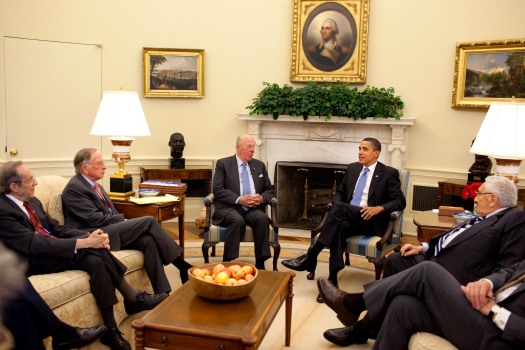
(May 2009. Official White House photo by Pete Souza.)
At the beginning of January 2007, four well-respected US statesmen got together and published an extraordinary editorial in the Wall Street Journal. It was based on their 40-plus years of experience in national and international affairs, working with both Democratic and Republican presidents.
George Shultz, William Perry, Henry Kissinger, and Sam Nunn had this to say:
Nuclear weapons today present tremendous dangers, but also an historic opportunity. U.S. leadership will be required to take the world to the next stage -- to a solid consensus for reversing reliance on nuclear weapons globally as a vital contribution to preventing their proliferation into potentially dangerous hands, and ultimately ending them as a threat to the world.
Nuclear weapons were essential to maintaining international security during the Cold War because they were a means of deterrence. The end of the Cold War made the doctrine of mutual Soviet-American deterrence obsolete. Deterrence continues to be a relevant consideration for many states with regard to threats from other states. But reliance on nuclear weapons for this purpose is becoming increasingly hazardous and decreasingly effective.
The piece goes on to mention President Reagan and General Secretary Gorbachev's historic summit in Reykjavik nearly twenty years ago, during which the two leaders discussed ending the nuclear arms race once and for all. The authors list very specific answers to their ultimate question:
What should be done? Can the promise of the NPT [Nuclear Non-Proliferation Treaty] and the possibilities envisioned at Reykjavik be brought to fruition? We believe that a major effort should be launched by the United States to produce a positive answer through concrete stages.
Several weeks later, Mikhail Gorbachev voiced his support, saying:
We must put the goal of eliminating nuclear weapons back on the agenda, not in a distant future but as soon as possible. It links the moral imperative -- the rejection of such weapons from an ethical standpoint -- with the imperative of assuring security. It is becoming clearer that nuclear weapons are no longer a means of achieving security; in fact, with every passing year they make our security more precarious.
Meanwhile, that very same year, a new, rather ambitious Democratic Senator was working with a long-time Republican Senator on a nuclear non-proliferation bill. S.1977 essentially followed the principles laid out in the January 2007 Wall Street Journal editorial, specifically:
The provisions of S. 1977 include the following: support for an international nuclear fuel reserve to discourage countries from building their own uranium enrichment capability; additional funding to strengthen the inspection capabilities of the International Atomic Energy Agency (IAEA); talks with Russia to further reduce global nuclear arsenals; progress on a verifiable global ban on the production of fissile material for weapons; reconsideration of the Comprehensive Test Ban Treaty; expansion of export controls and interdiction capabilities; and the establishment of a commission to develop recommendations about U.S. nonproliferation policy.
The bill became known as the Obama-Hagel Nuclear Weapons Threat Reduction Act. The entire bill never became law, but essential parts of it were adopted as amendments to other bills.
Fast-forward to November 2008. The young, ambitious Democratic Senator who sponsored that bill handily wins the US presidential election. For the first time since the Reagan years, we finally have someone in the White House who is very vocal about his interest in eliminating nuclear weapons. Indeed, he even gave a pivotal speech early one April morning Prague which many seem to have forgotten, a speech in which he expressed his desire to negotiate a new START treaty, ratify the Comprehensive Test Ban Treaty, pursue a treaty to end the production of weapons-usable fissile material, strengthen the Nuclear Non-Proliferation Treaty, and a number of other goals.
Not unsurprisingly, the "four statesmen" who penned that January 2007 Wall Street Journal editorial strongly support President Barack Obama's nuclear arms control agenda. Most recently, they spoke up about his chairing of a September 24, 2009 meeting of the UN Security Council, in which the Council unanimously adopted a US-drafted resolution "to seek a safer world for all and to create the conditions for a world without nuclear weapons...", lauding the resolution as but one of many critical steps the president intends to take toward moving away from the Cold War state of mind that has characterized the US "nuclear state of mind" for so long.
So when Barack Obama was awarded the Nobel Peace Prize last week, the only people who weren't surprised were those of us who follow nuclear weapons issues, and actually read the Nobel Peace Prize committee's press release. Among other things, it said:
The Committee has attached special importance to Obama's vision of and work for a world without nuclear weapons.
I spoke to Daryl Kimball, the Executive Director of the Arms Control Association, about his thoughts on Obama winning the Nobel Peace Prize. I think he clears up a lot of the uncertainty that many have expressed.
Clearly what the Nobel Committee is doing is they are recognizing the fact that Obama has embraced and championed an action plan for reducing the threat that nuclear weapons will be used, that they will spread, and for the steps he's actively pursuing, to reduce the number and role of nuclear weapons so that we can achieve a world without nuclear weapons.
I think... it underscores the value and the importance of US leadership -- not necessarily Obama in particular, but US leadership -- on this issue. Only the United States can shape the debates in the ways that it needs to be shaped in order to deal with the multiple problems and challenges we face with nuclear weapons.
He's meeting with some early successes here that could lead to more dramatic gains in the near future. Like many Nobel Prizes... they're providing positive reinforcement for an American administration that is moving in a direction that the international community supports, and for which there is growing bipartisan consensus here in the United States.
[snip]
If you notice in the speech he gave to the General Assembly, on the 23rd of September... there was a section on nuclear issues. He said that our nuclear posture review will reduce the role of nuclear weapons in US strategy, and open the way for deeper reductions in nuclear arsenals.
That can only mean a couple of things: that he intends to reduce the role of nuclear weapons, and achieve deeper reductions, meaning deeper than 1,500, which is the target number for this next round of US-Russian reduction in this interim START follow-on agreement.
So I think it [the Nobel Peace Prize] puts an exclamation point, or a double underline on that statement, because it seems as though the man says what he means and he means what he says, and it is going to be more difficult for some elements in the bureaucracy who support the nuclear status quo to dig in their heels against a president who seems very committed to effecting transformational change. I think this Nobel Peace Prize is going to make that all the more difficult for them to resist change.
Finally, the historical context of the Nobel Peace Prize is important to note. Specifically, it has been awarded for ongoing nuclear non-proliferation efforts before. I'll use the example of the 2005 Nobel Peace Prize, which was awarded to Mohammed ElBaradei and the International Atomic Energy Agency:
"for their efforts to prevent nuclear energy from being used for military purposes and to ensure that nuclear energy for peaceful purposes is used in the safest possible way"
ElBaradei gave a brief interview regarding Barack Obama's Nobel Peace Prize. You can watch it here; I'd like to emphasize his answer to the third question put to him:
Q: As a Nobel laureate yourself, how do you think this will impact on President Obama's future work?
Well, there has been already, in the last couple of hours, a lot of skepticism, what has Barack Obama achieved, why the rush to give Barack Obama the Nobel Peace Prize?
I think these people misunderstand the motive of the Nobel Prize Committee. The Committee sometimes crown[s] achievement, but in many cases encourage, you know, people who are on the right track, and I heard the Committee's chairman today, basically he is echoing what he said in our case, in the Agency case, and myself, that not necessarily rewarding a complete work, but encouraging a person or an organization to continue on the track that they have chosen to follow, and in that case, in the case of Barack Obama, they are saluting his commitment to disarmament, they are saluting his commitment to an inclusive system of security, they are saluting his commitment to a code of moral values, that it's about time we restore in our relationship as individuals, as a nation, his effort to move across a divide, to focus on what unites us as human family and not what divides us, irrespective of ethnicity, color, or religion. I think it's an inspiration to everyone one of us.
So this a prize that will give him the moral authority, that will give him additional visibility to continue doing what he is doing, and we all should share with him in his commitment to have a world that is at peace with itself, a world that we can -- a better world that we can leave to our children and grandchildren.
Winning the Nobel Peace Prize is indeed an honor, but it is also a responsibility. Those who realize the dangers posed by nuclear proliferation understand and applaud Barack Obama's intention, and ongoing efforts, to make sure our national security goals set an example for other nuclear powers in the world.
It's time to move beyond Cold War "old-think", as Daryl Kimball told me.
Obama knows this. Let's hope he keeps on that path.
Bardwell has said he always asks if a couple is interracial and, if they are, refers them to another justice of the peace. Bardwell said no one had complained in the past and he doesn't marry the couples because he's worried about their children's futures.
"Perhaps he's worried the kids will grow up and be president," said Bill Quigley, director of the Center for Constitutional Rights and Justice, referring to President Barack Obama, the son of a black father from Kenya and a white mother from Kansas.
Obama's deputy press secretary Bill Burton echoed those sentiments.
"I've found that actually the children of biracial couples can do pretty good," Burton told reporters aboard Air Force One as it flew to Texas.
The new demands are leading some officials, both inside and outside the agency, to raise the possibility of the service curtailing or dropping its role in fighting financial crime to focus more on protecting leaders and their families from assassination attempts and thwarting terrorist plots aimed at high-profile events.
"If there were an evaluation of the service’s two missions, it might be determined that it is ineffective . . . to conduct its protection mission and investigate financial crimes,’’ according to a internal report issued in August by the Congressional Research Service.
Pigs still can't fly, but this winter, the mayor of Moscow promises to keep it from snowing. For just a few million dollars, the mayor's office will hire the Russian Air Force to spray a fine chemical mist over the clouds before they reach the capital, forcing them to dump their snow outside the city. Authorities say this will be a boon for Moscow, which is typically covered with a blanket of snow from November to March. Road crews won't need to constantly clear the streets, and traffic — and quality of life — will undoubtedly improve.
Delete: The Virtue of Forgetting in the Digital Age
By Viktor Mayer-Schonberger
Hardcover: 256 pages, $24.95
Princeton University Press: Princeton, NJ
October 2009
Since the beginning of time, for us humans, forgetting has been the norm and remembering the exception. Because of digital technology and global networks, however, this balance has shifted. Today, with the help of widespread technology, forgetting has become the exception, and remembering the default. How and why this happened, what the potential consequences are for us individually and for our society, and what--if anything--we can do about it, is the focus of the book.
If the measure of a successful book is how long you spend thinking about its premises and conclusions long after you've finished it, then Viktor Mayer-Scholberger's Delete a blockbuster. Even after I decided after much thought that I disagreed with his theories, they are theories that haunt, raising questions about personal identity, memory and ultimately our relationships with our own individual histories.
A couple strands of the book are straightforward and non-controversial. Early on, Mayer-Schonberger runs through a quick overview of the rise of curating human knowledge, from oral storytelling and memorization through clunky tablets and unwieldy papyrus to popular books. It's a good, quick sketch of the evolution of documentation, which led, the author argues convincingly, to a "shared memory" and a "community of belonging." So far, so good.
He then begins to make a strong case for enforcing informational privacy, that our digital trail should belong to us and that few of us realize how many of our details are available to corporations and government. For those of us who are aware of how just how long everything is stored, particularly those of us who use social media or comment and write on the web, the author has a specific concern: "... fostered by our knowledge of the vast digital memories that Google and others have about us, we may thus become overly cautious about what we say--in other words, the future has a chilling effect on what we do in the present."
It is along around here that skepticism began to seep in for me. Mentioning this in passing, note it, propose a couple of solutions and move on? Sure, why not. But if this were a novel, passages such as the following would be but a foreshadowing of greater preoccupation--I would argue nearly obsessed preoccupation-- to come: "... once we realize that information can reach anyone, we'll err on the side of caution and if in doubt censor ourselves rather than risk incalculable damage."
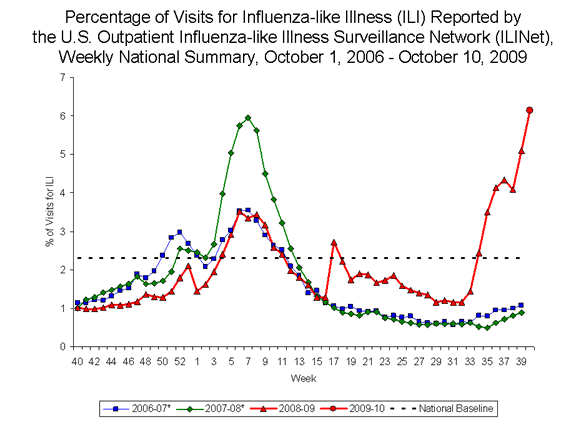
It's hard to ignore the concern in the wording of the latest weekly CDC flu update.
The influenza-like illness that we track with our ILInet sentinel provider system is showing higher levels of illness than we saw last week. Again, these are unprecedented levels of illness. The national average is about 6.1% of doctors visits, for purposes of influenza-like illness that's very high at any time particularly in October. We also track mortality around the country. Through something called the pneumonia and influenza mortality survey with 122 cities. And for the first week this fall, we're seeing that the amount of influenza and pneumonia mortality is above the epidemic threshold. All of these things may suggest it's a very busy and difficult flu season and we are seeing very high levels of activity around the country. We are also having updates on the pediatric deaths. Unfortunately those are going up as well. There are now a total of 86 children under 18 who died from this H1N1 influenza virus, the 2009 H1N1 influenza virus. We had 11 more influenza pediatric deaths reported in week 40, which is the week that ends October 10. Ten of those are confirmed to be due to the new strain, the 2009 H1N1 strain and the 11th is probably due to that but the typing hasn't been completed. About half of the deaths that we've seen in children since September 1st have been occurring in teens between the ages of 12 and 17. These are very sobering statistics, unfortunately, they are likely to increase...
We hope that the continuing deaths in children will be as few as possible but this is a very brisk number, usually in a whole season that lasts from going to September all the way to may, you would only have about 40 or 50 deaths so in just one month's time we've had that many.
Yet even as the data show increases in flu cases (widespread in most states) and increases in mortality, the public remains skeptical about vaccination. It isn't disinterest. The latest Pew poll clearly shows that folks are paying attention:
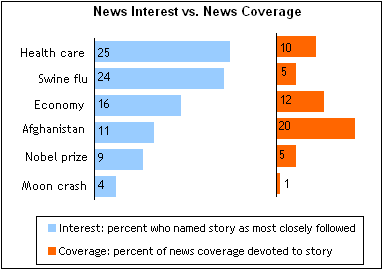
It may be under-appreciation of risk, but that will sort itself out over time. Here's why I say that (see red line):
Still, right now the public health officials and the public are not sharing exactly the same concerns (vaccine safety is a considerable public issue and perception of safely is what's on public health's radar.) As outlined by John Solomon on his blog via an anonymous public health expert (comments I've heard myself), public health officials are concerned about three things:
"My biggest concerns as of the moment:
1) Concerned that a substantial portion of country may be infected before vaccine arrives — will depend on speed with which epidemic moves in next month, as well as speed with which vaccine can be delivered to states, as well as how fast states are able to get vaccine into people.
2) Concerned that large numbers of persons who could get vaccine will choose not to vaccine because of concerns that it is experimental or untested — great deal of misinformation out there on the streets. The Paul Offit editorial in [Monday's] New York Times describes many of the widely circulating beliefs about the vaccine and the actual facts. Poll about 2 weeks ago showed that while 60% of American parents willing to get their kids vaccinated for seasonal flu, only 40% were planning on their kids vaccinated for H1N1 – even though almost all of the flu circulating now is H1N1.
3) Concerned that antiviral resistance could develop –so far there is no sustained neurominidase inhibitor resistant strain circulating, just single cases popping up and very rarely. If sustained resistance occurred, we would lose key tool for treating the sickest patients. It is good sign that no sustained resistance has developed so far, but it would be a non-linear event if it happened. No accepted view from the hard core flu virology community on the likelihood of this happening or not."
Luckily, there's no current evidence for other than occasional cases of antiviral resistance. And how's the vaccination plan going? Here are the basics: with current technology, flu vaccine takes six months to make. With the description of the new virus in print in mid-April, we are now six months in, vaccine is now being made, and it is just now rolling out for inoculation. Is it timely? Yes. Is it timely enough? No, because the virus didn't wait for us. We could have closed schools to slow spread, but that would have cost us between 10 and 47 billion dollars in a recession (reserved for a more virulent bug.)
In fact, the vaccine is slow to arrive, as many of us predicted (an easy prediction because nothing goes as planned on paper.) Here's how much we'll need, based on CDC projections:

But for right now we only have 11.8 million on hand and delivered, and 40 million doses scheduled for October arrival; the rest will be here in November. That means health care workers will get vaccine offered to them first, along with young children and pregnant women and kids with underlying conditions. Healthy children less than 24 will go next, followed by 25-64 year olds with underlying conditions. After that, healthy adults, and after that, healthy seniors. There's room in line for everyone, but the kids go first. That is the message we have been passing along since September: with pandemics there are always shortages of staff, space and stuff, and that should be the expectation and part of planning.
And so once we have vaccine will everyone ask for it? Not even close, according to Pew, although for context remember that only 20-30% of the public gets vaccinated every year against flu, and that includes seniors (75% vaccination rate), who get vaccinated more than any other group (8% for pregnant women, less than 30% for asthmatic kids younger than 17.)
Overall, fewer than half of Americans (47%) say that they would get the swine flu vaccine if it was available to them; an identical percentage says they would not get the vaccine. A clear majority of Democrats (60%) say they would get the swine flu vaccine if it was available, compared with 41% of Republicans and the same percentage of independents.
It might seem like Democrats are more inclined to trust this government, and that the anti-Administration bent of right wing nutters is taking a toll. After all, there's a partisan edge to this:
More than half of Republicans (54%) say news reports are overstating the swine flu's danger, compared with 42% of independents and just 35% of Democrats.
But given that this is a political blog, think of this as if it were an election. The main issue is not the hard core opposition (they are always there, fixed in their thinking, and not subject to rational discussion), it's the reasonable and persuadable public that needs convincing that this vaccine is safe, and they won't be reached by yelling at the nutters. To put this another way, there are legitimate concerns about wanting to see safety data that should be addressed rather than ignored. For example, whenever something gets studied, it ought to get published asap and made available. Here's a good start:
By day 21 after vaccination, antibody titers of 1:40 or more were observed in 116 of 120 subjects (96.7%) who received the 15-µg dose and in 112 of 120 subjects (93.3%) who received the 30-µg dose. No deaths, serious adverse events, or adverse events of special interest were reported. Local discomfort (e.g., injection-site tenderness or pain) was reported by 46.3% of subjects, and systemic symptoms (e.g., headache) by 45.0% of subjects. Nearly all events were mild to moderate in intensity.
Do rare adverse events happen? Sure. But the rare real event doesn't mean everyone else should, for example, abandon flying.
Sullenberger Flies Fateful Route Again, to Cheers
And if you were on that plane and won't fly the route again, bless you, I understand.
Absent more data like that above, safety is the number 1 issue (Pew again):
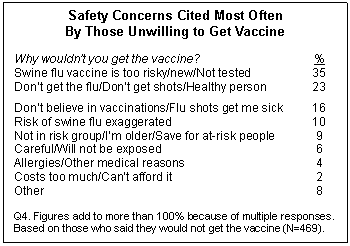
Note that only 16% "don't believe in vaccination" (even that small number includes those who think flu shots make them ill, which can happen for the egg allergic or those who have had previous reactions) and that as many (9%) "want to give their slot to someone who needs it more" as those (10%) who think "the swine flu risk is exaggerated". The big chunks of concern are safety (35%) or those who simply think they are too healthy to worry (23%).
The betting is that local deaths will increase demand, while stories about side effects will do the opposite. But if those flu numbers keep spiking, demand will start to grow.
So what's the best way to proceed? Follow the advice in this Nature editorial:
Public-health authorities, who are keen to contain the pandemic's spread, need to realize that their best hope of dealing with such public reluctance is to patiently address the concerns that underlie it.
Sometimes, it's true, those concerns go beyond any appeal to reason. They grow out of a visceral mistrust of authority in general - and of government, regulatory agencies, medical researchers and multinational pharmaceutical companies, in particular. A sophisticated anti-vaccine movement has emerged that plays on this wariness, and helps to feed the conspiracy theories about the H1N1 vaccine that are circulating on the Internet and in viral e-mails.
But far more often, say researchers who have studied this subject, people are assessing vaccination through a perfectly rational cost-benefit analysis.
[snip]
More generally, for officials and researchers at all levels, the scepticism over the pandemic vaccine should serve as a timely reminder of the imperative to work to gain greater public trust in science-based advice and in those who give it.
Most vaccine skeptics have legitimate reasons for concern and are indeed making their own decisions for this voluntary program. Think of them as the independents. I completely agree with the thrust of the editorial, and think it's worth time to discuss the pros and cons of vaccination with them. It'll save lives to do so.
Oh, yeah, and there's this:
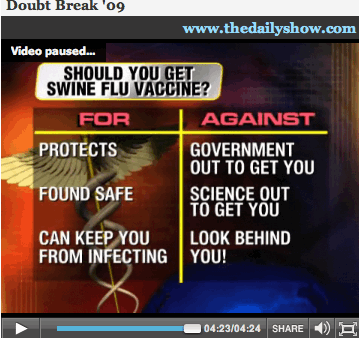
Skepticism is healthy. And as I noted here, I think a persuasive voluntary program is the best way to get as many people as possible to accept vaccination. In the meantime, I reserve the right to give the nutters a hard time.
See Rimjob's recommended diary on vaccine fact and fiction. There's more to skepticism than just the nutters, but they're no help at all.
Last time we talked how money is raised for a business by issuing stock. But there’s another way to raise money: borrow it, which means a lender is needed. If you as an investor lend the US Treasury money, it’s called a Treasury bond or note. Loan a municipality money and it’s called a municipal bond. Loan a corporation money, say for example our hypothetical company from last week called World's Best Hotdogs, and what do you think it’s called? Correct, a corporate bond.
In the old days, bonds were a fancy piece of paper, a legal written document, with the conditions spelled out something like this:
This certificate from World's Best Hotdogs entitles John Doe to $50.00 installments paid on the 1st of December and June of each year, for ten years. The last interest payment will include the Face Value of $1000.00 to be paid on Dec 1, 2019.
This hypothetical bond is paying ten per cent -- 50 dollars in Dec
and June -- and comes due, or matures, after ten years. Some of the
old-style bonds even had little detachable coupons printed on them. 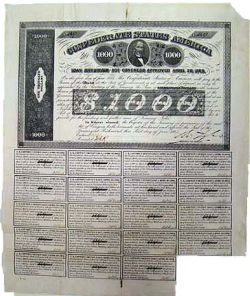 In
the image below you can see where the bond holder has clipped off one
of coupons and presumably mailed it off to collect that interest
payment (Good luck with that considering this bond was issued by the
Confederacy during the Civil War). That's why the initial interest rate
stated on the bond is called to this day the 'coupon rate.'
Some bonds don't pay yearly interest; you get it all on the maturity
date, those are called 'zero coupon bonds'. But nowadays most bonds are
held in 'book entry' in a bank or brokerage account. The interest payments hit the account just like a direct deposit paycheck.
In
the image below you can see where the bond holder has clipped off one
of coupons and presumably mailed it off to collect that interest
payment (Good luck with that considering this bond was issued by the
Confederacy during the Civil War). That's why the initial interest rate
stated on the bond is called to this day the 'coupon rate.'
Some bonds don't pay yearly interest; you get it all on the maturity
date, those are called 'zero coupon bonds'. But nowadays most bonds are
held in 'book entry' in a bank or brokerage account. The interest payments hit the account just like a direct deposit paycheck.
Suppose after making the loan to WBH, a few later before the bond matures, John Doe wants his principle back even though the company is making his interest payments? Well, he can go to the bond market to sell, or transfer, the piece of paper to another person who wants it. Good question, what's the bond worth?
Remember, the coupon rate on our sample WBH ten-year bond was fixed at 100 bucks a year when it was issued, so if interest rates in general have gone up since then, Mr. Doe's bond will be worth less than the thousand dollars he paid for it. Let's say John Doe sells it for $500, since it's paying $100 a year, the bond is now currently yielding 20 per cent to the new buyer! And since it will be worth one thousand dollars on maturity in another few years, the total yield to maturity will be even more.
Interest rates are important! When the fed raises short term interest rates, already issued bonds trading on the bond exchange may go down a little and vice-versa. Just like earnings, banks and broker-dealers pay analysts huge bucks to try and predict future interest rate changes.
When you’re thinking about loaning money, what are the worries? If you said 'how safe is this loan,' you’re right! Naturally, the riskier the loan, and/or the longer it’s going to take to get paid back, the more interest you should get. A T-note is backed by the full faith and credit of the US Treasury Department is considered pretty safe, so the interest isn’t very high. The risk of loaning to a corporation is harder to judge, it depends a lot on the company asking for the loan, how well they're doing, how long they've been doing it, how much debt do they have, etc. If a corporate bond is really risky, it has to pay a lot of interest to attract investors, those high yielding bonds are often called ‘junk'.
Most regular Joe’s – what brokers call retail investors -- have neither the time or expertise to dig into the issuing company’s books or future projections year after year. Fortunately, there are private companies called rating agencies which audit the company and the terms of the bond for you. Most bond rating agencies use a system that ranks bonds from very safe (Like AAA or Triple A) all the way down to something really horrible, (Like single D). When you look at a bond quote on an exchange, it might look something ike this:
World's Best Hotdogs 10yr AA Rated Note 12/1/09 Paydate Dec & Jun
Last Trade: 1000 Volume: 50 Coupon Yield: 10% Current Yld: 10% YTM: 10%
Now, here’s a dilemma: Those rating agencies are paid by the company to rate that same company’s bond[s]. The better the rating the less the company has to pay in interest. We’re talking tens of thousands of bonds per issue, so we’re talking about millions of dollars or more in interest. The rating agency knows the company wants the best rating possible and, like any customer, will be more likely to come back for repeat business if they get a good one. Aha! The rating agency has a big conflict of interest between keeping their corporate customer happy and getting more business, and putting out the most accurate rating for potential investors.
This conflict reared its ugly head during the mortgage meltdown. It turned out that some rating agencies had put their seal of approval, via a high and therefore safer rating, on a bunch of corporate bonds that depended on a strong mortgage market. Investors bought those bonds believing they were relatively safe because of the high rating, and they accepted a low interest rate as part of the deal. Even worse, in some cases it is alleged that some rating agencies just let the issuing company say what their rating should be! When the mortgage market crashed, you can guess what happened to the investors.
You might wonder at this point, isn’t that illegal, or at least an example of gross negligence on the part of the rating agency? Maybe, although so far the credit raters have miraculously escaped accountability. Isn’t someone in the government supposed to be watching over this stuff? And the answer there is, yes, someone is supposed to be, the question will get too eventually is why weren’t they, and how will Congress make sure they will be watching in the future?
Sunday funnies. Yanks win.
In the debate over health care reform, no issue has produced more fury and sound bites than the question of whether to include a government-run insurance plan. It is not indispensable, and its role would be limited. Even so, we strongly support inclusion of a public option — the bigger and stronger the better. That is the best way to give consumers more choices, inject more competition into insurance markets, hold down the cost of insurance policies, and save money for the federal budget.
Goldman is this century’s octopus — almost literally so. The most-quoted sentence in financial journalism this year, by Matt Taibbi of Rolling Stone, describes the company as a "great vampire squid wrapped around the face of humanity, relentlessly jamming its blood funnel into anything that smells like money." That’s why Goldman’s chief executive, Lloyd Blankfein, recycled Rockefeller’s stunt last week: The announcement of Goldman’s spectacular third-quarter earnings ($3.19 billion) was paired with the news that the company was donating $200 million to its own foundation, which promotes education. In Goldman dollars, that largess is roughly comparable to the nickels John D. handed out to children a century ago. At least those kids could spend the spare change on candy.
In places like Egypt, Syria, Saudi Arabia, Afghanistan or Pakistan you have violent religious extremist movements fighting with state security services. And while the regimes in these countries are committed to crushing their extremists, they rarely take on their extremist ideas by offering progressive alternatives. That’s largely because the puritanical Islamic ideology of the Saudi state or segments of the Pakistani military is not all that different from the ideology of the extremists. And when these extremists aim elsewhere — like at India or at Shiites or at Israelis — these regimes are indifferent. That is why there is no true war of ideas inside these countries — just a war.
The tyro American president got the Nobel for the mere anticipation that he would provide bold moral leadership for the world at the very moment he was caving to Chinese dictators. Awkward.
[Peter] Wehner, hilariously, sneers, "Very few columnists have a degree in psychology. E.J. Dionne is not one of them. He should therefore leave the psychological explanations to others who are better equipped to deal with such matters." This was two paragraphs after diagnosing numerous figures with Bush Derangement Syndrome!
There is no longer any need to get bogged down in this phony debate, which itself constitutes an abuse of the fair-mindedness of the rest of the media. One glance at Fox's Web site or five minutes randomly viewing the channel at any hour of the day demonstrates its all-pervasive political slant. The lefty documentary Outfoxed spent a lot of time mustering evidence about Fox managers sending down orders to reporters to take the Republican side. But after 13 years working for Roger Ailes, Fox employees don't need to be told to help the right any more than fish need a memo telling them to swim.
 Worlds collided this week, as the Ron Paul Revolution turned its sights on Sen. Lindsey Graham, in what marked an escalation in the battle over the future of the GOP.
Also coming under attack was Sen. Olympia Snowe.
Meanwhile, Party Chairmoon Steele was busy rewriting the past.
And Rush Limbaugh's words came back to haunt him.
What a mess.
Somebody grab a mop.
Tonight's rescue brought to you by Blank Frank, HoosierDeb, shayera, sunspark says, vcmvo2, and ybruti, with srkp23 editing.
jotter serves up High Impact Diaries: October 16, 2009.
carolita brings Top Comments 10-17-09 -- Justice Edition.
Enjoy and please promote your own favorite diaries in this open thread.
According to Politico, John Ensign's Q309 fundraising is down 90% from the previous quarter:
The sex scandal surrounding Sen. John Ensign has had a devastating effect on his once-mighty fundraising machine.
According to newly filed campaign finance reports, Ensign pulled in just under $33,000 between July and September; that's down from the $301,792 he raised in the previous quarter. He spent more than he raised last quarter, shelling out $46,000 on legal fees, meetings, political consultants and administrative expenses.
Let's put this another way: in Q309, the amount of cash John Ensign added to his campaign kitty was less than one-third the amount of hush money his parents gave to the family of his mistress.
Race tracker wiki: NV-SEN
New Jersey Governor, polled by The New York Times, 10/9/09-10/14/09, Likely Voters, MoE +/- 4-5%
Jon Corzine (D) 40
Chris Christie (R) 37
Chris Daggett (I) 14
After a week in which Republican challenger Chris Christie has watched poll after poll showing a dwindling lead in the gubernatorial race in the Garden State, this poll is the first to show a Corzine lead of greater than a point.
What's more, among registered voters, the polls lead really expands:
New Jersey Governor, polled by The New York Times, 10/9/09-10/14/09, Registered Voters, MoE +/- 3%
Jon Corzine (D) 40
Chris Christie (R) 30
Chris Daggett (I) 13
That would seem to suggest that the pool of persuadable voters, who are not yet quite sold on voting, is even more anti-Christie than the corps of likely voters identified by the New York Times.
This is, by far, the best polling performance by Corzine since last winter. It is also the first poll that would be able to gauge the effects of the latest campaign scandal to hit the Republican nominee--the revelation mid-week that Christie had billed the taxpayers for luxurious travel that often (over 87% of the time last year) exceeded government limits.
This is a scandal that has some legs, because it runs counter to the "corruption fighter/good government" meme that Christie has tried to flog incessantly.
It is also a scandal that shows no signs of abatement. The latest revelation? Apparently, Chris Christies loves himself some stretch limousine service:
Brown also approved another controversial expenditure for Christie: a $700 round-trip limousine ride between Newark and Atlantic City. Christie, according to his schedules, was attending the annual dinner of the County Prosecutors Association of New Jersey. He was shuttled to Atlantic City, stayed over night at the Taj Mahal, submitted $190 in expenses, and took the same limo service back to Newark the next day. Brown approved the final travel voucher for Christie's reimbursement. According to the limousine service, a $700 round-trip fare from Newark to Atlantic City gets you a stretch limo that seats 8.
Christie is starting to push back on the story, but he does not seem to be pushing very hard, and his rationales do not seem to be very good:
"My secretary made my hotel reservations every time I had to travel and the instructions were very clear: find a government rate if you could, and if you couldn't, get me the best rate at the most convenient hotel," explained Christie yesterday. Asked if he signed all of the accompanying paperwork, he responded, "Yes, I have to sign my own forms, but I don't always know what government rate is."
But later in the piece, it is pointed out that he has to submit paperwork when he exceeded the government limit:
Christie submitted a waiver for the room in Boston, as required. In it, he requested additional lodging expenses because there were no rooms available at the $203 per night government rate "due to a high demand for rooms."
Unless there is a logical leap being missed here, this appears to make no sense. How can Christie claim he did not know what the government rate was, when he had to submit paperwork for a waiver every time he exceeded the government rate?
Another fairly sketchy part of the story is that any requests for waivers had to be signed off on. Christie's waivers were signed off on by Michele Brown, his assistant U.S. Attorney, constant travelling companion, and loan recipient. Any waivers for Brown were signed by...Chris Christie. A third party then signed off on the waivers.
Christie would seem to have some explaining to do on the lush travel arrangements. A quick tally by Millennium Radio's Kevin McArdle shows that Christie exceeded federal travel limits 77% of the time between 2004 and 2008. Given such an astonishing frequency, the "hey, sometimes every hotel in the city was booked" excuse isn't going to hold out for long.
Race tracker wiki: NJ-Gov
Coming up on Sunday Kos ....
The Lamont-Lieberman race really is a treasure trove of bankrupt Beltway CW 180 degrees opposite of reality.
Here's Cokie Roberts:
During a panel discussion on the August 6 broadcast of ABC's This Week, ABC News chief congressional analyst Cokie Roberts asserted that it would be "a disaster for the Democratic Party" if businessman Ned Lamont were to win the Connecticut Democratic Senate primary against incumbent Joseph I. Lieberman on August 8. Roberts's comments came in response to a question from host George Stephanopoulos, who asked her to explain why there has been such strong opposition to Lieberman because of his support for the Iraq war. She later explained: "I think that ... pushing the party to the left, which is what's likely to happen, is pushing the party to the position from which it traditionally loses ... presidential elections." She also stated that "it will send a signal to everybody in the Senate: 'Watch out. The only smart thing to do here is play to your base.' And then ... what that means is that your legislation becomes a mess," in which case, "you get ... total chaos."
However, as ABC News national correspondent Sam Donaldson pointed out, opposition to the war is not simply playing to the base, "it's playing to the country," since the majority of the American public opposes the war in Iraq. Despite that fact, Roberts later concluded that if Lamont wins, "I think you start, you know, talking about the liberal blogs and all that taking over the party," a result she said would be "a disaster."
Give credit to Sam Donaldson. He didn't get wrapped up in the Beltway hysteria. That's a genuine accomplishment. Cokie Roberts, on the other hand, was wrong, wrong, wrong. Not that anyone at ABC News or in DC cares.
AFSCME's McEntee takes on W.H.
By: Ben Smith
October 17, 2009 05:33 AM ESTThe president of one of America’s largest labor unions, Gerry McEntee, has emerged as a major obstacle to the White House’s efforts to maintain a unified front in the health care debate.
Here's the part that sets up what interests me:
"We have had just about enough of his gratuitous slaps," said a senior White House official Friday, calling the politically charged language "outrageous and unacceptable" from an ally — even from one that had, the official noted, devoted substantial resources to health care efforts.
And now, the part itself:
McEntee’s posture – and the fierce response from a White House determined to keep allies in line – reflects a broader dilemma on the left of the Democratic Party, which is feeling both lingering satisfaction at Obama’s victory and frustration at his caution.
The fierce response from a White House determined to keep allies in line...
...but not Democratic Senators, who continue to imply coyly that they'll vote "no" on cloture if the bill actually helps someone.
F you, boys.
"Allies" don't pass this thing. Senators do. Keeping "allies" in line is about keeping up appearances. Keeping Senators in line is about getting results.
Now, you could certainly argue that you use the soft touch with Senators, since they're a prickly bunch. But what does a hard line with "allies" get you, really? What's "unity" worth, exactly? What's it good for?
You'll get unity if you pass decent reform and are seen fighting for it. You'll need unity if you plan to shush critics, pass a piece of crap and call it a win.
Whip this m-fing vote, and be seen doing it.
You can't do this on every vote, on every issue. But this is the one you staked it all on.
I watched carefully the reporting of the Dow breaking 10,000 the other day and not anywhere did I see a major news organization include a paragraph of the "On the other hand, so fucking what?" sort, one that might point out that unemployment is still at a staggering high, foreclosures are racing along at a terrifying clip, and real people are struggling more than ever. In fact the dichotomy between the economic health of ordinary people and the traditional "market indicators" is not merely a non-story, it is a sort of taboo — unmentionable in major news coverage."
NEW YORK—According to a report published this week in American Journalism Review, 93 percent of all newspaper sales can now be attributed to kidnappers seeking to prove the day's date in filmed ransom demands.


There's a Cat in the Freezer: And Other Tales of Early Co-Habitation
It's Too Late for Brunch - Open Thread
Smudging, Paint, & Dreamcatchers
25 comments
44 comments
95 comments
63 comments
1042 comments
72 comments
317 comments
86 comments
3 comments
28 comments
2 comments
3 comments
2 comments
20 comments
2 comments
3 comments
12 comments
9 comments
3 comments
11 comments
54 comments
25 comments
13 comments
39 comments
4 comments
19 comments
18 comments
63 comments
11 comments
86 comments
97 comments
6 comments
5 comments
44 comments
72 comments
17 comments
45 comments
3 comments


Congress Matters
Daily Kos TV
Mother Talkers
Sports Blogs
Street Prophets
Twitter: @markos
Steve Gilliard (RIP)
Jed Report
Steve Soto
Swing State Project
Time to Pull the Plug
Albany Project (NY)
America Blog
Atrios
Balloon Juice
Blue Commonwealth (VA)
Blue Hampshire (NH)
Blue Jersey (NJ)
Blue NC (NC)
Buckeye State Blog (OH)
Burnt Orange Report (TX)
Calitics (CA)
Juan Cole
Cooper Uncovered (TN-05)
Crooks and Liars
Brad DeLong
Digby
The Field
Firedoglake
Five Thirty Eight
FLA Politics (FL)
Glenn Greenwald
Huffington Post
Iraq Casualty List
Jack and Jill Politics
Jesus' General
Lawyers, Guns, and Money
Lefty Blogs (local blogs)
Mudflats (Alaska)
Needlenose
Oliver Willis
Open Left
Pandagon
Political Cortex
Political Wire
Sanctuary
Show Me Progress (MO)
Square State (CO)
Talk Left
Talking Points Memo
Tapped
Tom Tomorrow
James Wolcott
ePluribusMedia
Kicking Ass (DNC)
The Stakeholder (DCCC)
NDN Blog
The Field
Square State
Feministe
Texas Kaos
Slashdot
Think Progress
FLA Politics
Robert Reich
Marc Ambinder
Vet Voice

© Kos Media, LLC
Site content may be used for any purpose without
explicit permission unless otherwise specified.
"Kos" and "Daily Kos" are registered trademarks of Kos Media, LLC
Privacy Policy
Powered by Scoop.


