



Say Yes to the Mess
The Yes Men take responsibility; plus, an epic from John Woo and a housewife's secrets
Comments (0)Thursday, December 03, 2009
 Shadow Distribution photo
** 1/2 The Yes Men Fix the World
Written and directed by Andy Bichlbaum and Mike Bonnano. (NR)
For almost a decade the Yes Men, operating under the noms de guerre Andy Bichlbaum and Mike Bonnano, have executed stunts that make crashing a White House state dinner look like child's play. They build a fake corporate Web site, wait for a conference or news organization to take the bait, then impersonate a spokesman at the event or on the news. Chaos ensues within hours, if not minutes, but their points — about globalization, unbridled capitalism, and human rights — have been made. Their story was told in Chris Smith, Dan Ollman and Sarah Price's fine documentary The Yes Men, and for those who have been wondering what these merry pranksters have been up to since 2003, they've made their own film, assisted by Michael Moore co-producer/editor Kurt Engfehr.
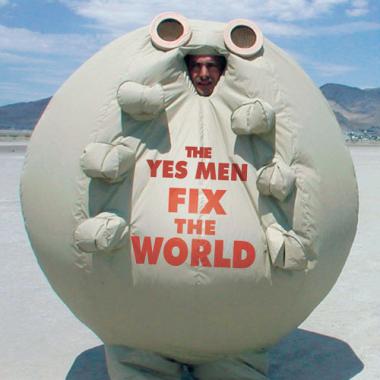
Therein lies one of the problems with The Yes Men Fix the World, which, with its first-person narration by Bonnano feels very much like a Michael Moore film. Lacking the restraint imposed by an outsider's lens, Bichlbaum and Bonnano fall to mugging for the camera. But the greater problem is the stunts themselves. The Yes Men's tactics generally fall into two categories: either they say exactly what you wish corporations would say — taking full responsibility for an environmental disaster, for example — or they present a ludicrous invention that takes capitalist dogma to its Swiftian extreme. Here the former succeed both as comedy and catharsis. The latter fall flat, pale copies of Bichlbaum's jaw-dropping pro-slavery presentation in The Yes Men. Their new inventions are an Exxon fuel made from corpses (with apologies to their grandfathers, both of whom died in the Holocaust) and a Haliburton "survival ball" affordable only by the very rich, a point made with more wit in Roland Emmerich's 2012. And that's a sentence I never thought I'd write.
But then there's Bichlbaum, masquerading as the assistant deputy secretary of HUD, sitting on the dais next to New Orleans Mayor Ray Nagin, announcing the reopening of condemned housing projects and Exxon and Shell's restoration of wetlands lost to oil refineries. A prank, yes, but it's also a call for common decency, as the Yes Men call their production company, hard to laugh at and harder to ignore.
** 1/2 Red Cliff
Directed
by John Woo. Written by John Woo, Khan Chan, Kuo Cheng and Sheng Heyu.
With Tony Leung, Takashi Kaneshiro and Chang Chen. (R)
Red Cliff, the John Woo two-part historical blockbuster that topped Titanic's box-office record in mainland China, has made it to these shores shorn of 132 minutes. Left is what the director's fans expect: kinetic action, with staves and spears instead of two-fisted gunplay. But what's missing makes this Chinese Troy both inscrutable and simplistic, hardly able to sustain its two-and-a-half-hour running time.
Woo intends his film as a historical corrective to the 13th-century Romance of the Three Kingdoms, a mythic retelling of the Han Dynasty's attempt to quell a rebellion by the southern Xu and Wu kingdoms in 208 A.D. He has jettisoned the supernatural elements and reclaimed Wu Viceroy Zhou Yu as the hero, casting his Hard Boiled star Tony Leung. As for the other characters, Woo's claims of nuance seem to have ended up on the cutting room floor: the Han Prime Minister Cao Cao (Zhang Fengyi) is simply evil, Wu King Sun Quan (Chang Chen) is purely good, and the Xu Kingdom's military strategist Zhuge Liang (Takeshi Kaneshiro), shorn of his magical powers, merely boring. Interestingly, it's the women who prove indispensable in the nonsupernatural defense against the Han: Sun Shangxiang (Zhao Wei) in the familiar role of the warrior princess, and Xiao Qiao (Chiling Lin), the Helen for whom 2,000 ships were sunk.
Woo does retain the novel's invention of a ruse that causes the Han army to fire 100,000 arrows at decoy ships. It's one of the most memorable scenes in the movie, although it would have been better had so many of the arrows not been cartoons dignified by the term "CGI." But best is a scene in which Sun Quan and Zhou Yu jam on traditional instruments, which not only provides breathing room but the character development this shortened version sorely lacks. And for the considerable expense that must have gone into hiring 1,000 actors and all that CGI, the film has been lensed with a perversely shallow depth of field that throws anything more than a few feet from the camera out of focus.
**1/2 The Private Lives of Pippa Lee
Written and directed by Rebecca Miller. With Robin Wright Penn, Alan Arkin and Blake Lively. (R)
Pippa (Robin Wright Penn) and her husband Herb (Alan Arkin), a New York publisher 30 years her senior, have moved into "their weird new condo" in a Connecticut retirement community. Their life is still fabulous — Cornel West comes over for dinner — but, says Pippa as she's torching the crème brûlée, "I can't help wondering how many people have died here." But The Private Lives of Pippa Lee is not about the waning years of a May-December relationship, nor is it, as the title implies, about a woman with multiple personality disorder. No, Pippa's impending midlife crisis merely causes her to reexamine her repressed past, in which she fell upward like a Fielding hero.
Pippa is born with a coat of hair, a misfortune she soon sheds to pursue a life propelled by beauty and luck. Young Pippa (Blake Lively) fights with her pill-popping mother (Maria Bello), runs away to live with her aunt (Robin Weigert) and her "roommate" (Julianne Moore), and makes her way through drugs, stripping and lesbian S&M porn to an artfully distressed East Village squat. It's during her Rent period that she meets Herb, at a party in one of those white-box mansions in the Hamptons. Soon the fishnet gloves are off and Pippa has made herself over as the perfect housewife, setting the table with locally sourced fish and strawberries.
Lurking in the background is Chris (Keanu Reeves), a 35-year-old convenience-store clerk living with his mother (Shirley Knight). He has an enormous Jesus tattoo on his chest, so of course he is going to save her. But first Herb must do something awful, because Pippa cannot do anything that might jeopardize the audience's affections. "I don't want to make butterflied lamb anymore," says Pippa, but having developed no interests or ambitions over the years, she's like Betty Draper without the campaign to stop the water tank. It's enough to make one long for the '70s that Pippa left behind, when Carrie Snodgress discovered that she couldn't find herself in Frank Langella's bed. Pippa baby, you haven't come a long way at all.

 Print
Print Email
Email


 RSS feed


 |
The Yes Men take responsibility; plus, an epic from John Woo and a housewife's secrets
Film editor Phil Hall talks to the Weekly about his new book on the history of independent filmmaking
One's young, smart and restless; one's crazy; and one just happens to be in a wheelchair


