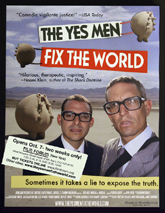
 Over
the past 10 years, the Yes Men have emerged as an infamously daring and
creative duo of anti-corporate pranksters. In their new movie, The Yes Men Fix the World,
Andy Bichlbaum and Mike Bonanno (known in their non-activist lives as
Jacques Servin and Igor Vamos) explain their methodology: "What we do
is pass ourselves off as representatives of big corporations we don't
like," they say. "We make fake websites, then wait for people to
accidentally invite us to conferences."
Over
the past 10 years, the Yes Men have emerged as an infamously daring and
creative duo of anti-corporate pranksters. In their new movie, The Yes Men Fix the World,
Andy Bichlbaum and Mike Bonanno (known in their non-activist lives as
Jacques Servin and Igor Vamos) explain their methodology: "What we do
is pass ourselves off as representatives of big corporations we don't
like," they say. "We make fake websites, then wait for people to
accidentally invite us to conferences."
When they are invited, the Yes Men pose as spokespeople for
companies such as Halliburton and Exxon, or bodies such as the World
Trade Organization, and they give presentations that highlight the
logic of corporate greed.
In one instance, on the 20th anniversary of the notorious chemical
plant disaster in Bhopal, India, Bichlbaum appeared on the BBC as a
representative of Dow Chemical, which now owns Union Carbide, the
company responsible for the 1984 calamity. He announced a $12 billion
plan to provide medical care to the 120,000 victims of the disaster and
to fully remediate the factory site. The company's market value dropped
$2 billion in 23 minutes before the hoax was discovered and Dow rushed
to explain that it was still refusing to meet the victims' demands for
justice.
The Yes Men Fix the World opened in New York City on
October 7 and begins showing in cities around the country on October
23. Shortly after the start of the New York run, the perpetually
mischievous Bichlbaum spoke with Foreign Policy In Focus senior analyst
Mark Engler.
MARK ENGLER: How have you felt about the reception of the film so far?
ANDY BICHLBAUM: Great. People have loved it.
They've taken to the streets. Every day last week, they left the
theater and stormed to a nearby destination. [Laughs.]
Of course we had people encouraging that. On Wednesday, somebody
from Rainforest Action Network showed up after the film and told the
audience about a nearby bank, Chase Bank, which is the last big bank
financing mountaintop removal coal mining. Pretty much the entire
audience went over and used coal to deface a branch of Chase Bank. We
drew all over the sidewalk in front of it, on the bank itself --
messages about how we felt about mountaintop removal. Hopefully at
least a few people saw that and understood the messages that we were
trying to send.
Making the film, we wanted it to be active. It was great to see that
all the organizers had to do was say to the audience, "yeah, come," and
the audience went. It feels great; it feels logical.
ENGLER: The idea of walking out of the theater with the audience reminds me of Steve Martin's memoir, Born Standing Up,
where he's experimenting with stand-up comedy in the 1970s. At a
certain point, he takes people out of the club at the end of his act
and continues the show by walking around with them. I wonder if there
are antecedents like this that have been significant for you?
BICHLBAUM: Well, we kind of stumbled into what we
do. Since then, we've discovered lots of people doing similar things.
We've been inspired by them. But what we do as the Yes Men didn't
happen because we looked at other people and thought, "Oh, we'll do
that." In our case it just sort of happened.
We wanted to go to the big Seattle protests in 1999, protests
against the World Trade Organization, and we couldn't make it. So we
set up a fake website that looked like the real WTO website. It didn't
occur to us that people would actually mistake the site for the real
thing and write to us, but they did. We eventually got invited to
business conferences, and we decided to go.
ENGLER: This November 30th is the 10-year anniversary of the Seattle protests. How has your activism changed in that span of 10 years?
BICHLBAUM: Over the last 10 years, I guess our
activism has gotten much more group-oriented and movement-oriented. Of
course, right from the beginning, it was spurred by what was being
called "the movement of movements," the anti-globalization movement.
And it was spurred by Seattle, which really put anti-globalization on
the map of the First World. It had been big in Mexico and elsewhere in
the developing world, where the effects of globalization were already
very strong. But Seattle really put it on our map.
It was out of that big action that we stumbled into our weird form
of activism. For a while we were happy to do hits making fun of the
WTO. And then, at a certain point, in 2003, somebody wrote to us who
was involved in the Bhopal struggle and said, "OK, you've made a lot of
comments about the WTO and the way corporate globalization hurts
people. Now maybe you could actually try to make a difference to a
specific struggle involving thousands of people who are very directly
hurt."
We decided to try to do something that would matter to the Bhopal
struggle. We set up a fake Dow website at dowethics.com. The rest is
history. We got invited as Dow onto the BBC, where we got our chance to
make this big announcement that resulted in 600 articles in the U.S.
press about the Bhopal situation. This was a huge success for us —
getting that much attention for an on-the-ground struggle. Since then
we've continued to work with different activist groups.
ENGLER: Part of the media response to your Bhopal
action, which you show in the film, was to depict your hoax as a cruel
trick on the victims. They reported, "Many of the victims in Bhopal
cried tears of joy upon hearing the news and then were bitterly
disappointed." Was that something that you had been concerned about?
BICHLBAUM: We were in touch with a few people who
were campaigning on the Bhopal issue before we went on the BBC, but we
didn't want word about what we were about to do to spread too far. So
when we did it, people didn't know that it was a hoax right away. The
media reported that there were these tears of joy and then that people
were bitterly disappointed, and we believed it. We felt really bad. It
took a month before we met one of the activists, and she said, "Oh no,
we were totally delighted." Then we talked to other activists by phone.
So by the time we went to India, we knew fully well what the reaction
was going to be. But we use the trip to create dramatic tension in the
film. We let the media strangle us a bit…because it's fun to be
strangled. [Laughs.]
ENGLER: In the film, a BBC broadcaster asks you
after the stunt: "Do you expect the next knock at the door to be Dow's
lawyer?" I think many people watching the movie wonder what legal
repercussions you've faced and why they haven't been more severe.
BICHLBAUM: I think the reason we haven't faced any
legal repercussions at all is because we're very vocal about things.
When we do get a threatening letter from a corporation, we just
publicize it far and wide. We also get offers of pro bono legal help, so if we do get threatened we don't back down. Some corporations have threatened us a little bit, written cease-and-desist letters. But those are worthless. They're just pro forma.
I think they know that if they went any further they could run into a
lot of trouble — like when McDonald's went after a couple of activists
who were ready to fight back.
ENGLER: Can you say more about that situation?
BICHLBAUM: In the 1990s a couple of activists were
pamphletting outside of a McDonald's in London and the company decided
to sue them. The case lasted 10 years. The activists won and dragged
McDonald's through the dirt. It became the greatest corporate public
relations disaster of all time. It was really a mess for McDonald's and
it became a great movie called McLibel.
I think corporations have learned something from that and from other
such examples. It doesn't stop them from trying to squelch opposition.
But basically, if you are ready to make a big stink about something, a
trial can give you tremendous leverage. It gives you the option to do
legal "discovery" on the corporation and learn a lot about them.
ENGLER: You mention the McLibel movie.
How do you think your work relates with other recent documentaries that
use humor to do some form of social commentary — films like Super Size Me, or filmmakers such as Sacha Baron Cohen and Michael Moore?
BICHLBAUM: We obviously think what we do is related
to what Sacha Baron Cohen does except that our targets are powerful,
not helpless or pathetic. But we do the same sort of thing. We go in,
we pull a con job, we make people look ridiculous, and we leave.
Hopefully, we make the system look ridiculous.
I think there's a very obvious point to what we do. We're saying:
There are these powerful people who are fucking us all up. And we've
got to do something about that.
With Michael Moore, I obviously love what he does. We do things a
bit differently. He does this thing, which is very effective, where he
goes in and says exactly what's up. It's full frontal. We do something
a little more tricky and weird. But we hope the point comes across just
as clearly.
ENGLER: Are there other people you consider as peers?
BICHLBAUM: Oh yeah. There's Mark Thomas in UK. He's
a comedian. He gets invited to arms conferences and gives lessons to
dictators on how to address accusations of human rights violations.
He's very, very funny. There's Chris Morris, who has this amazing
series called Brass Eye that makes fun of the news and all kinds of public perceptions. There are lots of people we're inspired by.
ENGLER: One thing that strikes me when I watch Sacha Baron Cohen's Borat
is how politeness becomes a factor in his stunts. When there's a con
going on, sometimes people go along with it essentially because they
are being polite. I wonder how much you encounter that? Sometimes you
show in the film that there are people in the audience at a conference
who are rolling their eyes or expressing disbelief. In those cases,
they might not confront you, but they show some skepticism.
BICHLBAUM: At one conference there was a guy in the
audience who was clearly not having it. He was looking around and
laughing and clearly enjoying the spectacle, but not believing for a
second that we were serious. But everybody else believed it!
Why don't those people speak out? Maybe it's politeness. Or maybe
they're thinking, "Oh, let's just see where this goes." Occasionally
we've even gotten people coming up to us after these things and saying,
"Good job, Yes Men...Where can I get a DVD?"
But, by and large, the audience doesn't get it, and that's of course the point.
ENGLER: This raises the question of why you're not recognized more?
BICHLBAUM: We did get kicked out of the Exxon
conference because someone recognized us and texted the conference
organizers. But that was the only time.
Other times, people may recognize us, but they're not necessarily
against what we're saying. They might be working in some horrible
industry, but that doesn't mean that they fully agree with its goals or
its implicit ideology. Other times they may just be polite, as you said.
ENGLER: Along those lines, to what extent do your
actions focus on individuals who are doing bad things, and to what
extent do they try to raise systemic questions?
BICHLBAUM: It's all systemic. Some people think,
"If you just make the managers of these companies understand the evil
that they're doing, they'll stop doing it." Well, it's not going to
happen that way.
We demonstrated what would happen if Dow did do the right thing in Bhopal. What happened? The stock market punished Dow. And if it had really happened, the stock market would have kept
punishing Dow. The guy who made the decision would have lost his job.
Or he would have been sued by the shareholders, which happens.
So there's your answer to who's really to blame and who the bad
apples really are. It's us. It's all of us for not changing the rules.
ENGLER: So that's the solution?
BICHLBAUM: Yes. Changing the rules of game. Making
it so that companies can't do things only to make money. We have to
build our goals as people into the system. Companies should do what
they're good at, which is a lot of things. But making ethical decisions
is not one of them.
Nor should it be. We need to make the ethical decisions.
And then we need to make very strong regulations and laws — or take
away other laws that allow the companies to do whatever they want.
ENGLER: To what extent do you see the pranks as your activism and to what extent do you see your role as really being a filmmaker?
BICHLBAUM: The pranks are about drumming up
interest in an issue and giving journalists an excuse to write about
important things. We hope that after people hear about them they feel
that they know a little bit more or that they are energized and want to
do something.
It's the same with the movie. We hope that after seeing an hour and
a half of us, people understand a little more about the issues and are
energized and motivated. We hope they realize, if the two of us can do
what we did with the little that we have, then imagine what they can do.
ENGLER: In the film there are scenes of you being
nervous before going on television or getting up to give a presentation
before a conference. Do you always find it nerve-wracking to do these
types of pranks?
BICHLBAUM: It's incredibly nerve-wracking — and fun. It's like bungee jumping, I guess, but with a purpose. [Laughs.] The adrenaline rush is great. It's exhausting. But I totally recommend it. Even just for fun.
ENGLER: What do you tell people who want to do what you do?
BICHLBAUM: We say it's good entertainment. It's
amusement. We give away all our secrets — how to get in to corporate
conferences and pose as somebody you're not. All of our secrets are at challenge.theyesmen.org. It can be as simple as just showing up at the conference, picking up a badge at the door, and walking right in.
But we don't think that it's the best way to do things at all. It's just what we do.
We tell people: Figure out what you really care about — what you're
really mad about. And figure out what will make you feel better if you
do something about it. Then find other people who also want to feel
better. Join up with them and do stuff.
ENGLER: Has the context for your work changed in the past year, since the economic collapse?
BICHLBAUM: Yes, definitely. For one thing, having a
progressive president has changed it. And with the economic crisis, you
don't really have to tell people that the free market is not a good
idea. The idea that we should let the rich do what they want and they
will take care of everything no longer has to be shot down. [Laughs.]
Hopefully, one contribution our film makes is to say, we can't wait
for anybody else to change things. We have to do it ourselves. We say:
"Do something about it. Now. And don't complain."
There's nothing I get sick of more than hearing liberals complain about
how the politicians aren't doing what we thought they would. The only
people we have to blame are ourselves for not taking to the streets.
Mark Engler, a writer based in New York City, is a senior analyst with Foreign Policy In Focus and author of How to Rule the World: The Coming Battle Over the Global Economy (Nation Books, 2008). He can be reached via the website http://www.DemocracyUprising.com. Research assistance for this article provided by Rajiv Sicora.