And when he had made a scourge of small cords, he drove
them all out of the temple, and the sheep, and the oxen; and poured out
the changers' money, and overthrew the tables; and said unto them that
sold doves, "Take these things hence; make not my Father's house an
house of merchandise."
- the gospel according to John
Ever since Jesus tangled with the moneychangers in the temple there's been a sense that the marketplace is a legitimate target for abuse, ridicule and subversion.
One-upping Jesus was the hack of a more recent Jewish troublemaker, Abbie Hoffman, who used the greed of Wall Street against itself - showering dollar bills onto the trading-room floor and watching the brokers claw through each other to get at the cash. Only one picture of that event has survived, and it's the one that's going to be in your mind when you hear the phrase "guerrilla theater."
They've installed barriers to keep the riff-raff away from the stock exchange, but that doesn't mean it's any harder to hack the ticker.
The folks who gave us gatt.org, a parody World Trade Organization site, managed to so faithfully mimic the modest proposals of organized capitalism that they were mistaken for the real thing.
The Conference on International Services in Salsburg, Austria invited a speaker from gatt.org to make a presentation at their Session on International Trade in 2000. They of course accepted the offer. Hilarious hijinks ensued.
"Dr. Bichlbauer" gave a confusing PowerPoint presentation and then was pied by anti-WTO terrorists.
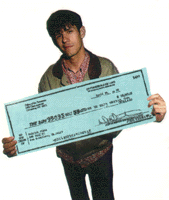
You ever get one of those letters in the mail that looks like a check but turns out to be just an advertisement? A fellow named Patrick Combs took one down to the bank and deposited it - it resembled a check so much (and may have met the legal requirements for a binding contract of debt) that the bank accepted it. $95,000 later, someone figured out that something was fishy, but by that time, Combs had gotten a cashier's check written out and placed in a safe deposit box! Go to his web page to get the details of his adventures.
Advertisements lie and they don't even try to be coy about it. The rules have been written about what lies you can tell without being hauled into court for fraud, and the rules are generous to the liars (well, when you see who wrote the rules, it's no big surprise).
If you want to interrupt pathological, media-simulated social interaction such as is often found in advertising, you ought to follow that there link and find out how it's done.
For those of you in the parody market, there are a few web sites that display satirical commercials and cereal boxes and such. Also, Adbusters and subvertise.org take regular aim at the advertising world and the consumer ethic.
Alas, the advertisers themselves have more than enough resources and creativity to leapfrog the adbusters and remimic their parodies into new commercials.
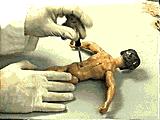
Kudos to The Barbie Liberation Organization - they switched the voice chips in Barbie and G.I. Joe dolls, and returned them to toy stores in altered form to strike a blow against stereotyped gender roles.
Jonah Peretti has an interesting collection of email exchanged with the Nike shoe people, explaining why they'd be unable to grant his wish for personalized "NIKE iD" shoes emblazoned with the word "sweatshop."
The friendly folks at Happyclown Inc. have taken on the task of helping McDonald's advertise their new Bilder Burger.
Cacophonists have infiltrated and mocked some of the most beloved idols of the consumer culture, for instance Chuck-E-Cheese.
In one such prank, the Los Angeles Cacophony Society snuck into a Toys'R'Us and put a selection of labeled, bar-coded, cement-filled teddy bears on the shelves, then stuck around to witness the resulting mayhem.
Marketers themselves aren't beneath using sneaky and viral techniques to generate buzz.
Some clever musicians-rights advocates are battling MP3-based piracy by spiking on-line distributed music databases like Napster with MP3 files they call cuckoo's eggs that are named as though they were reproductions of copyrighted songs but which actually contain other sounds.
When a telemarketer calls, it's only humane to try to transmogrify the encounter into something just a little more fun.
And, speaking of rude panhandling, no billboard should escape being forced to uncover its ugliness or ours. (However, some billboards seem to need no help...)
And writes a junkmail-sick fellah named Charlie: "I have it (on fairly good authority) that the best (worst) thing you can do to a junk mailer is send back those postage paid envelopes with an oz. or so of the 'sparkles' you can get in most craft shops. They are stick tenaciously to everything, including the scan heads of the mail sorters, and jam up the works. Word has it that it takes about 1/2 hour to clean up after this happens."
A bunch of angry Canadians going by the name "L'Anti-Noël Avant le Temps" sent letters to Montreal shopkeepers warning them to take down their too-early Christmas decorations and leave them down until at least December first, or face the consequences, which included vandalism and further "well written, poetic" threats.
Things that aren't actually for sale, but have been promoted by pranksters nonetheless include Microsoft's Windows for Macintosh, a 1-900 number for evesdropping on 911 emergency calls, such plants as Common Dickweed and Heinous Welsh Squash, complementary, advertising-laden motor vehicles, cyber dildos, and pure, uncut cocaine.
Adbusters has been promoting an annual "buy nothing day" as a way to make a stand against consumerism. However, this "perfect feel-good, liberal, middle-class activist non-happening" doesn't impress one group:
"A day when the more money you make, the more influence you have (like every other day). A day which, by definition, is insulting to the millions of people worldwide who are too poor or marginalized to be considered 'consumers'.... Well, this year, while the Adbusters cult enjoys yet another Buy Nothing Day, accompanied by their fancy posters, stickers, TV and radio advertisements and slick webpages, a few self-described anarcho-situationists from Montreal's East End are inaugurating Steal Something Day."
Creative use of email chain-letters is showing a great deal of promise - one promised that for each pair of used tennis shoes that you send in to Nike, they'll send you back a brand new pair. Last I heard, Nike had 500 boxes of old shoes that they didn't particularly want.
Someone else sent out email to 25,000 customers of the Safeway grocery store chain, warning them of huge price increases, and suggesting that they shop elsewhere.
A particularly wicked hack was Luther Blissett's parody of the archetype of poisonous product tampering - instead of putting rat poison in children's candy, he bought packages of rat poison, replaced the poison with candy, sealed up the packages and put them back on the shelf.
The workplace, degrading and soul-suffocating as it so often is, has become a favorite place for sabotage Entertaining tales are common of employees who get even with worthless supervisors, or who play pranks just to disrupt the tedium.
If you're thinking of getting involved in commerce jamming, you should check out the folks at ®TMark. They are sponsoring a number of interesting commerce jamming projects, and even claim to provide funding for creative hacks and creative career counselling for employees whose pranks have gotten them fired.
 |
|---|
 |
|---|
 |
|---|

